## Diagram: Pipeline Architecture Comparison
### Overview
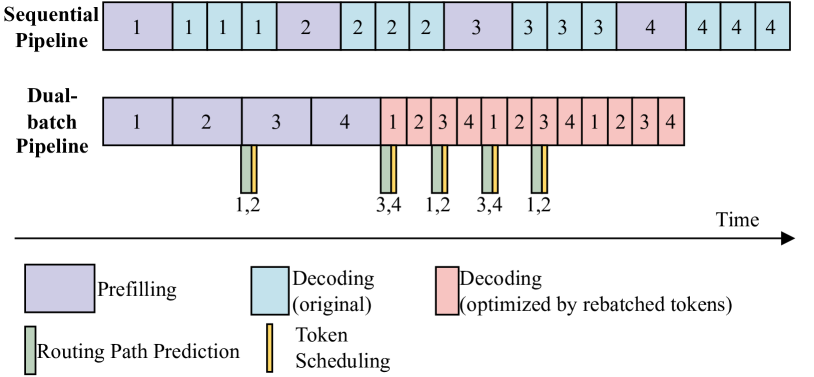
The image compares two pipeline architectures for processing tasks: **Sequential Pipeline** and **Dual-batch Pipeline**. It visualizes stages of processing over time, highlighting differences in workflow, parallelism, and optimization techniques.
### Components/Axes
- **X-axis**: Labeled "Time" with an arrow indicating progression from left to right.
- **Legend**:
- **Purple**: Prefilling
- **Blue**: Decoding (original)
- **Pink**: Decoding (optimized by rebatched tokens)
- **Gray**: Routing Path Prediction
- **Yellow**: Token Scheduling
- **Key Elements**:
- **Sequential Pipeline**: Top section with stages 1–4 repeated sequentially.
- **Dual-batch Pipeline**: Bottom section with stages 1–4 split into sub-stages (e.g., 1,2; 3,4) and overlapping processes.
### Detailed Analysis
#### Sequential Pipeline
- **Structure**:
- Stages 1–4 are processed sequentially, with each stage repeated 4 times (e.g., "1 1 1 1" for stage 1).
- **Color Coding**:
- **Blue**: Decoding (original) dominates, indicating no optimization.
- **Trends**:
- Linear progression with no overlap between stages.
#### Dual-batch Pipeline
- **Structure**:
- Stages 1–4 are split into sub-stages (e.g., "1,2" for stages 1 and 2).
- Overlapping processes:
- **Prefilling** (purple) occurs in early stages (1–2).
- **Routing Path Prediction** (gray) and **Token Scheduling** (yellow) appear intermittently.
- **Decoding** alternates between **blue** (original) and **pink** (optimized).
- **Trends**:
- Parallelism: Sub-stages (e.g., 1,2 and 3,4) overlap in time.
- Optimization: Pink blocks (optimized decoding) appear in later stages, suggesting rebatched tokens improve efficiency.
### Key Observations
1. **Sequential vs. Dual-batch**:
- The Dual-batch Pipeline introduces parallelism (e.g., overlapping sub-stages) and optimization (pink decoding), unlike the strictly sequential blue decoding in the Sequential Pipeline.
2. **Token Scheduling**:
- Yellow blocks (Token Scheduling) are concentrated in the Dual-batch Pipeline, indicating dynamic resource allocation.
3. **Routing Path Prediction**:
- Gray blocks (Routing Path Prediction) appear in the Dual-batch Pipeline, suggesting adaptive decision-making for task routing.
### Interpretation
- **Efficiency Gains**: The Dual-batch Pipeline’s use of rebatched tokens (pink decoding) and parallel sub-stages reduces idle time, improving throughput compared to the Sequential Pipeline.
- **Complexity Trade-off**: While the Dual-batch Pipeline adds complexity (e.g., routing, scheduling), it optimizes resource utilization, likely critical for high-throughput systems.
- **Optimization Impact**: The shift from blue to pink decoding in later stages highlights the performance benefits of rebatching, though the exact timing and frequency of optimization are not quantified.
### Uncertainties
- No numerical values or time intervals are provided, making quantitative analysis impossible.
- The exact mechanism of "rebatched tokens" and its impact on decoding speed is implied but not explicitly defined.