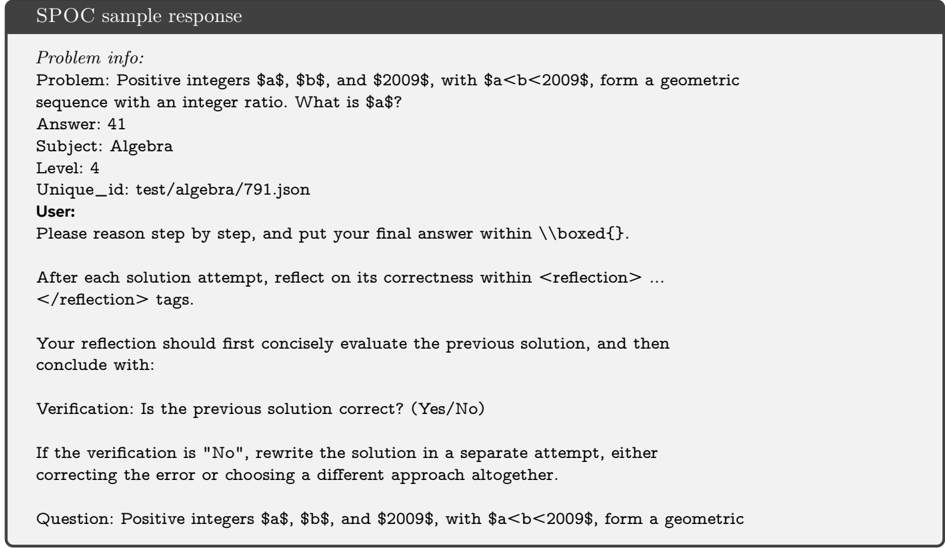
## Text Document: SPOC Sample Response
### Overview
The image is a text document titled "SPOC sample response". It presents a math problem, its answer, and instructions for the user. The problem involves finding the value of 'a' in a geometric sequence of positive integers a, b, and 2009, where a < b < 2009. The document also provides guidelines for the user to reason step-by-step, reflect on their solution, and verify its correctness.
### Components/Axes
The document is structured into the following sections:
* **Header:** "SPOC sample response"
* **Problem Info:**
* Problem: The mathematical problem statement.
* Answer: The correct answer to the problem.
* Subject: The subject of the problem (Algebra).
* Level: The difficulty level of the problem (4).
* Unique\_id: A unique identifier for the problem (test/algebra/791.json).
* **User Instructions:**
* Instructions on how to approach the problem, including reasoning step-by-step, reflecting on the solution, and verifying its correctness.
* Specific formatting requirements for the final answer (\\boxed{}).
* Instructions on how to handle incorrect solutions.
* **Question:** Restatement of the mathematical problem.
### Detailed Analysis or ### Content Details
**Problem Info:**
* **Problem:** Positive integers $a$, $b$, and $2009$, with $a<b<2009$, form a geometric sequence with an integer ratio. What is $a$?
* **Answer:** 41
* **Subject:** Algebra
* **Level:** 4
* **Unique\_id:** test/algebra/791.json
**User Instructions:**
* Please reason step by step, and put your final answer within \\boxed{}.
* After each solution attempt, reflect on its correctness within <reflection> ... </reflection> tags.
* Your reflection should first concisely evaluate the previous solution, and then conclude with:
* Verification: Is the previous solution correct? (Yes/No)
* If the verification is "No", rewrite the solution in a separate attempt, either correcting the error or choosing a different approach altogether.
**Question:**
* Positive integers $a$, $b$, and $2009$, with $a<b<2009$, form a geometric sequence.
### Key Observations
* The document provides a structured format for presenting a math problem and guiding the user through the solution process.
* It emphasizes the importance of step-by-step reasoning, reflection, and verification.
* The use of specific tags (<reflection>) and formatting (\\boxed{}) suggests an automated system for evaluating user responses.
### Interpretation
The document is designed to be used within a SPOC (Small Private Online Course) environment. It aims to provide a clear problem statement, a correct answer for validation, and a set of instructions that encourage a thoughtful and iterative problem-solving approach. The inclusion of reflection and verification steps promotes metacognitive skills and helps users identify and correct their errors. The structured format and specific instructions likely facilitate automated assessment and feedback within the online course.