\n
## Diagram: Global Pruning
### Overview
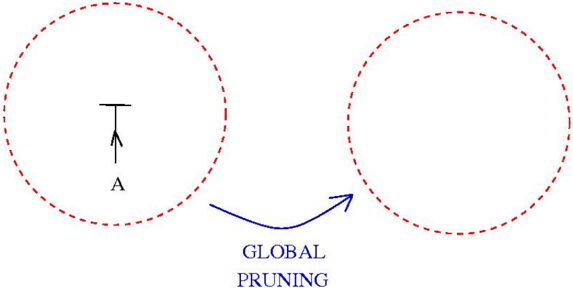
The image depicts a diagram illustrating a process labeled "GLOBAL PRUNING". It shows a circular region containing a symbol, with an arrow indicating a transfer or removal of content to another empty circular region.
### Components/Axes
The diagram consists of:
* Two circular regions, both outlined with dashed red lines.
* A symbol within the left circular region, resembling a horizontal line with a vertical line extending upwards from its center. This symbol is labeled "A".
* An arrow originating from the center of the symbol "A" and pointing towards the center of the right circular region.
* Text "GLOBAL PRUNING" positioned below the arrow.
### Detailed Analysis or Content Details
The left circular region contains the symbol "A". The symbol appears to be a representation of a variable or a measurement, with the vertical line indicating a value or direction. The arrow indicates a transfer or removal of the content represented by "A" from the left circle to the right circle. The text "GLOBAL PRUNING" suggests that this transfer or removal is part of a larger process of reducing or eliminating elements.
### Key Observations
The diagram is simple and conceptual. It doesn't contain numerical data or specific measurements. The focus is on the process of "GLOBAL PRUNING" and the movement of an element "A" as part of that process. The empty right circle suggests a destination or a state after the pruning process.
### Interpretation
The diagram likely represents a concept in machine learning, optimization, or data processing. "GLOBAL PRUNING" suggests a technique for reducing the complexity of a model or dataset by removing less important elements. The symbol "A" could represent a feature, a connection, or a data point that is being pruned. The arrow indicates that this element is being removed from its original context and potentially discarded or moved to a different location. The diagram highlights the idea of selectively removing elements to improve efficiency or performance. The lack of specific details suggests that this is a high-level illustration of a general principle rather than a specific implementation.