## Diagram: System Pruning Process
### Overview
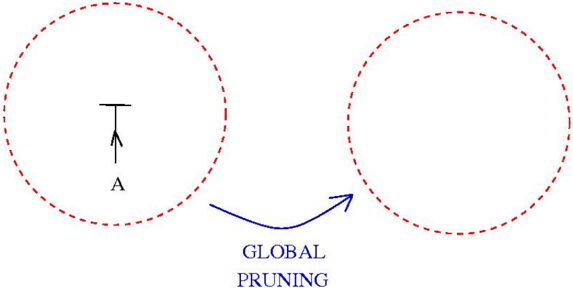
The diagram illustrates a two-stage system transformation labeled "GLOBAL PRUNING." It features two interconnected dashed circles with a directional arrow between them. The left circle contains a labeled structural component, while the right circle remains empty, suggesting a simplification or reduction process.
### Components/Axes
- **Left Circle**: Contains a vertical line with a T-shaped intersection and a downward-pointing arrow labeled "A" at its base.
- **Right Circle**: Empty dashed circle with no internal elements.
- **Connecting Arrow**: Blue arrow labeled "GLOBAL PRUNING" pointing from left to right circle.
- **No legend, axes, or numerical scales present.**
### Detailed Analysis
- **Left Circle Structure**: The T-shaped configuration with a vertical line and downward arrow suggests a hierarchical or decision-tree-like structure. The label "A" likely represents a specific node or decision point.
- **Right Circle**: Complete absence of internal elements implies a state of reduction, simplification, or elimination of all components.
- **Arrow Label**: "GLOBAL PRUNING" indicates a system-wide optimization or elimination process affecting all elements.
### Key Observations
1. The transformation from a structured system (left) to an empty state (right) occurs through global pruning.
2. The labeled component "A" in the left circle is the only explicitly marked element, suggesting it may be a critical node in the pruning process.
3. No intermediate states or transitional elements are shown between the circles.
### Interpretation
This diagram appears to represent a conceptual model of system optimization where:
- The left circle represents an initial complex system with identifiable components (specifically component A)
- "GLOBAL PRUNING" acts as a system-wide operation that removes all structural elements
- The right circle's emptiness suggests either complete elimination of components or abstraction to a minimal state
- The T-shaped structure in the left circle might represent decision points or branching logic that gets eliminated during pruning
The absence of intermediate states implies an all-or-nothing pruning approach rather than gradual simplification. The single labeled component "A" could indicate either a preserved element (if pruning is selective) or a placeholder for the system's original state before complete reduction.