\n
## Diagram: Convolutional Neural Network Architecture
### Overview
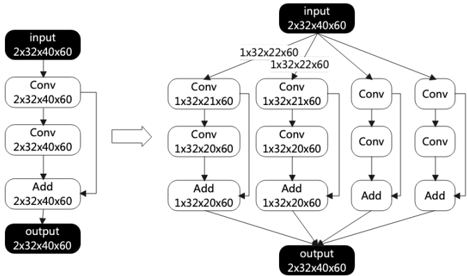
The image depicts a simplified diagram of a convolutional neural network (CNN) architecture, specifically illustrating a transition from a sequential structure to a parallel structure with multiple convolutional layers. The diagram shows the flow of data through convolutional layers ("Conv") and addition operations ("Add"), ultimately leading to an output. An arrow indicates a transformation between the two architectures.
### Components/Axes
The diagram consists of rectangular boxes representing layers, labeled with their function (input, Conv, Add, output) and dimensions. Arrows indicate the flow of data. The dimensions are explicitly stated for each layer. The diagram is divided into two sections by a horizontal arrow, representing a before and after state.
### Detailed Analysis or Content Details
**Left Side (Sequential Architecture):**
* **Input:** 2x32x40x60
* **Conv:** 2x32x40x60
* **Conv:** 2x32x40x60
* **Add:** 2x32x40x60
* **Output:** 2x32x40x60
**Right Side (Parallel Architecture):**
* **Input:** 2x32x40x60
* **1x32x22x60:** Intermediate layer after the initial input.
* **Conv:** 1x32x21x60 (appears twice)
* **Conv:** 1x32x20x60 (appears twice)
* **Add:** 1x32x20x60 (appears twice)
* **Conv:** (appears four times, no dimensions given)
* **Add:** (appears twice, no dimensions given)
* **Output:** 2x32x40x60
The arrow between the two sides indicates a transformation. The input on the right side is split into two branches. Each branch consists of two convolutional layers followed by an addition operation. The outputs of these branches are then fed into further convolutional layers and finally combined through addition to produce the final output.
### Key Observations
The diagram highlights a shift from a single path of processing (left side) to a parallel processing structure (right side). The dimensions of the layers change as the data flows through the network. The right side introduces multiple parallel convolutional paths, potentially allowing the network to learn more complex features. The dimensions of the final convolutional layers on the right side are not specified.
### Interpretation
This diagram illustrates a common architectural pattern in CNNs: increasing model capacity through parallelization. The initial sequential structure is simplified, while the parallel structure allows for more diverse feature extraction. The splitting of the input into multiple branches and the subsequent combination of their outputs suggest a mechanism for learning hierarchical representations of the input data. The lack of dimensions for the final convolutional layers on the right side suggests they are either implicitly determined by the preceding layers or are not crucial for understanding the overall architecture. The diagram is a high-level representation and does not include details such as activation functions, pooling layers, or specific kernel sizes. It focuses on the core concept of convolutional and addition operations and their arrangement within the network.