\n
## Binary Matrix Visualization: Cellular Automata Pattern
### Overview
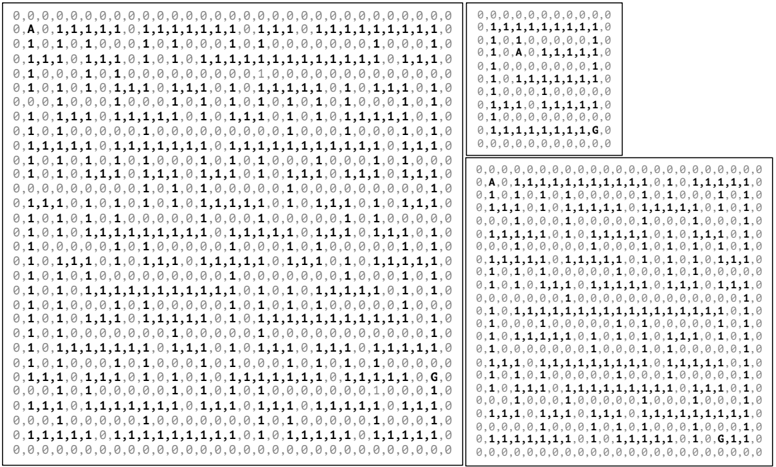
The image displays three distinct rectangular matrices composed of binary values (0 and 1), resembling a visualization of a cellular automaton or a similar discrete system. The matrices are arranged horizontally, with the leftmost matrix being the largest and the rightmost being the smallest. The values are represented by filled circles (1) and empty spaces (0). A green rectangle highlights the central matrix.
### Components/Axes
There are no explicit axes or labels in the traditional sense. The matrices themselves represent the data. The values within each matrix are arranged in a grid-like structure. The matrices are visually separated, suggesting they represent different states or iterations of a system.
### Detailed Analysis or Content Details
**Matrix 1 (Leftmost, Largest):**
This matrix is approximately 25 rows by 30 columns. The pattern appears largely random, with a higher density of '1' values in the upper-left quadrant and a sparser distribution towards the bottom-right. There are a few isolated clusters of '1's.
* Approximate number of '1's: ~350
* Approximate number of '0's: ~350
**Matrix 2 (Center, Highlighted in Green):**
This matrix is approximately 20 rows by 25 columns. The pattern is more structured than the first matrix. There's a clear diagonal band of '1's running from the top-left to the bottom-right. The density of '1's is higher along this diagonal.
* Approximate number of '1's: ~250
* Approximate number of '0's: ~250
**Matrix 3 (Rightmost, Smallest):**
This matrix is approximately 15 rows by 20 columns. The pattern is even more concentrated, with a prominent central cluster of '1's. The surrounding areas are mostly '0's.
* Approximate number of '1's: ~150
* Approximate number of '0's: ~150
**Value Distribution:**
Across all matrices, the values are binary: '0' and '1'. The distribution of these values varies between the matrices, with the leftmost matrix having a more uniform distribution, the center matrix having a diagonal concentration, and the rightmost matrix having a central concentration.
### Key Observations
* The matrices appear to represent successive states of a dynamic system.
* The green highlight on the central matrix suggests it is of particular interest.
* The pattern evolves from a more random distribution (leftmost) to a more concentrated one (rightmost).
* The number of '1's decreases as we move from left to right.
### Interpretation
The image likely depicts the evolution of a cellular automaton or a similar discrete dynamical system. The matrices represent snapshots of the system at different time steps. The green highlight suggests that the central state is being analyzed or is a key intermediate step in the evolution.
The transition from a random distribution to a concentrated pattern suggests that the system is converging towards a stable state or a specific configuration. The decreasing number of '1's could indicate a loss of energy or information within the system.
Without knowing the specific rules governing the system, it's difficult to provide a more detailed interpretation. However, the image clearly demonstrates a dynamic process with a clear trend towards a more ordered state. The matrices could represent, for example, the spread of a signal, the growth of a pattern, or the evolution of a population. The visual representation is a common method for studying complex systems and emergent behavior.