## Diagram: Multi-Task Learning Framework with BERT and GPT-2
### Overview
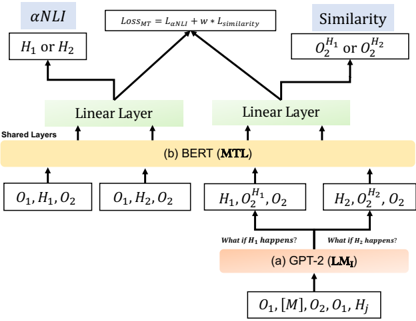
This diagram illustrates a multi-task learning (MTL) framework that utilizes both BERT and GPT-2 models. The framework aims to compute a total loss, `LOSSMT`, which is a weighted sum of two components: `L_αNLI` and `L_similarity`. The inputs to the framework are derived from different processing stages of GPT-2 and BERT, leading to distinct outputs for the NLI (Natural Language Inference) task and a similarity task.
### Components/Axes
This diagram does not contain traditional axes or scales. The components are represented by labeled boxes and arrows indicating data flow.
**Key Components and Labels:**
* **Top Section:**
* **αNLI (Blue Box):** Represents the output or task related to Natural Language Inference.
* **Similarity (Blue Box):** Represents the output or task related to similarity.
* **LOSSMT = L_αNLI + W * L_similarity (White Box):** This box defines the total loss function, indicating it's a weighted sum of the NLI loss (`L_αNLI`) and the similarity loss (`L_similarity`), where `W` is a weighting factor.
* **H₁ or H₂ (White Box):** Represents potential outputs or states related to hypothesis 1 or hypothesis 2, feeding into the αNLI task.
* **O₂<sup>H₁</sup> or O₂<sup>H₂</sup> (White Box):** Represents potential outputs or states related to hypothesis 1 or hypothesis 2, feeding into the Similarity task.
* **Middle Section:**
* **Linear Layer (Green Boxes, two instances):** These are processing layers that take input from the BERT (MTL) component and transform it before feeding into the αNLI and Similarity tasks.
* **Shared Layers (Text Label):** Indicates that the BERT (MTL) component operates on shared layers.
* **(b) BERT (MTL) (Orange Box):** Represents the BERT model configured for Multi-Task Learning. It receives various combinations of inputs.
* **Bottom Section:**
* **Input Boxes to BERT (MTL):**
* `O₁, H₁, O₂`
* `O₁, H₂, O₂`
* `H₁, O₂<sup>H₁</sup>, O₂`
* `H₂, O₂<sup>H₂</sup>, O₂`
* **(a) GPT-2 (LMᵢ) (Orange Box):** Represents the GPT-2 model acting as a Language Model (LMᵢ). It receives an initial input and branches out based on conditional questions.
* **Input Box to GPT-2 (LMᵢ):**
* `O₁, [M], O₂, O₁, Hⱼ`
* **Conditional Questions:**
* "What if H₁ happens?" (Text Label)
* "What if H₂ happens?" (Text Label)
**Arrows:** Arrows indicate the direction of data flow between components.
### Detailed Analysis or Content Details
The diagram outlines a process where:
1. **GPT-2 (LMᵢ)** processes an initial input `O₁, [M], O₂, O₁, Hⱼ`.
2. Based on the processing of GPT-2, two conditional paths emerge: "What if H₁ happens?" and "What if H₂ happens?". These conditions likely lead to different intermediate representations or outputs from GPT-2.
3. These conditional outputs from GPT-2, along with other inputs, are fed into **BERT (MTL)**. Specifically, the diagram shows four distinct input combinations to BERT:
* `O₁, H₁, O₂`
* `O₁, H₂, O₂`
* `H₁, O₂<sup>H₁</sup>, O₂`
* `H₂, O₂<sup>H₂</sup>, O₂`
It's implied that the "What if H₁ happens?" condition influences the inputs `H₁, O₂<sup>H₁</sup>, O₂`, and similarly for "What if H₂ happens?" influencing `H₂, O₂<sup>H₂</sup>, O₂`.
4. The **BERT (MTL)** component, operating on shared layers, produces outputs that are then passed through two separate **Linear Layers**.
5. One **Linear Layer** takes input from BERT and produces an output that feeds into the **αNLI** task, represented by `H₁ or H₂`.
6. The other **Linear Layer** takes input from BERT and produces an output that feeds into the **Similarity** task, represented by `O₂<sup>H₁</sup> or O₂<sup>H₂</sup>`.
7. Finally, the outputs from these two paths are used to calculate the total loss `LOSSMT = L_αNLI + W * L_similarity`.
### Key Observations
* **Modular Design:** The framework clearly separates the roles of GPT-2 and BERT, with GPT-2 potentially handling initial sequence generation or contextualization, and BERT performing multi-task learning on enriched inputs.
* **Conditional Processing:** The "What if H₁ happens?" and "What if H₂ happens?" labels suggest a conditional or counterfactual reasoning mechanism within the GPT-2 component that influences the subsequent BERT processing.
* **Task Specialization:** The two linear layers act as task-specific heads, adapting the shared BERT representations for the distinct αNLI and Similarity tasks.
* **Loss Combination:** The final loss function explicitly combines losses from two different tasks, a hallmark of multi-task learning, aiming to improve generalization by learning related tasks simultaneously.
### Interpretation
This diagram depicts a sophisticated neural network architecture designed for multi-task learning, likely in the domain of natural language understanding. The framework leverages the strengths of both GPT-2 and BERT.
* **GPT-2's Role:** GPT-2, often used for generative tasks, appears to be employed here to generate or condition inputs based on hypothetical scenarios (`H₁` or `H₂`). This suggests a capability to explore different linguistic possibilities or generate context that is then fed into BERT. The notation `LMᵢ` implies it's acting as a language model, possibly providing contextual embeddings or sequences. The input `O₁, [M], O₂, O₁, Hⱼ` to GPT-2 suggests it's processing a sequence of tokens, where `[M]` might represent a mask or a special token.
* **BERT's Role:** BERT, known for its strong performance in understanding contextual relationships, acts as the core multi-task learning backbone. It receives diverse inputs, potentially enriched by GPT-2's conditional processing, and its shared layers learn representations beneficial for both downstream tasks. The different input combinations to BERT (`O₁, H₁, O₂`, `O₁, H₂, O₂`, etc.) indicate that the model is trained on various configurations of observations (`O`) and hypotheses (`H`).
* **Task Integration:** The two linear layers serve as bridges, transforming the general-purpose BERT representations into task-specific outputs. The αNLI task likely involves determining the relationship (entailment, contradiction, neutral) between a premise and a hypothesis, while the Similarity task probably measures how semantically close two pieces of text are.
* **Learning Objective:** The `LOSSMT` equation signifies that the model is optimized to perform well on both NLI and similarity tasks simultaneously. By learning these related tasks together, the model can potentially achieve better performance and generalization than if trained on each task in isolation. The weighting factor `W` allows for tuning the relative importance of each task during training.
In essence, this framework appears to be designed to handle complex natural language tasks that require understanding context, generating hypothetical scenarios, and performing inference or similarity judgments, all within a unified learning objective. The conditional processing by GPT-2 adds a layer of flexibility, allowing the model to explore different linguistic pathways before BERT extracts shared representations for multiple tasks.