## Diagram: Hexagon with Arrow and Circle Variations
### Overview
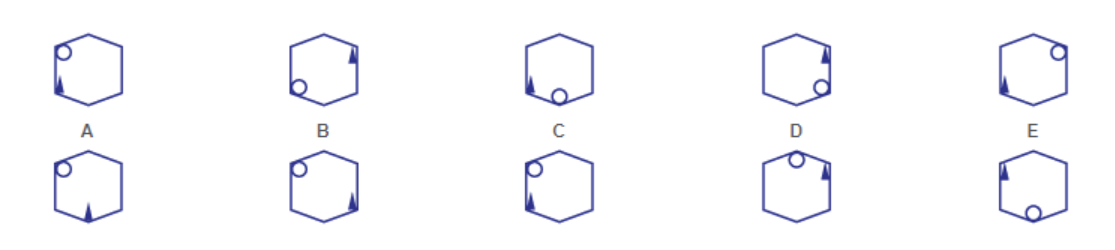
The image presents five variations (A, B, C, D, and E) of a blue hexagon, each containing a blue arrow and a blue circle. The positions of the arrow and circle vary within each hexagon.
### Components/Axes
* **Hexagon:** A six-sided polygon, serving as the base shape.
* **Arrow:** A directional indicator, positioned along one of the hexagon's sides, pointing either clockwise or counter-clockwise.
* **Circle:** A small, unfilled circle, also positioned along one of the hexagon's sides.
* **Labels:** A, B, C, D, and E, identifying each variation.
### Detailed Analysis
* **A:** Arrow points downwards, circle is at the top-left.
* **B:** Arrow points downwards, circle is at the top-left.
* **C:** Arrow points downwards, circle is at the bottom-left.
* **D:** Arrow points upwards, circle is at the top-right.
* **E:** Arrow points upwards, circle is at the bottom-right.
### Key Observations
* The arrow always points along the side of the hexagon.
* The circle is always positioned on a side adjacent to the arrow.
* The arrow can point either upwards or downwards.
* The circle can be positioned in the top-left, bottom-left, top-right, or bottom-right.
### Interpretation
The diagram likely represents different states or configurations of a system, where the hexagon is a container, and the arrow and circle represent components or variables within that system. The variations in arrow direction and circle position could indicate different operational modes or conditions. Without further context, the specific meaning of each configuration is unclear, but the diagram provides a visual representation of distinct states within a defined system.