## [Diagram]: Hexagonal Pattern Logic Sequence
### Overview
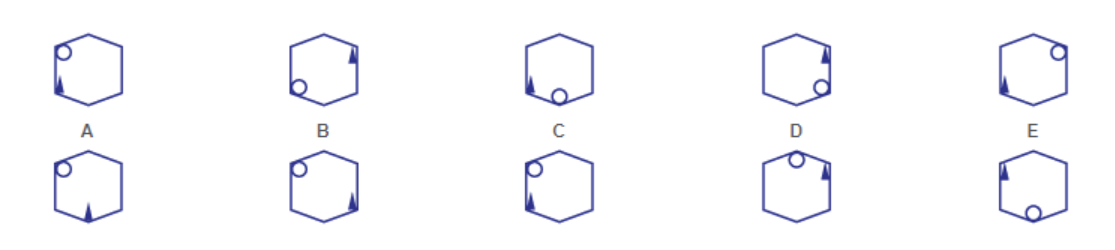
The image presents a series of five columns, labeled A through E. Each column contains two identical regular hexagonal diagrams stacked vertically. Inside each hexagon, there are two distinct geometric elements: a small open circle and an arrow. The position and orientation of these elements vary across each hexagon, suggesting a visual logic puzzle or pattern recognition sequence.
### Components/Axes
* **Labels:** A, B, C, D, E (positioned between the top and bottom hexagons of each column).
* **Shapes:** Regular hexagons.
* **Internal Elements:**
* **Circle:** An open, unfilled circle.
* **Arrow:** A directional indicator (pointing either up or down).
* **Spatial Orientation:** Elements are placed at vertices (corners) or along the edges of the hexagons.
### Detailed Analysis
The following is a breakdown of the elements within each hexagon, described from top to bottom for each column:
**Column A**
* **Top Hexagon:** Circle is located at the top-left vertex. The arrow is positioned along the left edge, pointing downward.
* **Bottom Hexagon:** Circle is located at the top-left vertex. The arrow is positioned at the bottom edge (center), pointing upward.
**Column B**
* **Top Hexagon:** Circle is located at the bottom-left vertex. The arrow is positioned along the right edge, pointing upward.
* **Bottom Hexagon:** Circle is located at the top-left vertex. The arrow is positioned along the right edge, pointing downward.
**Column C**
* **Top Hexagon:** The arrow is positioned at the bottom edge (center), pointing upward. The circle is located at the bottom-right vertex.
* **Bottom Hexagon:** Circle is located at the top-left vertex. The arrow is positioned along the left edge, pointing downward.
**Column D**
* **Top Hexagon:** The arrow is positioned along the right edge, pointing upward. The circle is located at the bottom-right vertex.
* **Bottom Hexagon:** The circle is located at the top edge (center). The arrow is positioned along the right edge, pointing upward.
**Column E**
* **Top Hexagon:** The circle is located at the top-right vertex. The arrow is positioned along the left edge, pointing downward.
* **Bottom Hexagon:** The arrow is positioned along the left edge, pointing upward. The circle is located at the bottom edge (center).
### Key Observations
* **Non-Uniformity:** There is no consistent, singular rule (such as simple clockwise rotation) that applies to all columns simultaneously.
* **Element Variation:** The circle and arrow change positions independently of one another between the top and bottom hexagons in each column.
* **Positional Logic:** The elements occupy specific "slots" (vertices or edge centers). The circle appears to move between vertices and edge centers, while the arrow appears to move between edge positions and changes orientation (up/down).
### Interpretation
This image is characteristic of a non-verbal reasoning test or an IQ assessment matrix. The data demonstrates a set of rules governing the movement and orientation of the circle and arrow.
* **Relationship:** The relationship between the top and bottom hexagon in each column is likely the key to solving the puzzle. For example, in Column A, the circle remains static while the arrow changes position and orientation. In other columns, both elements move.
* **Pattern Recognition:** To interpret the "meaning" of this data, one would need to determine the transformation rule that converts the top hexagon into the bottom hexagon for each column. The lack of a uniform pattern across all columns (A-E) suggests that each column may represent a separate logical operation or a step in a larger, complex sequence.