## Textual Analysis: Training Manuals Comparison
### Overview
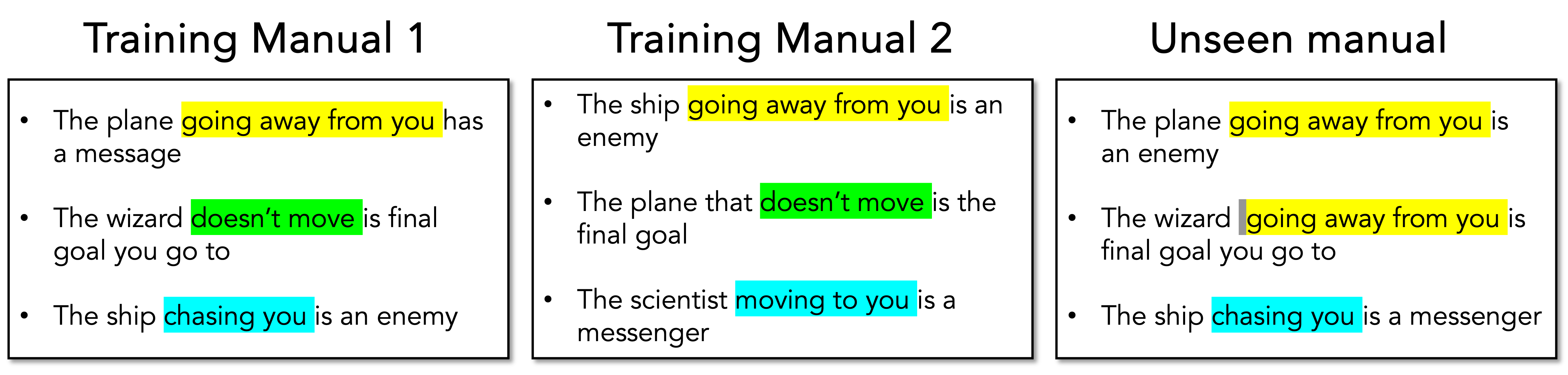
The image presents three side-by-side sections labeled "Training Manual 1," "Training Manual 2," and "Unseen manual." Each section contains three bullet points with color-highlighted phrases (yellow, green, blue) embedded in sentences. The structure suggests a comparison of contextual interpretations or semantic roles across different scenarios.
### Components/Axes
- **Sections**:
- Training Manual 1 (left)
- Training Manual 2 (center)
- Unseen manual (right)
- **Highlight Colors**:
- **Yellow**: "going away from you" (appears in all three sections)
- **Green**: "doesn't move" (Training Manual 1 and 2) and "going away from you" (Unseen manual)
- **Blue**: "chasing you" (Training Manual 1 and Unseen manual) and "moving to you" (Training Manual 2)
### Detailed Analysis
#### Training Manual 1
1. **Yellow Highlight**: "The plane **going away from you** has a message"
- Context: Plane as a messenger.
2. **Green Highlight**: "The wizard **doesn't move** is final goal you go to"
- Context: Wizard as a static endpoint.
3. **Blue Highlight**: "The ship **chasing you** is an enemy"
- Context: Ship as an active threat.
#### Training Manual 2
1. **Yellow Highlight**: "The ship **going away from you** is an enemy"
- Context: Ship as a retreating threat.
2. **Green Highlight**: "The plane that **doesn't move** is the final goal"
- Context: Plane as a static endpoint.
3. **Blue Highlight**: "The scientist **moving to you** is a messenger"
- Context: Scientist as a purposeful communicator.
#### Unseen manual
1. **Yellow Highlight**: "The plane **going away from you** is an enemy"
- Context: Plane as a hostile entity.
2. **Green Highlight**: "The wizard **going away from you** is final goal you go to"
- Context: Wizard as a dynamic endpoint.
3. **Blue Highlight**: "The ship **chasing you** is a messenger"
- Context: Ship as a purposeful communicator.
### Key Observations
1. **Color Consistency**:
- Yellow consistently highlights phrases involving spatial movement ("going away from you").
- Green highlights static or endpoint-related phrases ("doesn't move," "final goal").
- Blue highlights active movement toward or away from the subject ("chasing you," "moving to you").
2. **Contextual Shifts**:
- The same phrase ("going away from you") is labeled as "message," "enemy," or "final goal" depending on the manual.
- "Chasing you" and "moving to you" are both blue but assigned opposing roles (enemy vs. messenger).
### Interpretation
The color-coded highlights suggest a framework for categorizing entities based on their semantic roles (e.g., messenger, enemy, goal). However, the same phrase ("going away from you") is reinterpreted across manuals, indicating that context (e.g., "plane," "wizard," "ship") overrides literal meaning. This implies a training exercise in disambiguating ambiguous language or testing contextual awareness. The Unseen manual introduces contradictions (e.g., "chasing you" as a messenger), hinting at potential errors or deliberate ambiguity in the training data.
## Conclusion
The image demonstrates how identical phrases can carry divergent meanings depending on contextual cues. The color-coding system aids in categorizing roles but reveals inconsistencies when applied across different scenarios, emphasizing the need for nuanced interpretation in technical documentation or natural language processing tasks.