## Bar Chart: Comparative Analysis of ROAR Methods Across Vulnerability/Mitigation Scenarios
### Overview
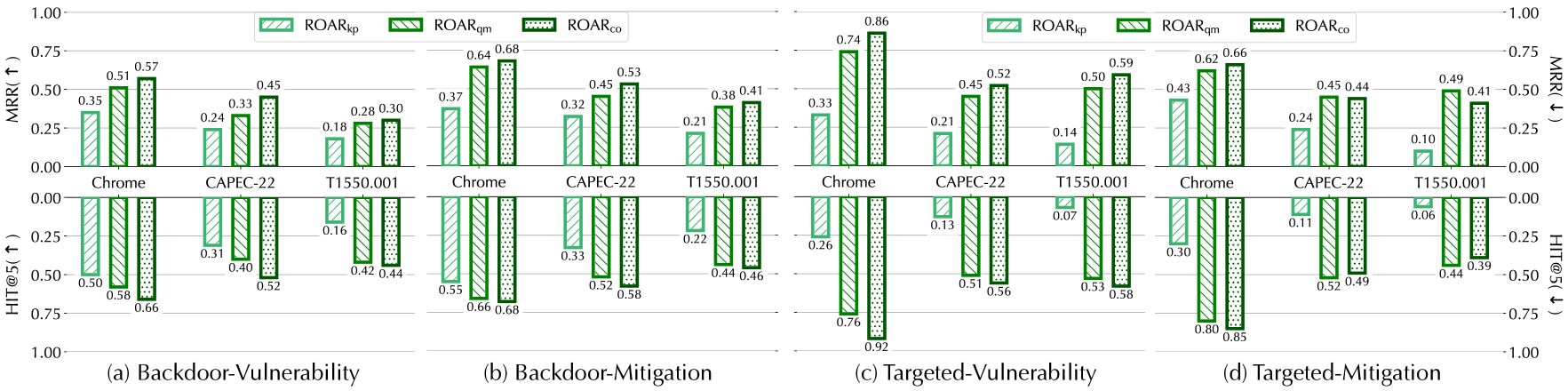
The image presents four grouped bar charts comparing three methods (ROAR_kp, ROAR_qm, ROAR_co) across four categories: Backdoor-Vulnerability, Backdoor-Mitigation, Targeted-Vulnerability, and Targeted-Mitigation. Each category contains three subcategories (Chrome, CAPEC-22, T1550.001). The y-axis measures two metrics: MRR (↑) and HIT@5 (↓), with values ranging from 0.00 to 1.00.
### Components/Axes
- **X-axis**: Categories (a-d) with subcategories (Chrome, CAPEC-22, T1550.001)
- **Y-axis**:
- MRR (↑): Top scale (0.00–1.00)
- HIT@5 (↓): Bottom scale (0.00–1.00)
- **Legend**:
- Top-right position
- ROAR_kp: Diagonal stripes (blue)
- ROAR_qm: Crosshatch (green)
- ROAR_co: Dots (dark green)
- **Color Patterns**:
- Blue (ROAR_kp) and green (ROAR_qm/ROAR_co) with distinct hatching
### Detailed Analysis
#### (a) Backdoor-Vulnerability
- **Chrome**:
- ROAR_kp: 0.51 (MRR), 0.58 (HIT@5)
- ROAR_qm: 0.35 (MRR), 0.50 (HIT@5)
- ROAR_co: 0.57 (MRR), 0.66 (HIT@5)
- **CAPEC-22**:
- ROAR_kp: 0.33 (MRR), 0.40 (HIT@5)
- ROAR_qm: 0.24 (MRR), 0.31 (HIT@5)
- ROAR_co: 0.45 (MRR), 0.52 (HIT@5)
- **T1550.001**:
- ROAR_kp: 0.28 (MRR), 0.42 (HIT@5)
- ROAR_qm: 0.18 (MRR), 0.16 (HIT@5)
- ROAR_co: 0.30 (MRR), 0.44 (HIT@5)
#### (b) Backdoor-Mitigation
- **Chrome**:
- ROAR_kp: 0.64 (MRR), 0.68 (HIT@5)
- ROAR_qm: 0.37 (MRR), 0.55 (HIT@5)
- ROAR_co: 0.68 (MRR), 0.68 (HIT@5)
- **CAPEC-22**:
- ROAR_kp: 0.45 (MRR), 0.52 (HIT@5)
- ROAR_qm: 0.32 (MRR), 0.33 (HIT@5)
- ROAR_co: 0.53 (MRR), 0.58 (HIT@5)
- **T1550.001**:
- ROAR_kp: 0.44 (MRR), 0.46 (HIT@5)
- ROAR_qm: 0.21 (MRR), 0.22 (HIT@5)
- ROAR_co: 0.41 (MRR), 0.46 (HIT@5)
#### (c) Targeted-Vulnerability
- **Chrome**:
- ROAR_kp: 0.74 (MRR), 0.76 (HIT@5)
- ROAR_qm: 0.33 (MRR), 0.26 (HIT@5)
- ROAR_co: 0.86 (MRR), 0.92 (HIT@5)
- **CAPEC-22**:
- ROAR_kp: 0.45 (MRR), 0.56 (HIT@5)
- ROAR_qm: 0.21 (MRR), 0.13 (HIT@5)
- ROAR_co: 0.59 (MRR), 0.58 (HIT@5)
- **T1550.001**:
- ROAR_kp: 0.50 (MRR), 0.53 (HIT@5)
- ROAR_qm: 0.14 (MRR), 0.07 (HIT@5)
- ROAR_co: 0.58 (MRR), 0.58 (HIT@5)
#### (d) Targeted-Mitigation
- **Chrome**:
- ROAR_kp: 0.62 (MRR), 0.80 (HIT@5)
- ROAR_qm: 0.43 (MRR), 0.30 (HIT@5)
- ROAR_co: 0.66 (MRR), 0.85 (HIT@5)
- **CAPEC-22**:
- ROAR_kp: 0.49 (MRR), 0.44 (HIT@5)
- ROAR_qm: 0.24 (MRR), 0.11 (HIT@5)
- ROAR_co: 0.44 (MRR), 0.49 (HIT@5)
- **T1550.001**:
- ROAR_kp: 0.41 (MRR), 0.39 (HIT@5)
- ROAR_qm: 0.10 (MRR), 0.06 (HIT@5)
- ROAR_co: 0.41 (MRR), 0.39 (HIT@5)
### Key Observations
1. **ROAR_co Dominance**:
- Consistently highest MRR across all categories (e.g., 0.86 in Targeted-Vulnerability Chrome)
- Strong HIT@5 performance in Backdoor-Mitigation (0.68) and Targeted-Mitigation (0.85 Chrome)
2. **ROAR_kp Trade-offs**:
- High MRR in Targeted-Vulnerability (0.74 Chrome) but lower HIT@5 (0.76)
- Poorest HIT@5 in Backdoor-Mitigation CAPEC-22 (0.33)
3. **ROAR_qm Weaknesses**:
- Lowest MRR in Backdoor-Mitigation T1550.001 (0.21)
- Extremely low HIT@5 in Targeted-Vulnerability T1550.001 (0.07)
4. **Category-Specific Trends**:
- Targeted-Mitigation shows highest MRR values overall (0.62–0.66)
- Backdoor-Vulnerability has most balanced performance (MRR/HIT@5 ratios <1.2)
### Interpretation
The data reveals method-specific trade-offs between MRR (precision) and HIT@5 (recall). ROAR_co excels in MRR but shows diminishing returns in HIT@5 for complex scenarios (e.g., Targeted-Mitigation T1550.001). ROAR_kp demonstrates situational strength in high-stakes categories (Targeted-Vulnerability) but underperforms in mitigation tasks. The consistent HIT@5 values in ROAR_co across subcategories suggest robustness in recall, while ROAR_qm's erratic performance indicates potential instability in complex environments. These findings imply that method selection should prioritize context-specific requirements: ROAR_co for precision-critical applications, ROAR_kp for recall-sensitive scenarios, and ROAR_qm for balanced but less extreme use cases.