\n
## Diagram: Foundation Model Data Flow
### Overview
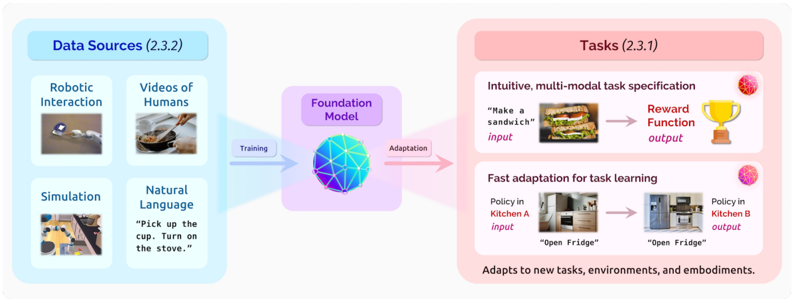
This diagram illustrates the data flow into and out of a "Foundation Model," highlighting its training sources and resulting task applications. The diagram is divided into three main sections: "Data Sources," "Foundation Model," and "Tasks." Arrows indicate the direction of data flow – training and adaptation.
### Components/Axes
The diagram contains the following components:
* **Data Sources (2.3.2):** This section is light blue and contains four sub-components:
* Robotic Interaction (image of a robotic arm manipulating objects)
* Videos of Humans (image of a person cooking)
* Simulation (image of a simulated environment with blocks)
* Natural Language ("Pick up the cup. Turn on the stove.")
* **Foundation Model:** A central, large, light purple sphere with a complex polygonal pattern. Arrows labeled "Training" and "Adaptation" point towards and away from this sphere.
* **Tasks (2.3.1):** This section is light pink and contains two sub-components:
* Intuitive, multi-modal task specification (input: "Make a sandwich", output: Reward Function - a golden trophy) with images of a sandwich.
* Fast adaptation for task learning (input: Policy in Kitchen A, output: Policy in Kitchen B) with images of kitchens.
* **Text:** Several text blocks provide labels and descriptions.
* **Arrows:** Arrows indicate the flow of data.
### Detailed Analysis or Content Details
The diagram shows a flow of information from the "Data Sources" to the "Foundation Model" via "Training." The "Foundation Model" then outputs to the "Tasks" section via "Adaptation."
* **Data Sources:**
* Robotic Interaction: Depicted as a robotic arm interacting with objects.
* Videos of Humans: Shows a person cooking.
* Simulation: Displays a simulated environment with building blocks.
* Natural Language: The text reads: "Pick up the cup. Turn on the stove."
* **Foundation Model:** The central component, receiving data for training and providing outputs for adaptation.
* **Tasks:**
* Intuitive, multi-modal task specification: The input is the phrase "Make a sandwich," and the output is represented by a golden trophy, labeled "Reward Function." Images of a sandwich are also present.
* Fast adaptation for task learning: The input is "Policy in Kitchen A," and the output is "Policy in Kitchen B." Images of two different kitchens are shown.
* **Footer Text:** "Adapts to new tasks, environments, and embodiments."
### Key Observations
The diagram emphasizes the versatility of the Foundation Model, showcasing its ability to learn from diverse data sources (robotic interaction, human videos, simulation, and natural language) and adapt to various tasks (sandwich making, kitchen policy adaptation). The use of images alongside text provides a multi-modal representation of the data flow.
### Interpretation
This diagram illustrates a modern approach to AI development, where a single "Foundation Model" is trained on a broad range of data and then adapted to specific tasks. This contrasts with traditional AI approaches where models are often built from scratch for each task. The diagram suggests that the Foundation Model acts as a general-purpose learning engine, capable of transferring knowledge across different domains. The inclusion of robotic interaction, human videos, simulation, and natural language highlights the importance of multi-modal learning. The "Adaptation" arrow suggests that the model can fine-tune its parameters to perform well on new tasks without requiring extensive retraining. The footer text reinforces the idea that the model is designed to be flexible and adaptable to changing environments and embodiments. The diagram is conceptual and does not provide specific numerical data or performance metrics. It is a high-level overview of a system architecture.