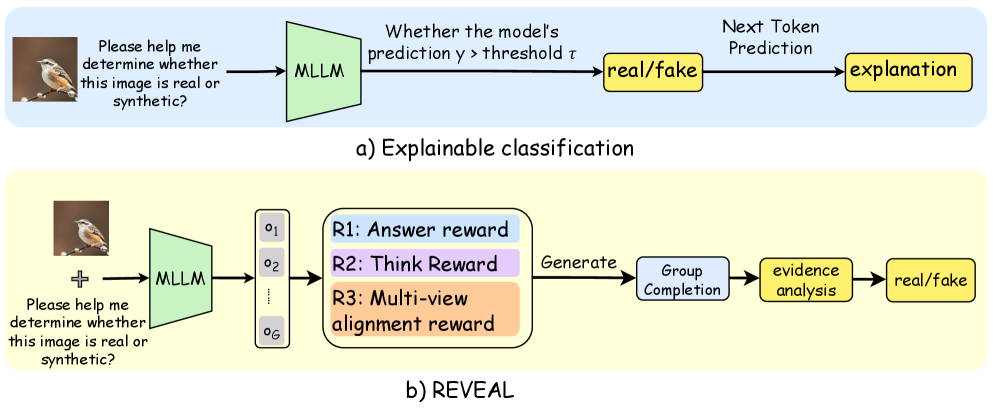
## Diagram: Comparison of Explainable Classification and REVEAL
### Overview
The image displays two distinct architectural workflows for determining whether an image is real or synthetic using Multimodal Large Language Models (MLLMs).
* **Panel (a)**, set against a light blue background, illustrates a standard "Explainable classification" pipeline.
* **Panel (b)**, set against a light yellow background, illustrates a more complex, multi-stage framework labeled "REVEAL".
### Components/Axes
**Panel (a): Explainable classification**
* **Input:** An image of a bird accompanied by the text prompt: "Please help me determine whether this image is real or synthetic?".
* **Processing Unit:** A green trapezoid labeled "MLLM".
* **Decision Logic:** An arrow labeled "Whether the model's prediction y > threshold $\tau$".
* **Output Path:**
* A yellow box labeled "real/fake".
* A subsequent arrow labeled "Next Token Prediction" leading to a yellow box labeled "explanation".
**Panel (b): REVEAL**
* **Input:** An image of a bird and a "+" symbol, accompanied by the text prompt: "Please help me determine whether this image is real or synthetic?".
* **Processing Unit:** A green trapezoid labeled "MLLM".
* **Intermediate State:** A vertical stack of boxes labeled $o_1, o_2, \dots, o_G$.
* **Reward/Logic Block:** A large rounded rectangle containing three distinct sub-components:
* **R1:** "Answer reward" (light blue background).
* **R2:** "Think Reward" (light purple background).
* **R3:** "Multi-view alignment reward" (light orange background).
* **Output Path:**
* An arrow labeled "Generate" leading to a blue box labeled "Group Completion".
* A subsequent arrow leading to a yellow box labeled "evidence analysis".
* A final arrow leading to a yellow box labeled "real/fake".
### Detailed Analysis
**Panel (a) Flow:**
1. The input (image + prompt) enters the MLLM.
2. The MLLM produces a prediction $y$.
3. The system checks if $y > \tau$ (threshold).
4. The system outputs a "real/fake" classification.
5. The system then generates an "explanation" via "Next Token Prediction".
**Panel (b) Flow:**
1. The input (image + prompt) enters the MLLM.
2. The MLLM generates a series of outputs $o_1$ through $o_G$.
3. These outputs are processed through a reward mechanism consisting of three components: Answer reward (R1), Think Reward (R2), and Multi-view alignment reward (R3).
4. The system performs "Group Completion" based on the rewards.
5. The system conducts "evidence analysis".
6. The final output is the "real/fake" classification.
### Key Observations
* **Complexity:** Panel (b) (REVEAL) is significantly more complex than Panel (a). While (a) relies on a single threshold-based decision, (b) incorporates a multi-view reward system and explicit evidence analysis.
* **Logic:** Panel (a) generates an explanation *after* the classification, whereas Panel (b) appears to generate evidence *before* the final classification, suggesting a "chain-of-thought" or evidence-based reasoning approach.
* **Intermediate Steps:** Panel (b) explicitly includes a "Think Reward" (R2) and "Multi-view alignment reward" (R3), indicating that the model is incentivized to reason and verify its own outputs across multiple views before finalizing the classification.
### Interpretation
The data demonstrates a shift from **direct classification** (Panel a) to **reasoning-based classification** (Panel b).
* **Panel (a)** represents a standard, potentially brittle approach where the model makes a binary decision based on a probability threshold and then attempts to justify it post-hoc. This is prone to hallucination or "lazy" reasoning.
* **Panel (b)**, labeled "REVEAL," represents a more robust, verifiable framework. By introducing intermediate outputs ($o_1 \dots o_G$) and specific rewards (Answer, Think, Multi-view alignment), the system is forced to perform internal verification. The inclusion of "evidence analysis" before the final "real/fake" decision suggests that the model is designed to ground its classification in verifiable facts rather than just statistical probability. This architecture is likely intended to improve the reliability and interpretability of synthetic image detection.