## Diagram: Verification of LinkedList<T>
### Overview
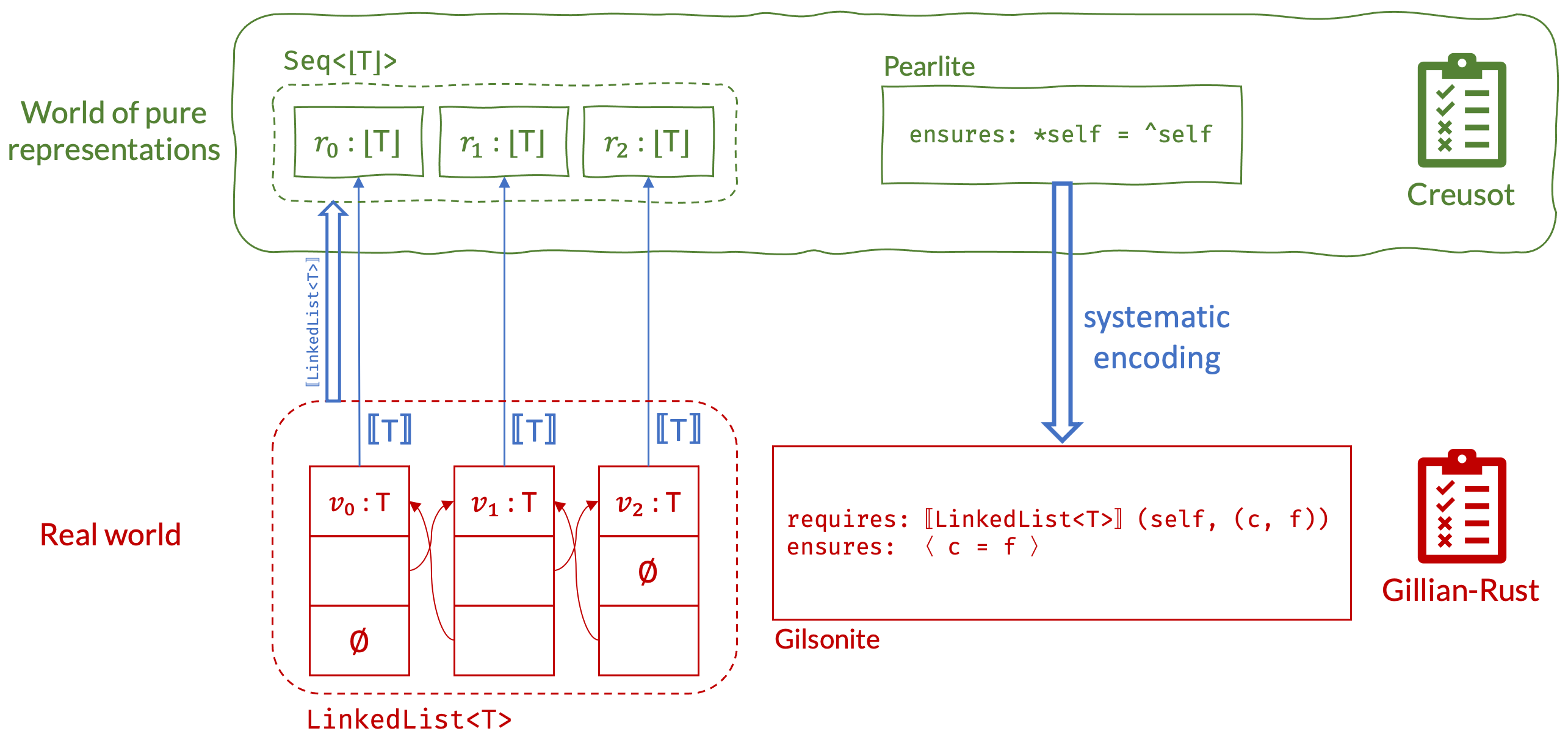
The image is a diagram illustrating the verification of a `LinkedList<T>` data structure using different verification tools and approaches. It contrasts the "World of pure representations" with the "Real world" implementation, showing how the abstract representation is encoded and verified against the concrete implementation.
### Components/Axes
* **Title:** None explicitly given, but the diagram focuses on the verification of `LinkedList<T>`.
* **Regions:**
* **Top (Green):** Represents the "World of pure representations" and includes `Seq<[T]>` and `Pearlite`.
* **Bottom (Red):** Represents the "Real world" and includes `LinkedList<T>` and `Gilsonite`.
* **Right (Green/Red):** Shows the verification tools `Creusot` and `Gillian-Rust`.
* **Elements:**
* `Seq<[T]>`: A sequence of type `T`. Contains three elements: `r0: [T]`, `r1: [T]`, and `r2: [T]`.
* `Pearlite`: A verification tool with the specification `ensures: *self = ^self`.
* `LinkedList<T>`: A linked list data structure. Contains three nodes: `v0: T`, `v1: T`, and `v2: T`. Each node has a value of type `T` and a pointer to the next node. The last node's pointer is `Ø` (null).
* `Gilsonite`: A verification tool with the specifications `requires: [LinkedList<T>] (self, (c, f))` and `ensures: < c = f >`.
* `Creusot`: A verification tool represented by a green clipboard icon with checkmarks.
* `Gillian-Rust`: A verification tool represented by a red clipboard icon with checkmarks.
* **Connections:**
* Blue arrows connect `r0: [T]`, `r1: [T]`, and `r2: [T]` in `Seq<[T]>` to `v0: T`, `v1: T`, and `v2: T` in `LinkedList<T>`, respectively. These arrows are labeled `[LinkedList<T>]`.
* A blue arrow connects `Pearlite` to `Gilsonite`, labeled "systematic encoding".
* Red arrows within the `LinkedList<T>` structure indicate the pointers between the nodes.
### Detailed Analysis or ### Content Details
* **World of pure representations (Top - Green):**
* `Seq<[T]>` is a sequence of elements of type `T`. It contains three elements:
* `r0: [T]`
* `r1: [T]`
* `r2: [T]`
* `Pearlite` ensures that `*self = ^self`.
* **Real world (Bottom - Red):**
* `LinkedList<T>` is a linked list with three nodes:
* `v0: T`: Points to `v1: T`. The bottom part of the node contains `Ø`.
* `v1: T`: Points to `v2: T`. The bottom part of the node is empty.
* `v2: T`: Points to `Ø`. The bottom part of the node contains `Ø`.
* `Gilsonite` requires `[LinkedList<T>] (self, (c, f))` and ensures `< c = f >`.
* **Verification Tools (Right):**
* `Creusot` is a verification tool.
* `Gillian-Rust` is a verification tool.
* **Connections:**
* The blue arrows labeled `[LinkedList<T>]` represent the mapping between the abstract representation and the concrete implementation.
* The "systematic encoding" arrow represents the encoding process from `Pearlite` to `Gilsonite`.
### Key Observations
* The diagram illustrates the verification process of a `LinkedList<T>` data structure.
* It shows the mapping between the abstract representation (`Seq<[T]>`) and the concrete implementation (`LinkedList<T>`).
* It highlights the use of different verification tools (`Pearlite`, `Gilsonite`, `Creusot`, `Gillian-Rust`) to ensure the correctness of the implementation.
* The red arrows within the `LinkedList<T>` structure show the pointers between the nodes.
### Interpretation
The diagram demonstrates how formal verification can be used to ensure the correctness of a data structure implementation. The "World of pure representations" provides an abstract model of the data structure, while the "Real world" represents the concrete implementation. The verification tools are used to prove that the implementation satisfies the specifications defined in the abstract model. The "systematic encoding" step is crucial for translating the abstract specifications into concrete requirements that can be checked against the implementation. The use of different verification tools suggests that different approaches and levels of rigor can be applied to the verification process. The diagram highlights the importance of formal verification in ensuring the reliability and correctness of software systems.