\n
## Diagram: Formal Verification Pipeline
### Overview
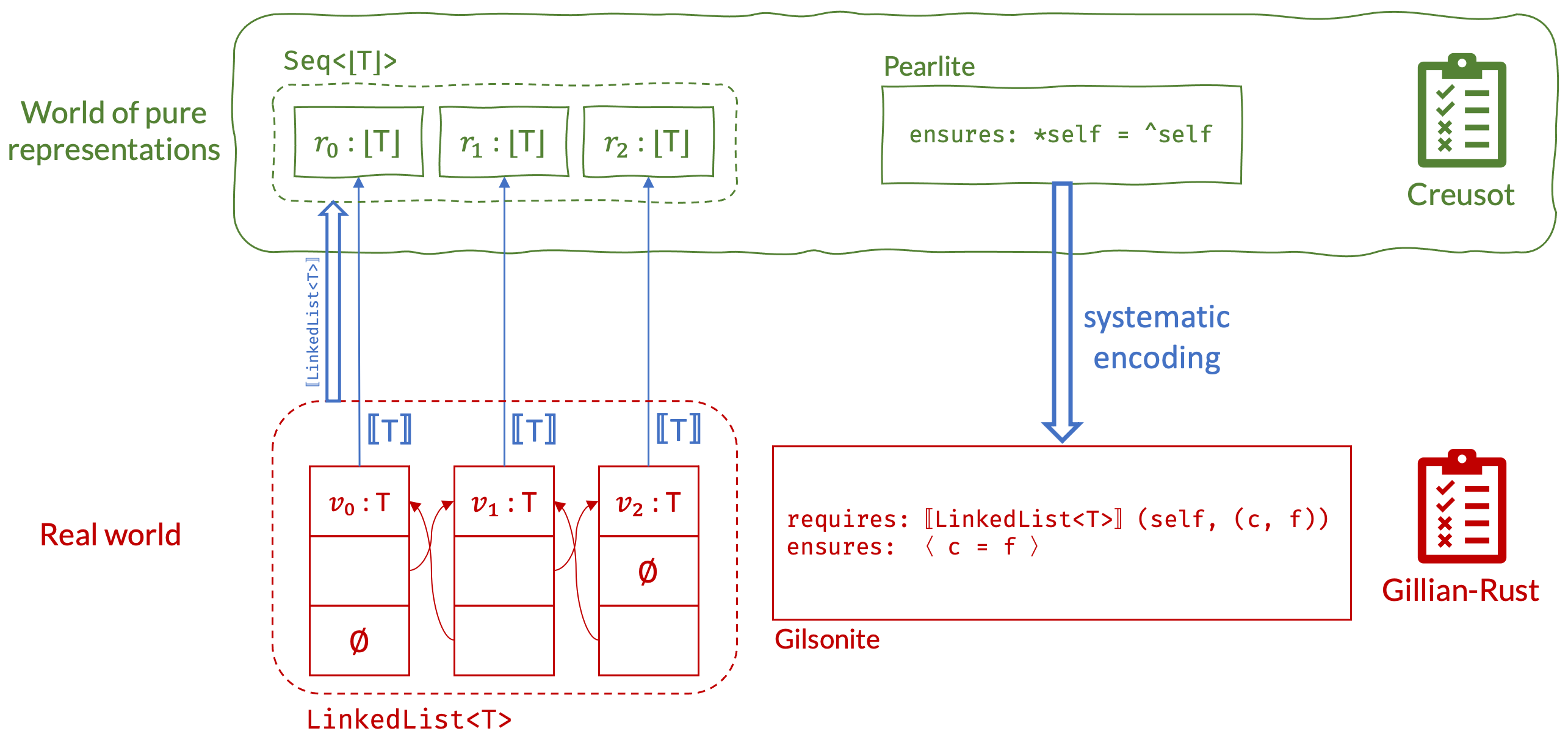
This diagram illustrates a formal verification pipeline connecting a "Real world" representation of data structures to a "World of pure representations" through encoding and verification tools. It depicts the flow of information from a `LinkedList<T>` to a `Seq<T>` and the use of tools like Pearlite, Creusot, and Gillian-Rust for verification.
### Components/Axes
The diagram is segmented into two main areas: "World of pure representations" (top-left) and "Real world" (bottom-left). A central flow connects these areas via "systematic encoding". Three verification tools are positioned on the right: Creusot, Pearlite, and Gillian-Rust.
* **World of pure representations:** Contains `Seq<T>`, with elements `τ₀: [T]`, `τ₁: [T]`, and `τ₂: [T]`.
* **Real world:** Contains `LinkedList<T>`, with elements `v₀: T`, `v₁: T`, and `v₂: T`. Also includes empty sets denoted by `Ø`.
* **Encoding:** Labeled "systematic encoding".
* **Verification Tools:**
* **Pearlite:** Associated with the text "ensures: *self ^= self".
* **Creusot:** Icon representing a tool.
* **Gillian-Rust:** Icon representing a tool.
* **Data Structures:** `Seq<T>`, `LinkedList<T>`.
* **Annotations:**
* `[LinkedList<T>]` appears near the encoding arrow.
* `requires: [LinkedList<T>] (self, (c, f))` appears near the encoding arrow.
* `ensures: ( < c = f )` appears near the encoding arrow.
### Detailed Analysis or Content Details
The diagram shows a mapping between a `LinkedList<T>` in the "Real world" and a `Seq<T>` in the "World of pure representations".
* **Mapping:** Dashed arrows connect elements in the `LinkedList<T>` to corresponding elements in the `Seq<T>`. Specifically:
* `v₀: T` maps to `τ₀: [T]`
* `v₁: T` maps to `τ₁: [T]`
* `v₂: T` maps to `τ₂: [T]`
* **Pearlite:** The annotation associated with Pearlite states "ensures: *self ^= self". This suggests a verification condition related to self-assignment or identity.
* **Encoding Details:** The encoding process is annotated with:
* `requires: [LinkedList<T>] (self, (c, f))` - This indicates a requirement for a `LinkedList<T>` with parameters `self`, `c`, and `f`.
* `ensures: ( < c = f )` - This indicates that the encoding ensures the condition `c = f` holds true.
* **Empty Sets:** The `LinkedList<T>` contains two empty sets denoted by `Ø`.
### Key Observations
* The diagram emphasizes the transformation of a concrete data structure (`LinkedList<T>`) into a more abstract, formal representation (`Seq<T>`).
* The annotations suggest a focus on verifying properties related to data structure manipulation, specifically around self-assignment and equality.
* The use of different tools (Pearlite, Creusot, Gillian-Rust) indicates a multi-faceted verification approach.
### Interpretation
This diagram represents a formal verification pipeline. The "Real world" represents the actual implementation of a `LinkedList<T>`, while the "World of pure representations" represents its formal specification using `Seq<T>`. The "systematic encoding" step translates the concrete implementation into a form suitable for formal analysis. The verification tools (Pearlite, Creusot, and Gillian-Rust) are then used to prove that the implementation satisfies its specification.
The annotation "ensures: *self ^= self" associated with Pearlite suggests a verification of a property related to the identity of the data structure. The `requires` and `ensures` clauses associated with the encoding step define the preconditions and postconditions of the encoding process, ensuring a correct transformation.
The presence of empty sets (`Ø`) in the `LinkedList<T>` suggests that the verification process also considers edge cases and empty data structures. The diagram highlights the importance of formal methods in ensuring the correctness and reliability of software systems, particularly those dealing with complex data structures. The diagram is a high-level overview and does not provide specific details about the encoding process or the verification algorithms used by each tool.