## Diagram: Technical System Architecture with Pure and Real-World Representations
### Overview
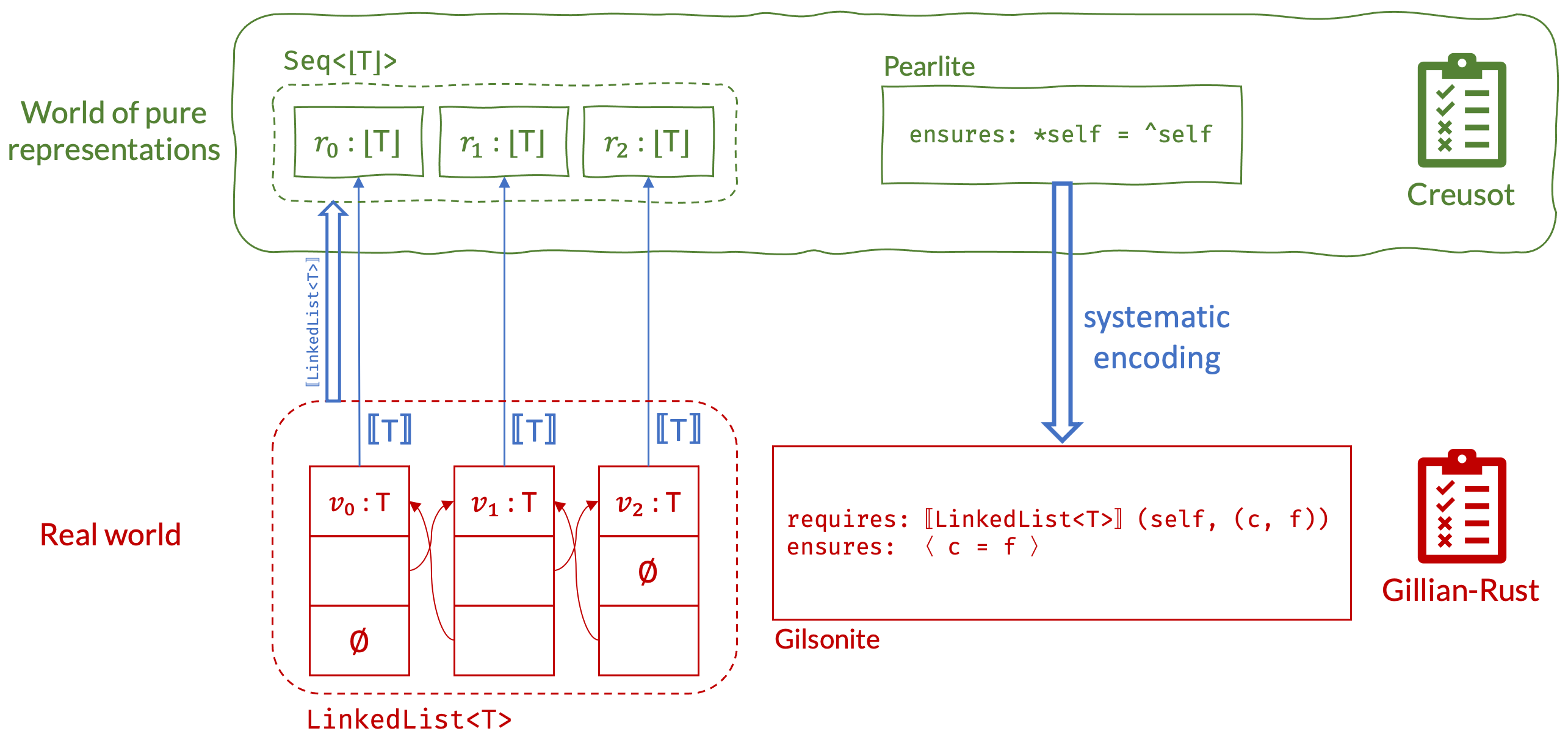
The diagram illustrates a conceptual framework contrasting "World of pure representations" (top) and "Real world" (bottom), connected through systematic encoding. It uses colored boxes, arrows, and textual annotations to depict relationships between abstract and concrete components, with explicit "ensures" and "requires" clauses.
### Components/Axes
1. **Top Section (Green - Pure Representations):**
- **Boxes:**
- `Seq<T>` (sequence of type T)
- `r₀: [T]`, `r₁: [T]`, `r₂: [T]` (three sequence representations)
- **Pearlite Box:**
- Text: `ensures: *self = ^self`
- Icon: Green clipboard with checkmarks (Creusot)
- **Arrows:**
- Blue upward arrows from `r₀`, `r₁`, `r₂` to `Seq<T>`
- Blue downward arrow labeled "systematic encoding" from Pearlite to Gillon-Rust
2. **Bottom Section (Red - Real World):**
- **Boxes:**
- `LinkedList<T>` (linked list of type T)
- `v₀: T`, `v₁: T`, `v₂: T` (three value representations)
- `ø` (empty set symbol)
- **Gillon-Rust Box:**
- Text: `requires: LinkedList<T> (self, (c, f))` and `ensures: <c = f>`
- Icon: Red clipboard with checkmarks (Gillon-Rust)
3. **Connectors:**
- Dashed red box labeled `LinkedList<T>` connecting pure and real-world sections
- Solid blue arrows showing flow between components
### Detailed Analysis
- **Pure Representations (Top):**
- Three sequence representations (`r₀`, `r₁`, `r₂`) are grouped under `Seq<T>`, suggesting a generic sequence abstraction.
- Pearlite enforces self-consistency (`*self = ^self`), acting as a validation mechanism (Creusot icon).
- **Real-World Implementation (Bottom):**
- Three value representations (`v₀`, `v₁`, `v₂`) and an empty set (`ø`) are grouped under `LinkedList<T>`, indicating concrete data structure implementation.
- Gillon-Rust requires a `LinkedList<T>` with parameters `(self, (c, f))` and ensures `c = f`, implying a constraint satisfaction mechanism (Gillon-Rust icon).
- **Systematic Encoding:**
- The blue arrow from Pearlite to Gillon-Rust labeled "systematic encoding" suggests a transformation process from abstract representations to real-world implementations.
### Key Observations
1. **Color Coding:**
- Green (top) represents abstract/pure components; red (bottom) represents concrete/real-world implementations.
2. **Arrow Flow:**
- Top-to-bottom flow indicates a dependency or transformation from pure representations to real-world systems.
3. **Constraints:**
- Pearlite enforces self-consistency; Gillon-Rust enforces parameter equality (`c = f`).
### Interpretation
This diagram appears to model a **formal verification or type system** in programming, where:
- **Pearlite** acts as a meta-level validator ensuring self-consistency in abstract representations.
- **Gillon-Rust** represents a concrete implementation framework requiring specific data structures (`LinkedList<T>`) and enforcing runtime constraints (`c = f`).
- The `LinkedList<T>` serves as a bridge between abstract sequences (`Seq<T>`) and concrete values (`v₀`, `v₁`, `v₂`), suggesting a type-safe mapping from theory to practice.
The "systematic encoding" arrow implies a compiler-like or transpiler process that translates high-level abstractions into executable code while preserving semantic guarantees. The use of "ensures" and "requires" clauses aligns with **Hoare logic** or **design by contract** principles, emphasizing formal correctness in system design.