## Screenshot: Esolog Park Shakespeare IDE
### Overview
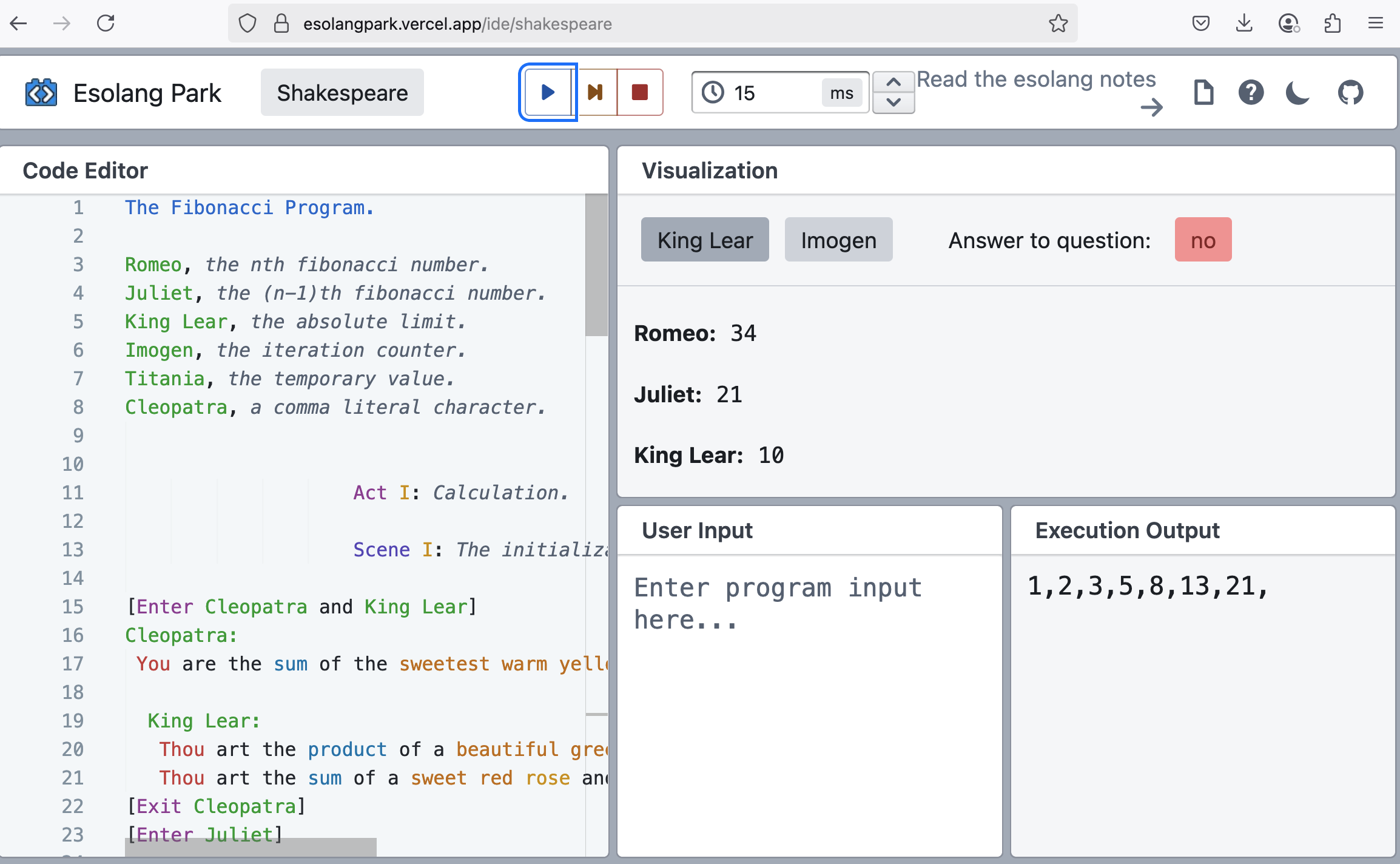
The image is a screenshot of a web-based Integrated Development Environment (IDE) called "Esolang Park Shakespeare". It shows a code editor, visualization, user input, and execution output sections. The code editor contains a Shakespeare programming language implementation of the Fibonacci sequence. The visualization section displays the current values of variables. The user input section allows for program input, and the execution output displays the calculated Fibonacci sequence.
### Components/Axes
* **Header:**
* Website URL: esolangpark.vercel.app/ide/shakespeare
* Title: Esolang Park Shakespeare
* Controls: Play, Step Forward, Stop, Timer set to 15 ms, Read the esolang notes
* **Code Editor:**
* Title: Code Editor
* Content: Shakespeare programming language code for calculating the Fibonacci sequence.
* **Visualization:**
* Title: Visualization
* Buttons: King Lear, Imogen
* Answer to question: no (displayed in a red box)
* Variables and values:
* Romeo: 34
* Juliet: 21
* King Lear: 10
* **User Input:**
* Title: User Input
* Placeholder text: Enter program input here...
* **Execution Output:**
* Title: Execution Output
* Output: 1,2,3,5,8,13,21,
### Detailed Analysis or ### Content Details
**Code Editor Content:**
```
1 The Fibonacci Program.
2
3 Romeo, the nth fibonacci number.
4 Juliet, the (n-1)th fibonacci number.
5 King Lear, the absolute limit.
6 Imogen, the iteration counter.
7 Titania, the temporary value.
8 Cleopatra, a comma literal character.
9
10 Act I: Calculation.
11
12 Scene I: The initializa
13
14
15 [Enter Cleopatra and King Lear]
16 Cleopatra:
17 You are the sum of the sweetest warm yello
18
19 King Lear:
20 Thou art the product of a beautiful gre
21 Thou art the sum of a sweet red rose and
22 [Exit Cleopatra]
23 [Enter Juliet]
```
**Visualization Details:**
* The "King Lear" button is highlighted, suggesting it's the currently selected variable set.
* The "Answer to question" is set to "no".
**Execution Output Details:**
* The output shows the beginning of the Fibonacci sequence: 1, 2, 3, 5, 8, 13, 21.
### Key Observations
* The code editor displays a program written in the Shakespeare programming language.
* The visualization section shows the current values of variables used in the program.
* The execution output displays the calculated Fibonacci sequence.
### Interpretation
The screenshot demonstrates a Shakespeare programming language IDE executing a Fibonacci sequence program. The IDE provides a code editor, variable visualization, user input, and execution output sections. The visualization section allows the user to inspect the values of variables during program execution. The "Answer to question" likely refers to a conditional statement within the Shakespeare program, which currently evaluates to "no". The Fibonacci sequence is correctly calculated and displayed in the execution output.