\n
## Interactive Development Environment: Esolang Park - Shakespeare
### Overview
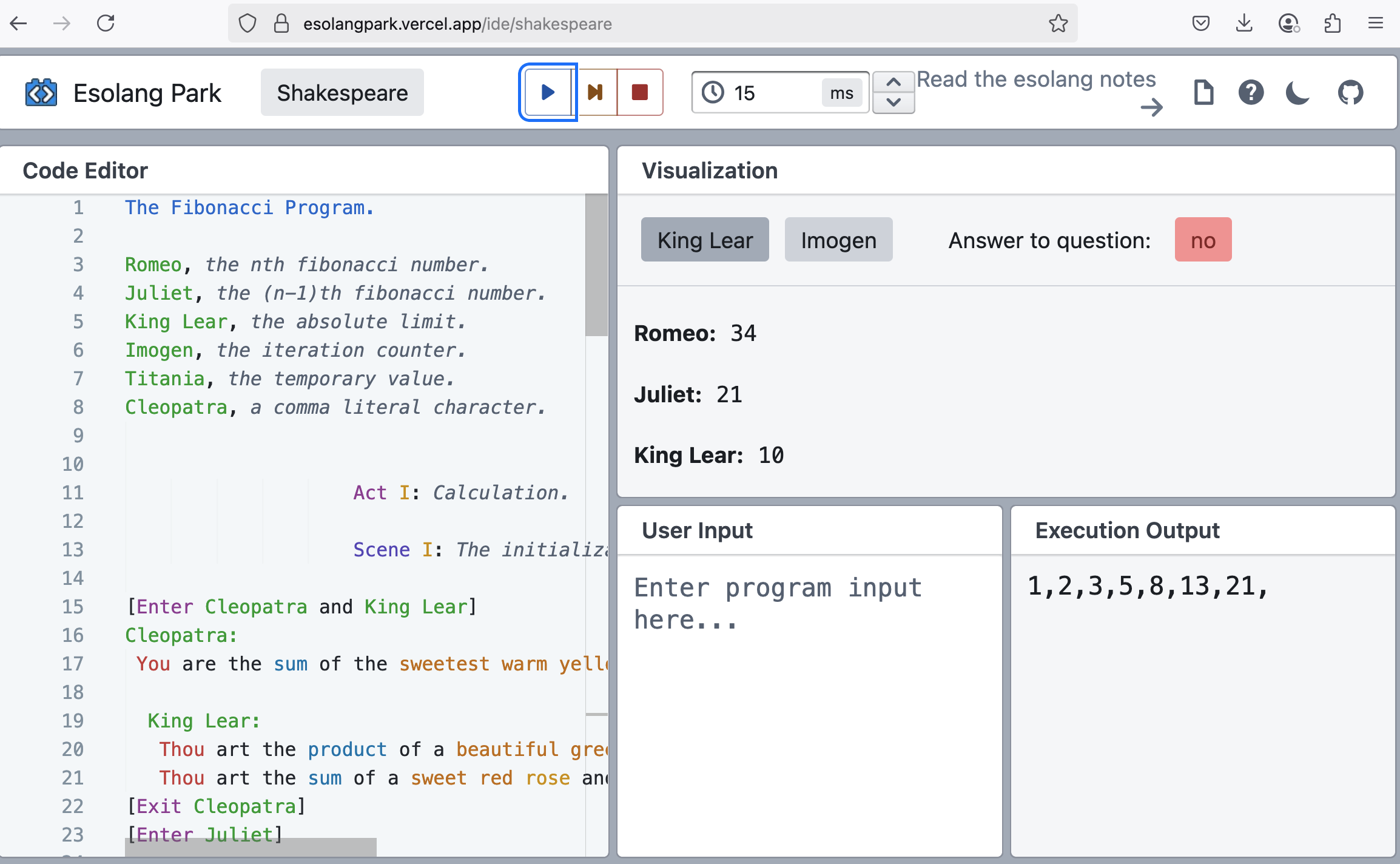
The image displays an interactive development environment named "Esolang Park" running a program written in a Shakespeare-inspired esoteric programming language. The interface is split into three main sections: a Code Editor, a Visualization panel, and a User Input/Execution Output area. The program calculates Fibonacci numbers.
### Components/Axes
* **Code Editor:** Displays the source code with line numbers.
* **Visualization:** Shows the current values of variables: King Lear, Imogen, Romeo, and Juliet. Includes a toggle for answering a question ("no" is selected).
* **User Input:** A text field for entering program input.
* **Execution Output:** Displays the calculated Fibonacci sequence.
* **Toolbar:** Contains buttons for running the program (play/pause), stepping through the code, and accessing documentation ("Read the esolang notes").
* **URL Bar:** Displays the URL: `esolangpark.vercel.app/ide/shakespeare`
### Detailed Analysis or Content Details
**Code Editor (Lines 1-23):**
1. `The Fibonacci Program.`
2. `Romeo, the nth fibonacci number.`
3. `Juliet, the (n-1)th fibonacci number.`
4. `King Lear, the absolute limit.`
5. `Imogen, the iteration counter.`
6. `Titania, the temporary value.`
7. `Cleopatra, a comma literal character.`
8. `Act I: Calculation.`
9. `Scene I: The initialization`
10. `[Enter Cleopatra and King Lear]`
11. `Cleopatra:`
12. `You are the sum of the sweetest warm yellow`
13. `King Lear:`
14. `Thou art the product of a beautiful green`
15. `Thou art the sum of a sweet red rose and`
16. `[Exit Cleopatra]`
17. `[Enter Juliet]`
**Visualization Panel:**
* King Lear: 10
* Imogen: (No value displayed)
* Romeo: 34
* Juliet: 21
**User Input:**
* Input field contains: `Enter program input here...`
**Execution Output:**
* `1,2,3,5,8,13,21`
### Key Observations
* The program appears to be calculating the Fibonacci sequence.
* The variables Romeo and Juliet hold consecutive Fibonacci numbers.
* King Lear seems to represent a limit or threshold for the calculation.
* The visualization panel shows the current values of these variables during execution.
* The output shows the first seven Fibonacci numbers.
* The code uses Shakespearean-style language for variable names and commands.
### Interpretation
The image demonstrates an esoteric programming language (Esolang) that uses Shakespearean terminology to define program logic. The program calculates the Fibonacci sequence, assigning values to variables named after Shakespearean characters. The visualization panel provides a dynamic view of the variables' values as the program executes. The output confirms the successful calculation of the Fibonacci sequence. The use of Shakespearean language is purely stylistic and does not affect the program's functionality. The "Answer to question" toggle suggests the environment might include interactive quizzes or challenges related to the code. The program's structure suggests a step-by-step calculation, with `Imogen` likely tracking the iteration number. The values of `Romeo` and `Juliet` are updated in each iteration, and `King Lear` appears to be a stopping condition. The code snippet provided is incomplete, as it only shows the initialization and a portion of the calculation. The program likely continues to calculate and output more Fibonacci numbers based on user input or a predefined limit.