## Screenshot: Web-Based Fibonacci Program with Shakespearean Visualization
### Overview
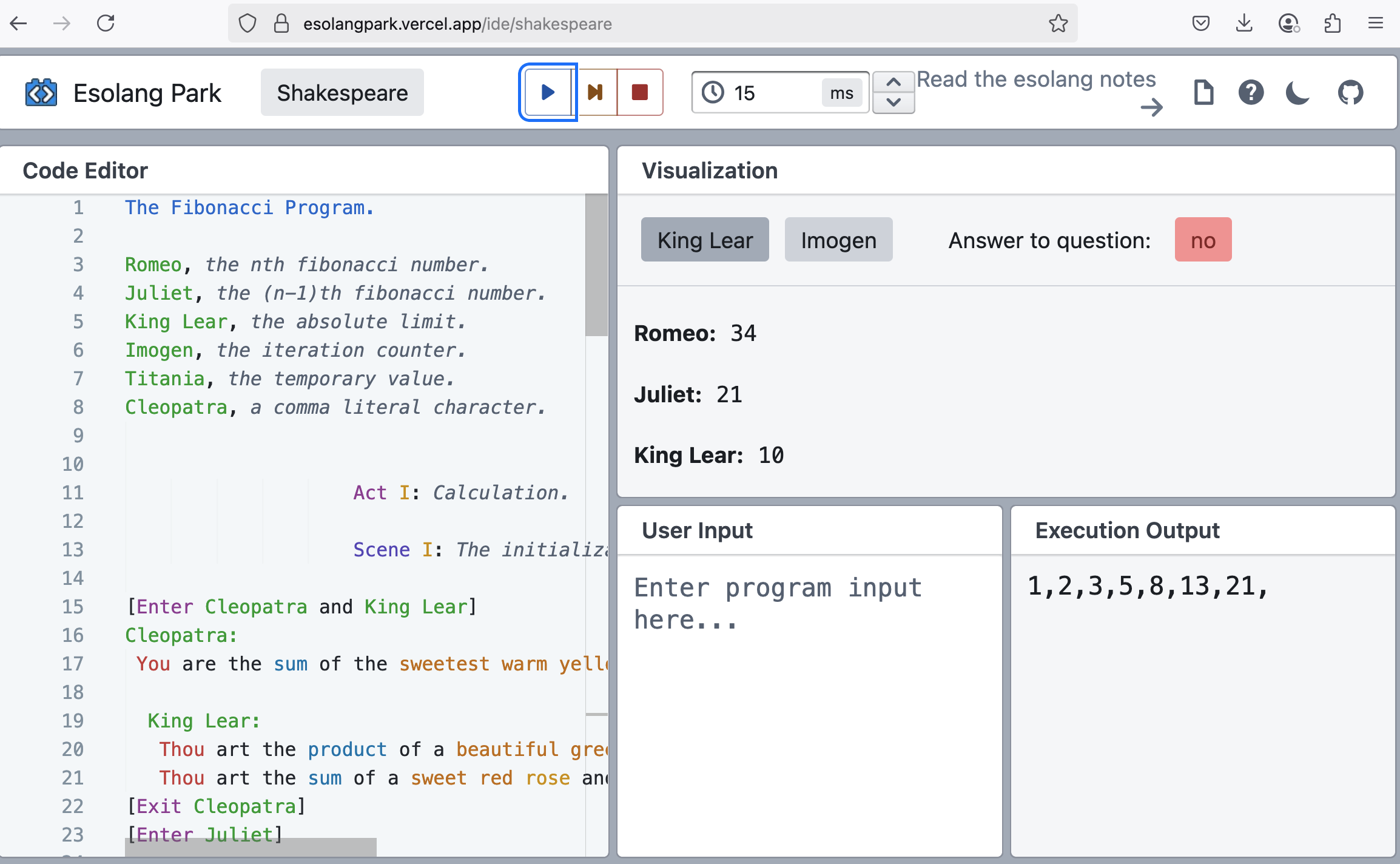
The image depicts a web-based code editor interface with a dual-panel layout. The left panel contains a code editor displaying a Fibonacci sequence program written in a mix of programming syntax and Shakespearean language. The right panel features a visualization dashboard with variable values, user input prompts, and execution output. The interface includes navigation controls (play, stop, record) and a timer set to 15ms.
### Components/Axes
1. **Code Editor Panel**:
- **Title**: "The Fibonacci Program."
- **Variables**:
- `Romeo`: nth Fibonacci number (value: 34)
- `Juliet`: (n-1)th Fibonacci number (value: 21)
- `King Lear`: absolute limit (value: 10)
- `Imogen`: iteration counter (value: 10)
- `Titania`: temporary value (value: 10)
- `Cleopatra`: comma literal character (value: 10)
- **Code Structure**:
- Act I: Calculation
- Scene I: Initialization
- Dialogue between Cleopatra and King Lear using poetic metaphors for mathematical operations.
2. **Visualization Panel**:
- **Tabs**:
- **King Lear**: Displays variable values (Romeo:34, Juliet:21, King Lear:10).
- **Imogen**: Iteration counter (value: 10).
- **User Input**: Prompt to "Enter program input here..."
- **Execution Output**: Displays Fibonacci sequence: `1, 2, 3, 5, 8, 13, 21,`.
### Detailed Analysis
- **Code Logic**:
- The program uses Shakespearean character names as variables to represent Fibonacci sequence elements.
- `Romeo` and `Juliet` correspond to consecutive Fibonacci numbers (e.g., 34 and 21, which are the 9th and 8th numbers in the sequence).
- `King Lear` acts as a termination condition (value: 10), likely limiting the sequence length.
- `Imogen` tracks iterations (value: 10), suggesting the program runs 10 times.
- `Titania` and `Cleopatra` are temporary variables initialized to 10, possibly for intermediate calculations.
- **Visualization**:
- The "King Lear" tab aggregates variable values, while "Imogen" tracks iterations.
- The execution output explicitly lists the Fibonacci sequence up to 21, confirming the program's output.
### Key Observations
1. **Shakespearean Theme**: Variable names and dialogue mimic Shakespearean language (e.g., "Thou art the sum of a sweet red rose").
2. **Fibonacci Sequence**: The execution output matches the expected sequence, with `Romeo` (34) and `Juliet` (21) representing consecutive terms.
3. **Termination Condition**: `King Lear` (value: 10) likely controls the loop's maximum iterations or sequence length.
4. **Placeholder Input**: The "User Input" section is empty, indicating the program may require external input for dynamic execution.
### Interpretation
The program combines poetic language with algorithmic logic to generate a Fibonacci sequence. The visualization panel abstracts the code's variables into a dashboard, making the sequence's progression tangible. The use of `King Lear` as a limit suggests a constraint on the sequence's length, while `Imogen` tracks the iterative process. The absence of user input implies the program may run with predefined parameters, though the interface allows for manual input. The Shakespearean theme adds a layer of narrative to an otherwise technical process, blending art and computation.