## Diagram: Workflow Comparison of ReAct and MapReduce with Context Constraints
### Overview
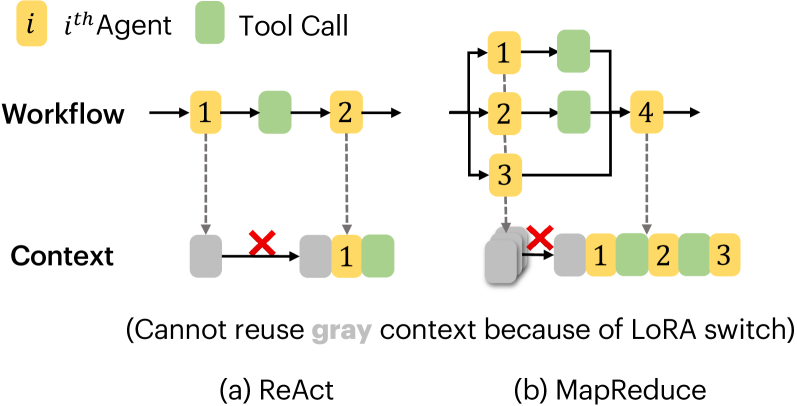
The image compares two workflows—**ReAct** and **MapReduce**—highlighting their structural differences and context reuse limitations due to a "LoRA switch." Both workflows involve sequential steps (labeled 1, 2, 3, 4) and context dependencies, with visual annotations indicating irreusable context elements.
### Components/Axes
- **Legend**:
- **Yellow squares**: Represent `iᵗʰ Agent` (agent actions).
- **Green squares**: Represent `Tool Call` (external tool interactions).
- **Red X**: Indicates "Cannot reuse gray context because of LoRA switch."
- **Labels**:
- **Left side**: "Workflow" (top) and "Context" (bottom).
- **Arrows**: Connect workflow steps to context elements, showing dependencies.
### Detailed Analysis
#### (a) ReAct Workflow
- **Workflow**:
- Linear sequence: `1 → 2` (yellow squares for agents, green squares for tool calls).
- **Context**:
- Steps `1` and `2` are grayed out.
- A red X marks step `2`, indicating it cannot be reused due to the LoRA switch.
#### (b) MapReduce Workflow
- **Workflow**:
- Branching structure:
- Path 1: `1 → 2 → 4` (steps 1 and 2 are agents; step 4 is a tool call).
- Path 2: `3 → 4` (step 3 is an agent; step 4 is a tool call).
- **Context**:
- Steps `1`, `2`, and `3` are grayed out.
- A red X marks step `1`, indicating it cannot be reused due to the LoRA switch.
### Key Observations
1. **ReAct**:
- Simpler, linear workflow with fewer steps.
- Context reuse failure occurs at step `2` (tool call).
2. **MapReduce**:
- More complex, branching workflow with parallel paths.
- Context reuse failure occurs at step `1` (agent action).
3. **LoRA Switch Impact**:
- Both workflows lose access to specific context steps, but the failure points differ (step `2` in ReAct vs. step `1` in MapReduce).
### Interpretation
The diagrams illustrate how workflow design affects context reuse under LoRA constraints. ReAct’s linear approach leads to a single point of failure in context reuse, while MapReduce’s branching structure introduces redundancy but still faces limitations. The inability to reuse grayed-out context steps suggests that LoRA switches disrupt dependencies critical to workflow continuity. This could imply trade-offs between workflow complexity and adaptability in dynamic environments.
**Note**: No numerical data or trends are present; the analysis focuses on structural and dependency relationships.