\n
## Diagram: Abduction and Consistency Optimization in a Neural Network
### Overview
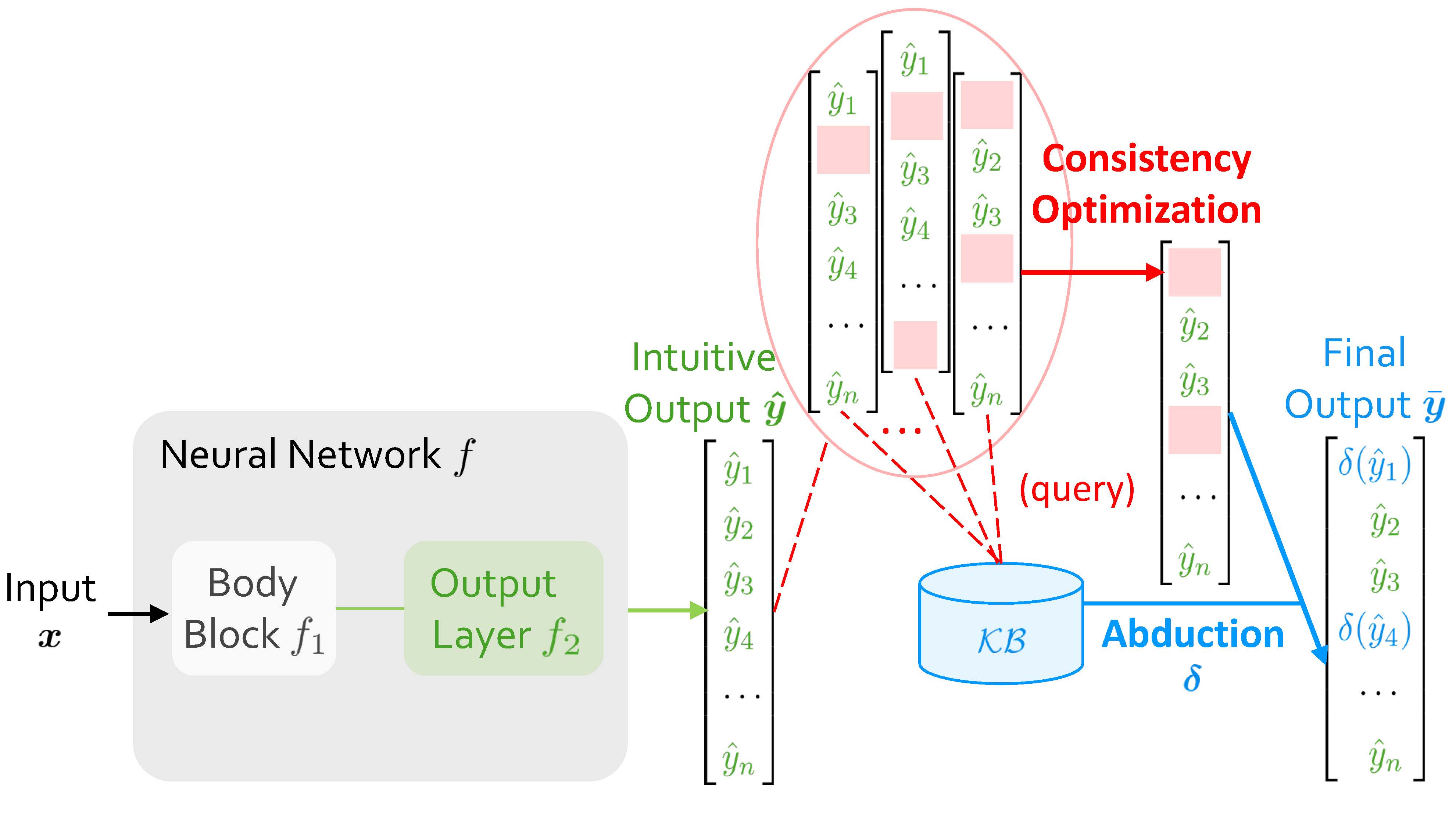
This diagram illustrates a process for refining the output of a neural network using abduction and consistency optimization. The neural network generates an initial "intuitive" output, which is then refined based on a knowledge base (KB) and a consistency optimization step to produce a final output. The diagram depicts the flow of information from input to final output, highlighting the key components and processes involved.
### Components/Axes
The diagram consists of the following components:
* **Input (x):** The initial input to the neural network.
* **Neural Network f:** Represented as a grey box, composed of a Body Block (f1) and an Output Layer (f2).
* **Intuitive Output (ŷ):** A vertical list of predicted values, labeled ŷ1, ŷ2, ŷ3, ŷ4, ... ŷn. The list is enclosed in a dashed-line rectangle.
* **Knowledge Base (KB):** A cylindrical shape labeled "KB".
* **Abduction (δ):** A process represented by a vertical block labeled "Abduction δ".
* **Consistency Optimization:** A vertical block labeled "Consistency Optimization".
* **Final Output (ȳ):** A vertical list of refined values, labeled ȳ1, ȳ2, ȳ3, ȳ4, ... ȳn. The list is enclosed in a solid-line rectangle.
* **Arrows:** Indicate the flow of information and dependencies between components. Red dashed arrows connect the Intuitive Output to the Knowledge Base and Abduction block. Solid arrows connect the Abduction block to the Consistency Optimization block, and the Consistency Optimization block to the Final Output.
### Detailed Analysis or Content Details
The diagram shows the following flow:
1. **Input x** enters the **Neural Network f**.
2. The Neural Network processes the input through its **Body Block f1** and **Output Layer f2**.
3. The **Output Layer f2** generates an **Intuitive Output ŷ**, which is a list of 'n' predicted values: ŷ1, ŷ2, ŷ3, ŷ4, and so on, up to ŷn.
4. The **Intuitive Output ŷ** is used as a **query** to the **Knowledge Base KB**.
5. The **Knowledge Base KB** and the **Intuitive Output ŷ** feed into the **Abduction δ** process.
6. The **Abduction δ** process outputs values that are used in the **Consistency Optimization** step.
7. The **Consistency Optimization** step refines the **Intuitive Output ŷ** to produce the **Final Output ȳ**, which is a list of 'n' refined values: ȳ1, ȳ2, ȳ3, ȳ4, and so on, up to ȳn. The final output is represented as δ(ŷ1), δ(ŷ2), δ(ŷ3), δ(ŷ4), ... δ(ŷn).
### Key Observations
The diagram highlights a multi-stage process for generating a final output. The initial output of the neural network is not considered final but is instead refined through abduction and consistency optimization, leveraging a knowledge base. The use of dashed lines for the initial output and solid lines for the final output visually emphasizes the refinement process. The notation δ(ŷi) suggests a transformation or adjustment applied to each element of the intuitive output.
### Interpretation
This diagram represents a system designed to improve the reliability and accuracy of a neural network's output. The inclusion of a Knowledge Base and the Abduction/Consistency Optimization steps suggest that the system aims to address potential inconsistencies or inaccuracies in the initial neural network prediction. The Abduction process likely infers explanations or hypotheses based on the intuitive output and the knowledge base, while the Consistency Optimization step ensures that the final output aligns with the knowledge base and other constraints. This approach is particularly relevant in scenarios where the neural network's output needs to be interpretable, explainable, or consistent with prior knowledge. The diagram suggests a move beyond purely data-driven predictions towards a more knowledge-aware and reasoning-based system.