## Diagram: Neural Network with Consistency Optimization and Abduction Process
### Overview
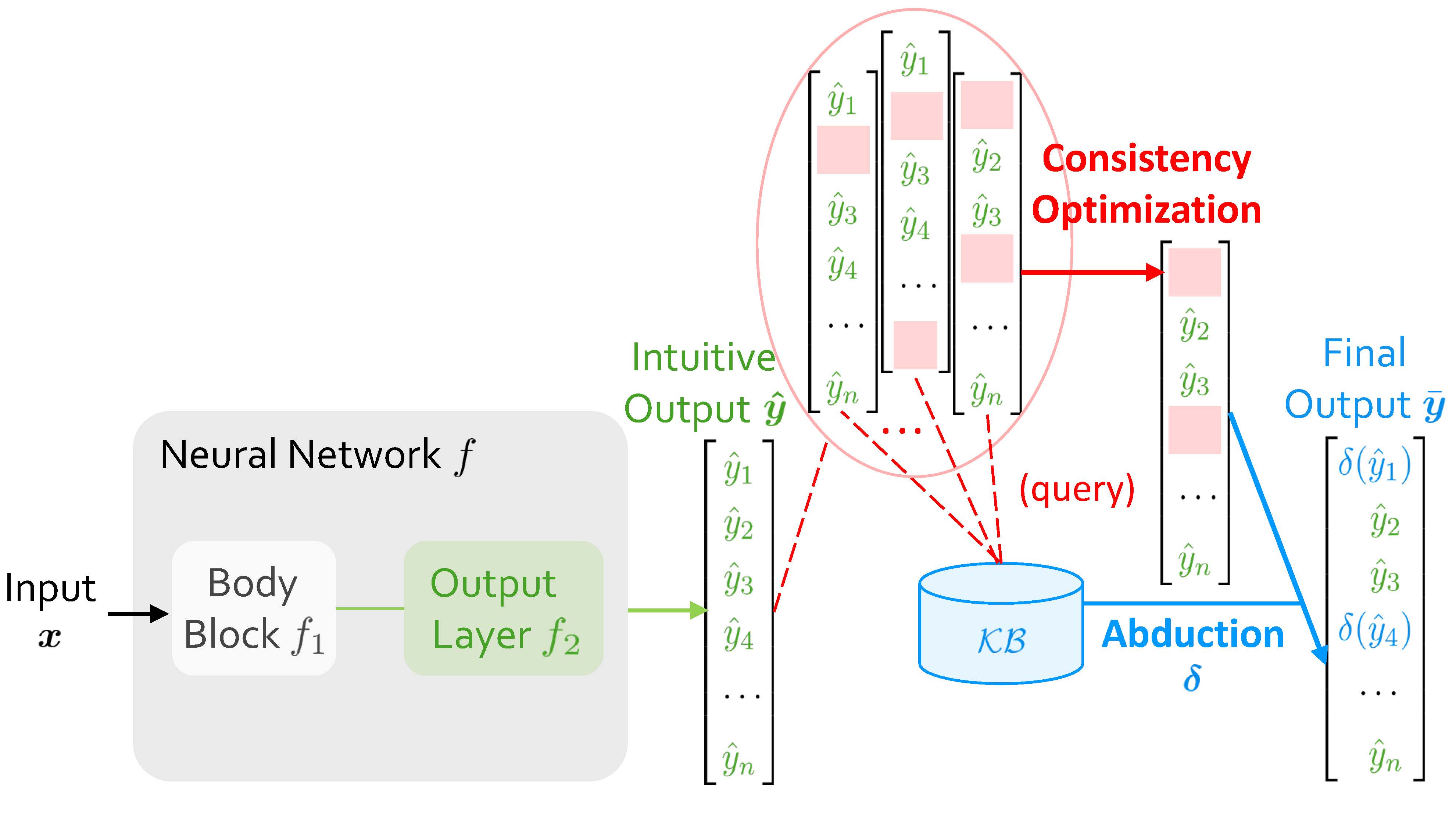
The diagram illustrates a multi-stage neural network architecture with post-processing steps for output refinement. It shows the flow from raw input through neural network processing, consistency optimization, knowledge-based abduction, and final output generation. Key elements include body blocks, output layers, query mechanisms, and transformation functions.
### Components/Axes
1. **Input Section**:
- **Input x**: Raw data entering the system
- **Body Block f₁**: Initial neural network processing unit
- **Output Layer f₂**: Primary output generator
2. **Processing Pipeline**:
- **Intuitive Output ŷ**: Intermediate predictions (ŷ₁ to ŷₙ)
- **Consistency Optimization**: Red-highlighted selection mechanism
- **KB (Knowledge Base)**: Blue cylindrical component for query operations
- **Abduction δ**: Transformation function
- **Final Output ŷ̄**: Refined predictions with δ(ŷ₁) to δ(ŷₙ)
3. **Visual Elements**:
- Red ellipse highlighting consistency optimization targets
- Dashed red lines connecting KB queries
- Solid blue arrow for abduction transformation
- Color-coded components (red/blue/green)
### Detailed Analysis
1. **Neural Network Structure**:
- Input x → f₁ (Body Block) → f₂ (Output Layer) → ŷ₁...ŷₙ
- Output layer produces n intuitive predictions
2. **Consistency Optimization**:
- Selects specific ŷ elements (ŷ₂ and ŷ₃ in diagram)
- Creates filtered output list [ŷ₂, ŷ₃, ..., ŷₙ]
3. **Knowledge Base Interaction**:
- Queries KB with intuitive outputs
- Dashed lines indicate multiple query paths
4. **Abduction Process**:
- Applies δ function to selected outputs
- Transforms ŷ₂ → δ(ŷ₂), ŷ₃ → δ(ŷ₃), etc.
5. **Final Output**:
- ŷ̄ contains transformed predictions
- Maintains original order but with modified values
### Key Observations
1. **Selective Processing**:
- Only ŷ₂ and ŷ₃ are explicitly highlighted for optimization
- Suggests prioritization mechanism in consistency step
2. **Knowledge Integration**:
- KB serves as external validation/source
- Abduction modifies but preserves output structure
3. **Output Transformation**:
- Final output maintains same dimension as intuitive outputs
- δ function appears to be element-wise transformation
### Interpretation
This architecture demonstrates a hybrid AI system combining:
1. **Deep Learning**: For initial pattern recognition (f₁/f₂)
2. **Rule-Based Optimization**: Through consistency checks
3. **Knowledge Engineering**: Via KB queries
4. **Logical Inference**: Through abduction process
The system appears designed to:
- Generate initial predictions through neural networks
- Filter/optimize predictions based on internal consistency
- Cross-reference with external knowledge
- Apply logical transformations to final outputs
The use of abduction (inference to the best explanation) suggests the system incorporates domain knowledge to refine predictions, potentially improving reliability over pure neural network outputs. The selective optimization step indicates awareness of prediction uncertainty, focusing computational resources on most promising candidates.