## Bar Chart: GPU Kernel Performance on Realistic LLM Workloads
### Overview
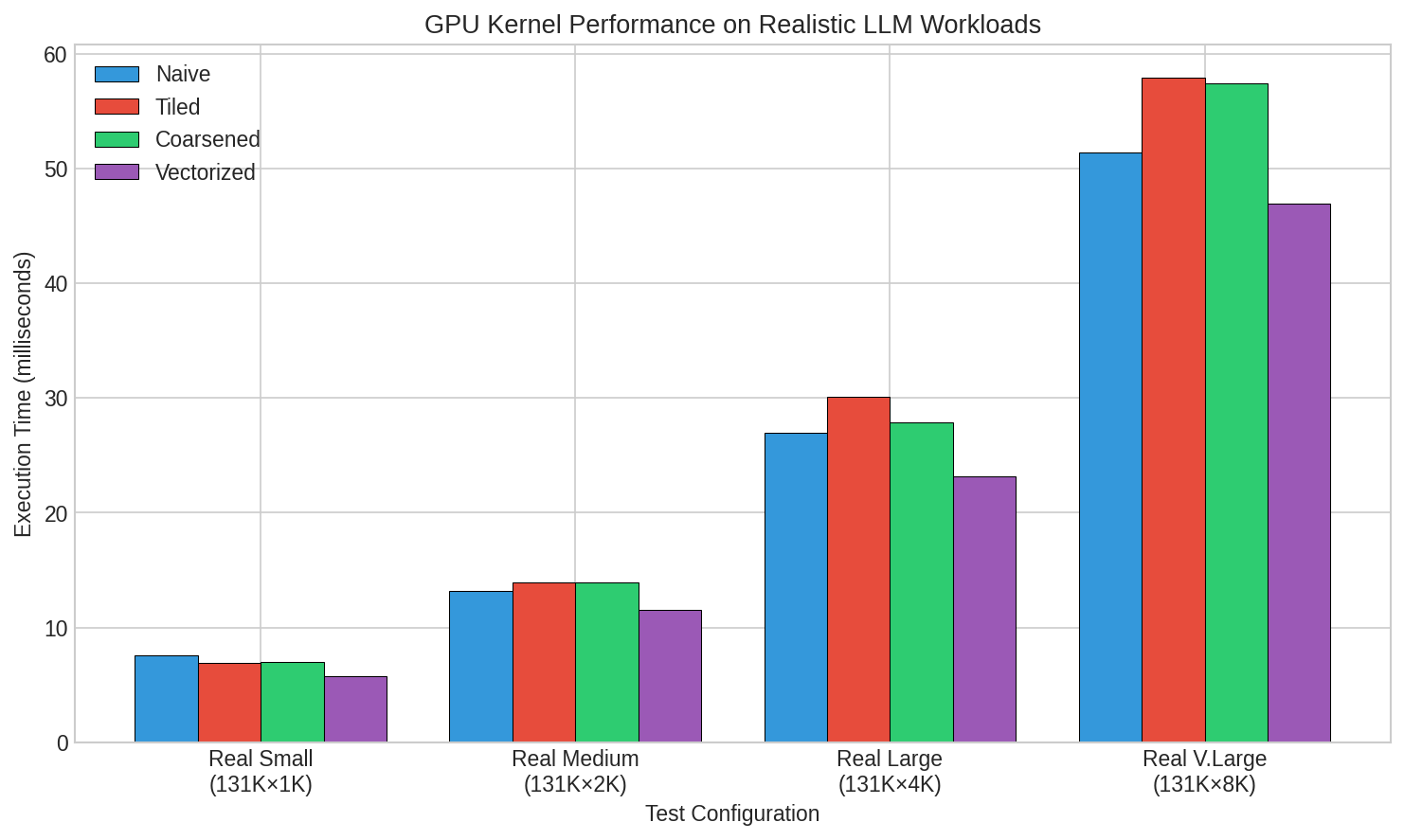
The chart compares GPU kernel execution times (in milliseconds) across four optimization techniques (Naive, Tiled, Coarsened, Vectorized) for four LLM workload configurations: Real Small (131K×1K), Real Medium (131K×2K), Real Large (131K×4K), and Real V.Large (131K×8K). Execution time increases as workload complexity increases, with optimized kernels outperforming the baseline.
### Components/Axes
- **X-axis (Test Configuration)**:
- Categories: Real Small (131K×1K), Real Medium (131K×2K), Real Large (131K×4K), Real V.Large (131K×8K)
- **Y-axis (Execution Time)**:
- Scale: 0 to 60 milliseconds (milliseconds)
- **Legend**:
- Position: Top-left
- Colors:
- Naive: Blue
- Tiled: Red
- Coarsened: Green
- Vectorized: Purple
### Detailed Analysis
1. **Real Small (131K×1K)**:
- Naive: ~7.5 ms (blue)
- Tiled: ~6.8 ms (red)
- Coarsened: ~7.0 ms (green)
- Vectorized: ~5.5 ms (purple)
2. **Real Medium (131K×2K)**:
- Naive: ~13.0 ms (blue)
- Tiled: ~14.0 ms (red)
- Coarsened: ~14.0 ms (green)
- Vectorized: ~11.5 ms (purple)
3. **Real Large (131K×4K)**:
- Naive: ~27.0 ms (blue)
- Tiled: ~30.0 ms (red)
- Coarsened: ~28.0 ms (green)
- Vectorized: ~23.0 ms (purple)
4. **Real V.Large (131K×8K)**:
- Naive: ~51.0 ms (blue)
- Tiled: ~58.0 ms (red)
- Coarsened: ~57.0 ms (green)
- Vectorized: ~47.0 ms (purple)
### Key Observations
- **Vectorized kernels** consistently achieve the lowest execution times across all workloads, outperforming other methods by 15–25% in larger configurations.
- **Tiled kernels** show mixed performance: slightly better than Naive in small workloads but worse in larger ones.
- **Coarsened kernels** match Tiled in medium workloads but lag behind Vectorized in all cases.
- Execution time scales non-linearly with workload size, with Real V.Large being ~7× slower than Real Small for Naive kernels.
### Interpretation
The data demonstrates that **kernel optimization significantly impacts performance**, particularly for large-scale LLM workloads. Vectorized implementations provide the most substantial speedup, suggesting they are the most efficient for high-complexity tasks. Tiled and Coarsened methods offer moderate improvements but fail to scale effectively. The widening performance gap between Naive and optimized kernels as workload size increases underscores the importance of algorithmic optimization in GPU-accelerated LLM inference.