## Photograph: Robotic Arm Training Setup
### Overview
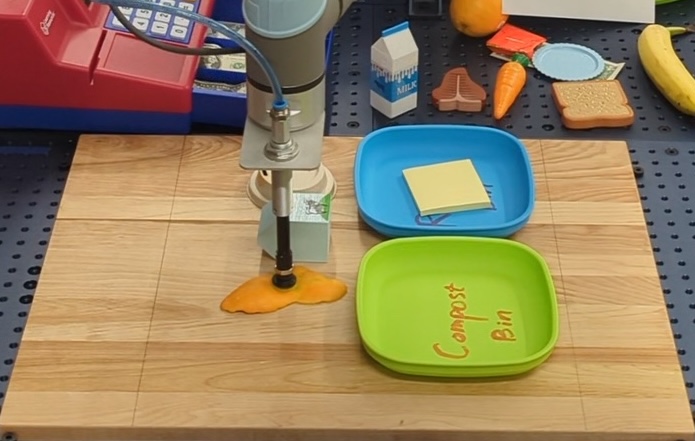
The image depicts a robotic arm interacting with objects on a wooden surface, likely part of a machine learning or robotics training environment. The scene includes labeled bins, a toy cash register, and play food items, suggesting tasks related to object recognition, sorting, or manipulation.
### Components/Axes
- **Robotic Arm**: Central focus, with a black gripper and metallic components. A blue cable connects the arm to an off-frame control unit.
- **Bins**:
- **Green Bin**: Labeled "Compost Bin" in orange text (bottom right).
- **Blue Bin**: Contains a yellow sticky note (top right).
- **Background Objects**:
- **Toy Cash Register**: Red and blue, with a numeric keypad (top left).
- **Play Food Items**: Includes a banana, carrot, bread, milk carton (labeled "MILK"), and a blue plate (scattered across the perforated metal surface).
- **Surface**: Light brown wooden board with visible grain, placed on a dark perforated metal table.
### Detailed Analysis
- **Robotic Arm**: Positioned centrally, the arm’s gripper is lowered toward a small white cube with a green label (possibly a training object). The arm’s base is mounted on the wooden surface.
- **Bins**:
- The green "Compost Bin" is empty but labeled, suggesting it may be a target for sorting tasks.
- The blue bin holds a yellow sticky note, though no text is visible on the note.
- **Background Items**:
- The cash register and play food items (banana, carrot, bread, milk carton) are arranged haphazardly, likely serving as training data for object recognition.
- The milk carton’s label ("MILK") is clearly visible in black text on a blue background.
### Key Observations
- The robotic arm’s gripper is in contact with a white cube, indicating an active manipulation task.
- The "Compost Bin" label is the only explicit textual instruction in the scene.
- Play food items are disproportionately sized compared to real-world objects, consistent with toy models.
- No numerical data, charts, or graphs are present.
### Interpretation
This setup appears designed for training a robotic system to recognize and interact with objects. The labeled bins ("Compost Bin") and play food items suggest tasks such as:
1. **Object Classification**: Identifying items (e.g., food vs. non-food).
2. **Sorting**: Placing items into designated bins (e.g., compostable vs. non-compostable).
3. **Manipulation**: Using the robotic arm to grasp and move objects.
The presence of a toy cash register and play food items implies a simulated environment for testing real-world scenarios in a controlled setting. The absence of numerical data or explicit instructions beyond the "Compost Bin" label suggests the focus is on visual and spatial reasoning rather than quantitative analysis.