\n
## Bar Chart: Normalized Execution Time vs. Context Length
### Overview
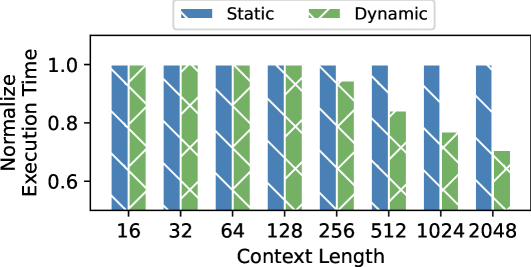
The image presents a bar chart comparing the normalized execution time of "Static" and "Dynamic" methods across varying context lengths. The chart displays execution time on the y-axis and context length on the x-axis. Each context length has two bars representing the execution time for each method.
### Components/Axes
* **X-axis Title:** "Context Length"
* **X-axis Markers:** 16, 32, 64, 128, 256, 512, 1024, 2048
* **Y-axis Title:** "Normalized Execution Time"
* **Y-axis Scale:** 0.6 to 1.0, with increments of approximately 0.02.
* **Legend:** Located at the top-right of the chart.
* "Static" - represented by a solid blue color.
* "Dynamic" - represented by a light green color with diagonal stripes.
### Detailed Analysis
The chart consists of paired bars for each context length.
* **Context Length 16:**
* Static: Approximately 0.98
* Dynamic: Approximately 0.98
* **Context Length 32:**
* Static: Approximately 0.98
* Dynamic: Approximately 0.98
* **Context Length 64:**
* Static: Approximately 0.98
* Dynamic: Approximately 0.98
* **Context Length 128:**
* Static: Approximately 0.98
* Dynamic: Approximately 0.98
* **Context Length 256:**
* Static: Approximately 0.96
* Dynamic: Approximately 0.96
* **Context Length 512:**
* Static: Approximately 0.98
* Dynamic: Approximately 0.85
* **Context Length 1024:**
* Static: Approximately 1.00
* Dynamic: Approximately 0.78
* **Context Length 2048:**
* Static: Approximately 1.00
* Dynamic: Approximately 0.68
**Trends:**
* For context lengths of 16, 32, 64, and 128, the execution times for both "Static" and "Dynamic" methods are nearly identical and remain around 0.98.
* As the context length increases beyond 256, the "Dynamic" method begins to show a decreasing trend in normalized execution time, while the "Static" method remains relatively stable around 1.00.
* The difference in execution time between the two methods becomes more pronounced at context lengths of 1024 and 2048.
### Key Observations
* The "Dynamic" method exhibits a significant performance improvement (lower normalized execution time) compared to the "Static" method at larger context lengths (1024 and 2048).
* For smaller context lengths, there is minimal difference in performance between the two methods.
* The "Static" method's execution time remains consistently high across all context lengths.
### Interpretation
The data suggests that the "Dynamic" method scales better with increasing context length than the "Static" method. At smaller context lengths, the overhead of the "Dynamic" method may be comparable to the "Static" method, resulting in similar performance. However, as the context length grows, the "Dynamic" method's ability to adapt or optimize its execution leads to a substantial reduction in execution time. This could indicate that the "Dynamic" method is more efficient in handling larger amounts of data or more complex computations associated with longer contexts. The consistent high execution time of the "Static" method suggests it may not be optimized for larger context lengths, or that its computational complexity increases linearly with context length. The chart highlights a trade-off: for small contexts, the methods are comparable, but for large contexts, the "Dynamic" method is clearly superior.