## Bar Chart: Normalized Execution Time by Context Length
### Overview
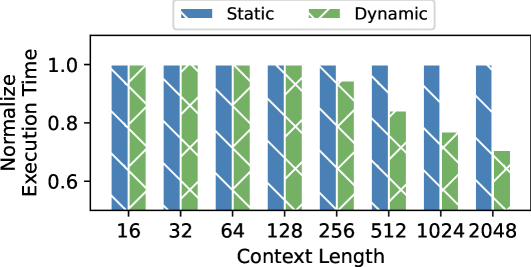
The chart compares normalized execution times for two methods ("Static" and "Dynamic") across varying context lengths (16 to 2048). Execution time is normalized to a scale of 0.6–1.0, with "Static" consistently at 1.0 and "Dynamic" decreasing as context length increases.
### Components/Axes
- **X-axis (Context Length)**: Discrete categories: 16, 32, 64, 128, 256, 512, 1024, 2048.
- **Y-axis (Normalize Execution Time)**: Scale from 0.6 to 1.0.
- **Legend**: Top-right corner, labeled "Static" (blue, crosshatch pattern) and "Dynamic" (green, crosshatch pattern).
- **Bars**: Paired bars per context length, grouped by method.
### Detailed Analysis
- **Static Method**:
- All bars are at **1.0** (no variation across context lengths).
- Crosshatch pattern matches the legend.
- **Dynamic Method**:
- Execution time decreases with increasing context length:
- 16: ~1.0
- 32: ~1.0
- 64: ~1.0
- 128: ~0.95
- 256: ~0.9
- 512: ~0.85
- 1024: ~0.75
- 2048: ~0.7
- Crosshatch pattern matches the legend.
### Key Observations
1. **Static Method Consistency**: Execution time remains constant at 1.0 regardless of context length.
2. **Dynamic Method Scalability**: Execution time improves (decreases) as context length increases, suggesting better performance scaling.
3. **Outlier**: Dynamic method at 2048 context length drops to ~0.7, the lowest observed value.
### Interpretation
- The data demonstrates that the **Dynamic method adapts more efficiently to larger context lengths**, with execution time decreasing by ~30% from 128 to 2048.
- The **Static method’s fixed execution time** implies it does not scale with context size, potentially making it less suitable for large-scale applications.
- The crosshatch patterns in the bars visually distinguish the two methods, aiding in quick comparison.
- The normalization of execution time suggests the results are relative to a baseline (e.g., maximum or average time), emphasizing proportional differences rather than absolute values.