# Technical Diagram Analysis
## Diagram Overview
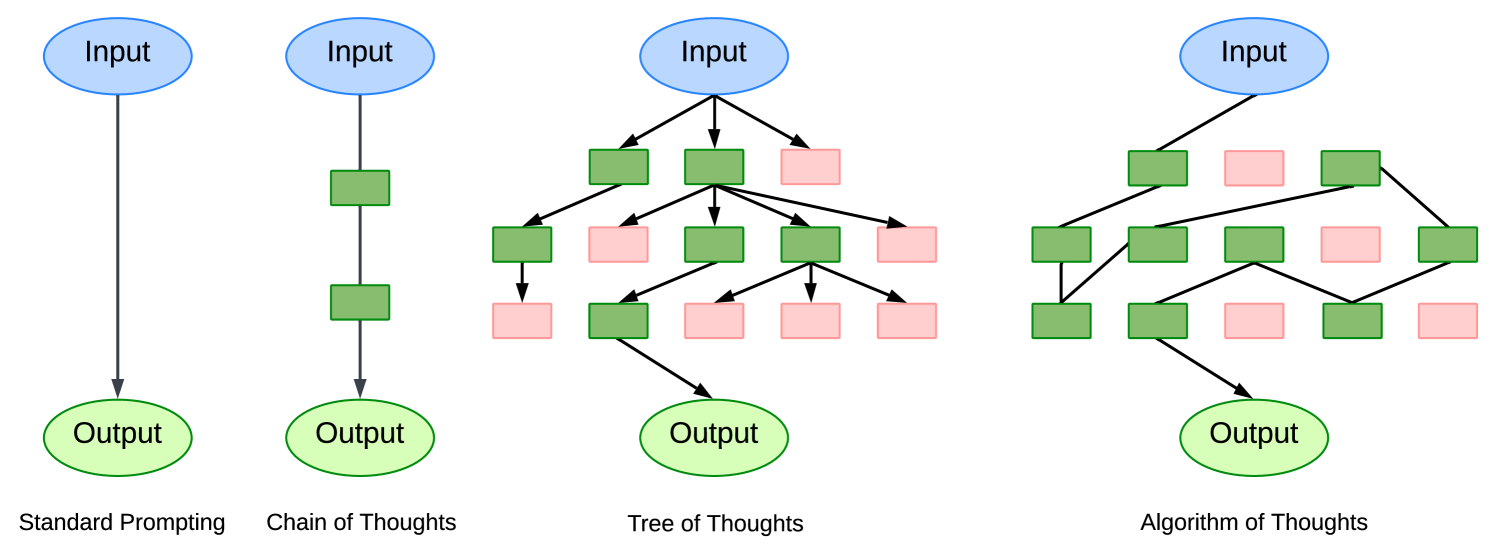
The image depicts a comparative analysis of four cognitive processing frameworks using flowchart structures. Each framework is represented by a distinct branching pattern, with standardized color coding (green for correct paths, pink for incorrect paths).
---
## Component Breakdown
### 1. Standard Prompting
- **Structure**: Linear flow
- **Input**: Single blue oval labeled "Input"
- **Processing**:
- One green rectangle (correct path)
- **Output**: Single green oval labeled "Output"
- **Flow**: Direct connection from Input → Processing → Output
### 2. Chain of Thoughts
- **Structure**: Branching flow
- **Input**: Single blue oval labeled "Input"
- **Processing**:
- Two green rectangles (correct paths)
- One pink rectangle (incorrect path)
- **Output**: Single green oval labeled "Output"
- **Flow**: Input → Branching paths → Output
### 3. Tree of Thoughts
- **Structure**: Multi-layered branching
- **Input**: Single blue oval labeled "Input"
- **Processing**:
- Three green rectangles (correct paths)
- Three pink rectangles (incorrect paths)
- **Output**: Single green oval labeled "Output"
- **Flow**: Input → First branching → Second branching → Output
### 4. Algorithm of Thoughts
- **Structure**: Complex hierarchical branching
- **Input**: Single blue oval labeled "Input"
- **Processing**:
- Four green rectangles (correct paths)
- Four pink rectangles (incorrect paths)
- **Output**: Single green oval labeled "Output"
- **Flow**: Input → First branching → Second branching → Third branching → Output
---
## Key Observations
1. **Color Coding**:
- Green rectangles: Represent correct processing paths
- Pink rectangles: Represent incorrect processing paths
- Blue ovals: Input nodes
- Green ovals: Output nodes
2. **Progression Complexity**:
- Standard Prompting: Simplest (1 processing step)
- Chain of Thoughts: Moderate complexity (2 processing steps)
- Tree of Thoughts: High complexity (3 processing steps)
- Algorithm of Thoughts: Most complex (4 processing steps)
3. **Path Diversity**:
- Each subsequent framework increases the number of processing paths exponentially
- Algorithm of Thoughts shows the highest path diversity (8 total paths)
---
## Technical Specifications
- **Diagram Type**: Comparative flowchart
- **Color Scheme**:
- Blue: Input nodes
- Green: Correct paths/output
- Pink: Incorrect paths
- **Flow Direction**: Top-to-bottom vertical progression
- **Node Types**:
- Ovals: Input/Output nodes
- Rectangles: Processing steps
---
## Framework Comparison Matrix
| Framework | Processing Steps | Correct Paths | Incorrect Paths | Total Paths |
|----------------------|------------------|---------------|-----------------|-------------|
| Standard Prompting | 1 | 1 | 0 | 1 |
| Chain of Thoughts | 2 | 2 | 1 | 3 |
| Tree of Thoughts | 3 | 3 | 3 | 6 |
| Algorithm of Thoughts| 4 | 4 | 4 | 8 |
---
## Flowchart Notation
- **Arrows**: Represent directional flow between nodes
- **Branching**: Indicates decision points in processing
- **Convergence**: All paths ultimately lead to Output node
- **Divergence**: Increasing path complexity in later frameworks
---
## Implementation Implications
1. **Resource Requirements**:
- Complexity increases with framework sophistication
- Algorithm of Thoughts requires 8x processing resources vs Standard Prompting
2. **Error Management**:
- Pink paths represent potential failure points
- Error rate increases with path complexity
3. **Optimization Opportunities**:
- Early elimination of pink paths could improve efficiency
- Algorithm of Thoughts offers maximum path optimization potential
---
## Conclusion
The diagram illustrates the evolution from simple linear processing (Standard Prompting) to complex multi-path decision-making (Algorithm of Thoughts). Each framework represents an incremental increase in cognitive processing capability, with corresponding increases in computational complexity and potential error points.