## System Diagram: Enhanced LLM Planning and Execution
### Overview
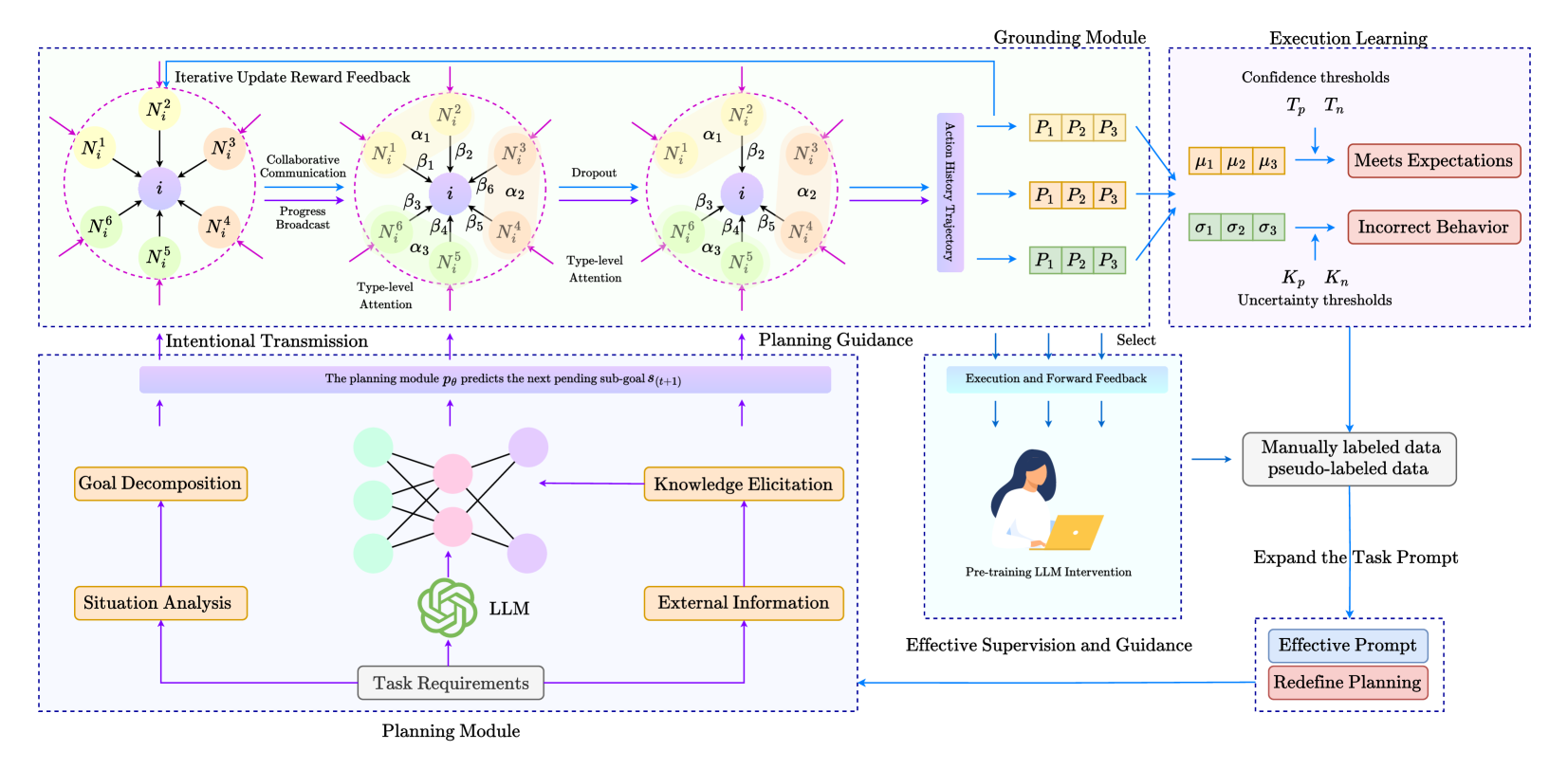
The image presents a system diagram illustrating an enhanced Large Language Model (LLM) planning and execution framework. It details the interaction between a Planning Module, a Grounding Module, and an Execution Learning component, emphasizing iterative feedback loops and attention mechanisms.
### Components/Axes
* **Modules:**
* Planning Module (bottom): Responsible for task decomposition, knowledge elicitation, and generating plans based on task requirements.
* Grounding Module (top-right): Connects the LLM's plans to real-world actions, using action history trajectories.
* Execution Learning (top-right): Evaluates the execution of plans, identifies incorrect behaviors, and refines the system through feedback.
* **Processes:**
* Iterative Update Reward Feedback (top): Refines the attention mechanisms based on the outcomes of actions.
* Intentional Transmission (bottom-center): Represents the flow of information from the Planning Module to guide the Grounding Module.
* Planning Guidance (top-center): Directs the Grounding Module based on the Planning Module's output.
* Effective Supervision and Guidance (bottom-center): Provides human intervention and feedback to improve the LLM's performance.
* **Nodes:**
* Nodes labeled N<sub>i</sub><sup>1</sup> to N<sub>i</sub><sup>6</sup> represent different aspects or features considered by the attention mechanisms.
* Nodes labeled α<sub>1</sub> to α<sub>3</sub> and β<sub>1</sub> to β<sub>6</sub> represent attention weights or parameters.
* **Data Flow:**
* Purple arrows indicate the flow of information and control signals between modules and processes.
* Blue arrows indicate feedback loops and refinement processes.
### Detailed Analysis
* **Planning Module (Bottom):**
* Inputs: Task Requirements (gray rectangle), Situation Analysis (orange rectangle), External Information (orange rectangle).
* Processes: Goal Decomposition (orange rectangle), Knowledge Elicitation (orange rectangle).
* Core: LLM (green stylized icon).
* Output: The planning module p<sub>θ</sub> predicts the next pending sub-goal s<sub>(t+1)</sub> (lavender rectangle).
* **Attention Mechanisms (Top-Center):**
* Collaborative Communication: Nodes N<sub>i</sub><sup>1</sup> to N<sub>i</sub><sup>6</sup> communicate with a central node 'i' (purple).
* Type-level Attention: Nodes N<sub>i</sub><sup>1</sup> to N<sub>i</sub><sup>6</sup> are associated with attention weights α<sub>1</sub> to α<sub>3</sub> and β<sub>1</sub> to β<sub>6</sub>.
* Dropout: Represents a regularization technique where some nodes are randomly dropped during training.
* **Grounding Module (Top-Right):**
* Input: Action History Trajectory (purple rectangle).
* Process: Transforms plans into actions P<sub>1</sub>, P<sub>2</sub>, P<sub>3</sub> (orange and green rectangles).
* **Execution Learning (Top-Right):**
* Confidence Thresholds: T<sub>p</sub>, T<sub>n</sub>.
* Evaluation: Compares predicted outcomes (μ<sub>1</sub>, μ<sub>2</sub>, μ<sub>3</sub> - orange rectangles; σ<sub>1</sub>, σ<sub>2</sub>, σ<sub>3</sub> - green rectangles) with actual results.
* Outcomes:
* Meets Expectations (red rectangle).
* Incorrect Behavior (red rectangle).
* Uncertainty Thresholds: K<sub>p</sub>, K<sub>n</sub>.
* **Feedback Loops:**
* Iterative Update Reward Feedback: Refines the attention mechanisms based on the outcomes of actions.
* Execution and Forward Feedback: Provides feedback to the Planning Module.
* Effective Supervision and Guidance: Allows for human intervention to correct and refine the LLM's behavior.
* Expand the Task Prompt: Modifies the task prompt based on the LLM's performance.
* Redefine Planning: Adjusts the planning strategy based on the LLM's performance.
* **Effective Supervision and Guidance (Bottom-Center):**
* Includes a visual representation of a person using a laptop, labeled "Pre-training LLM Intervention".
### Key Observations
* The diagram emphasizes the iterative nature of the planning and execution process, with multiple feedback loops for refinement.
* Attention mechanisms play a crucial role in focusing the LLM's resources on the most relevant aspects of the task.
* Human intervention is incorporated to provide supervision and guidance, ensuring the LLM's behavior aligns with desired outcomes.
* The system incorporates mechanisms for handling uncertainty and correcting incorrect behaviors.
### Interpretation
The diagram illustrates a sophisticated framework for enhancing LLM planning and execution. By incorporating attention mechanisms, feedback loops, and human supervision, the system aims to improve the LLM's ability to generate effective plans and execute them successfully in real-world scenarios. The iterative nature of the process allows the LLM to learn from its mistakes and refine its planning strategies over time. The inclusion of a Grounding Module bridges the gap between the LLM's abstract plans and concrete actions, enabling it to interact with the environment effectively. The system's ability to handle uncertainty and correct incorrect behaviors makes it more robust and reliable.