\n
## Diagram: Iterative Planning and Execution Framework
### Overview
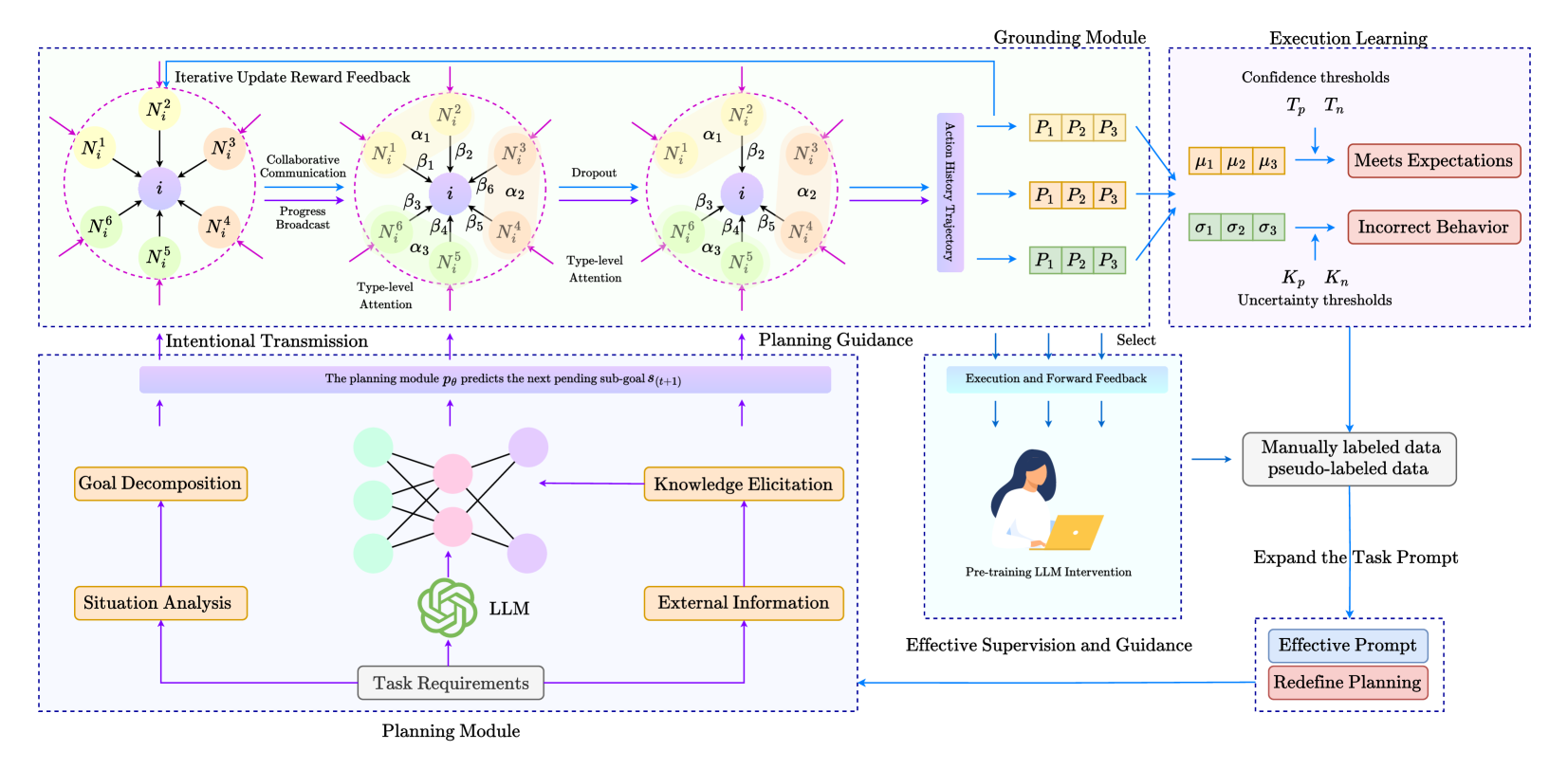
This diagram illustrates an iterative planning and execution framework, likely for a Large Language Model (LLM) based agent. The framework consists of a Planning Module and a Grounding Module, with iterative feedback loops between them and an Execution Learning component. The diagram emphasizes the interplay between goal decomposition, knowledge elicitation, planning guidance, and execution monitoring.
### Components/Axes
The diagram is segmented into three main modules:
* **Planning Module (Bottom):** Contains "Situation Analysis", "Task Requirements", "Goal Decomposition", "LLM", "Knowledge Elicitation", and "External Information".
* **Intentional Transmission/Planning Guidance (Center):** Connects the Planning Module to the Grounding Module. Includes elements like "Type-level Attention", "Dropout", and "Iterative Update Reward Feedback".
* **Grounding Module (Right):** Contains "Execution Learning", "Action History Trajectory", and "Confidence/Uncertainty Thresholds".
Key labels and text elements include:
* "Iterative Update Reward Feedback"
* "Collaborative Communication"
* "Progress Broadcast"
* "Type-level Attention" (appears twice, with slight variations)
* "Dropout"
* "Intentional Transmission"
* "Planning Guidance" - "The planning module predicts the next pending sub-goal s(t+1)"
* "Action History Trajectory"
* "Confidence thresholds: T<sub>p</sub>, T<sub>n</sub>"
* "Meets Expectations: μ<sub>1</sub>, μ<sub>2</sub>, μ<sub>3</sub>"
* "Incorrect Behavior: σ<sub>1</sub>, σ<sub>2</sub>, σ<sub>3</sub>"
* "Uncertainty thresholds: K<sub>p</sub>, K<sub>n</sub>"
* "Manually labeled data pseudo-labeled data"
* "Expand the Task Prompt"
* "Effective Supervision and Guidance"
* "Effective Prompt"
* "Redefine Planning"
* Nodes labeled N<sup>1</sup> through N<sup>6</sup> (appearing multiple times)
* Nodes labeled α<sub>1</sub> through α<sub>3</sub> (appearing multiple times)
* Nodes labeled β<sub>1</sub> through β<sub>3</sub> (appearing multiple times)
* "Pre-training LLM Intervention"
### Detailed Analysis or Content Details
The diagram depicts a cyclical process.
**Planning Module:**
* "Situation Analysis" and "Task Requirements" feed into the "LLM".
* The LLM outputs to "Goal Decomposition" and "Knowledge Elicitation".
* "Knowledge Elicitation" incorporates "External Information".
* Both "Goal Decomposition" and "Knowledge Elicitation" contribute to the "Intentional Transmission" stage.
**Intentional Transmission/Planning Guidance:**
* The "Intentional Transmission" stage involves a network of nodes (N<sup>1</sup>-N<sup>6</sup>, α<sub>1</sub>-α<sub>3</sub>, β<sub>1</sub>-β<sub>3</sub>) arranged in two parallel pathways.
* The left pathway shows nodes N<sup>1</sup>, N<sup>2</sup>, N<sup>3</sup>, N<sup>4</sup>, N<sup>5</sup>, N<sup>6</sup> connected by arrows.
* The right pathway shows nodes N<sup>1</sup>, N<sup>2</sup>, N<sup>3</sup>, N<sup>4</sup>, N<sup>5</sup>, N<sup>6</sup> connected by arrows.
* "Type-level Attention" and "Dropout" are applied within these pathways.
* "Iterative Update Reward Feedback" provides input to this stage.
**Grounding Module:**
* "Planning Guidance" feeds into the "Action History Trajectory".
* The "Action History Trajectory" is represented as a series of states P<sub>1</sub>, P<sub>2</sub>, P<sub>3</sub>, repeated three times.
* "Execution Learning" uses these states to determine "Meets Expectations" (μ<sub>1</sub>, μ<sub>2</sub>, μ<sub>3</sub>) or "Incorrect Behavior" (σ<sub>1</sub>, σ<sub>2</sub>, σ<sub>3</sub>) based on "Confidence" and "Uncertainty" thresholds.
* The "Execution Learning" component then influences the "Expand the Task Prompt" and "Redefine Planning" stages, completing the cycle.
* "Pre-training LLM Intervention" provides input to "Effective Supervision and Guidance".
### Key Observations
* The diagram emphasizes iterative refinement through feedback loops.
* The parallel pathways in the "Intentional Transmission" stage suggest exploration of multiple planning options.
* The use of confidence and uncertainty thresholds indicates a probabilistic approach to execution monitoring.
* The integration of manually labeled data with pseudo-labeled data suggests a semi-supervised learning approach.
* The diagram is highly conceptual and does not provide specific numerical data.
### Interpretation
This diagram represents a sophisticated framework for controlling an LLM-based agent. The core idea is to move beyond simple prompt engineering and towards a more robust, iterative planning and execution process. The "Planning Module" acts as the agent's reasoning engine, decomposing goals and leveraging external knowledge. The "Grounding Module" provides a mechanism for evaluating the agent's actions and providing feedback, allowing it to learn from its mistakes and refine its plans.
The "Intentional Transmission" stage, with its parallel pathways and attention mechanisms, suggests a process of exploring multiple potential plans and selecting the most promising one. The use of confidence and uncertainty thresholds in the "Execution Learning" component indicates a nuanced understanding of the agent's capabilities and limitations.
The diagram highlights the importance of both supervised learning (through manually labeled data) and unsupervised learning (through pseudo-labeled data) in training the agent. The feedback loops between the "Grounding Module" and the "Planning Module" suggest a continuous learning process, where the agent constantly adapts its plans based on its experiences.
The diagram is a high-level overview and does not provide details on the specific algorithms or techniques used in each component. However, it provides a valuable conceptual framework for understanding how an LLM-based agent can be designed to perform complex tasks in a reliable and efficient manner. The diagram suggests a system designed for continual improvement and adaptation, rather than a static, pre-programmed solution.