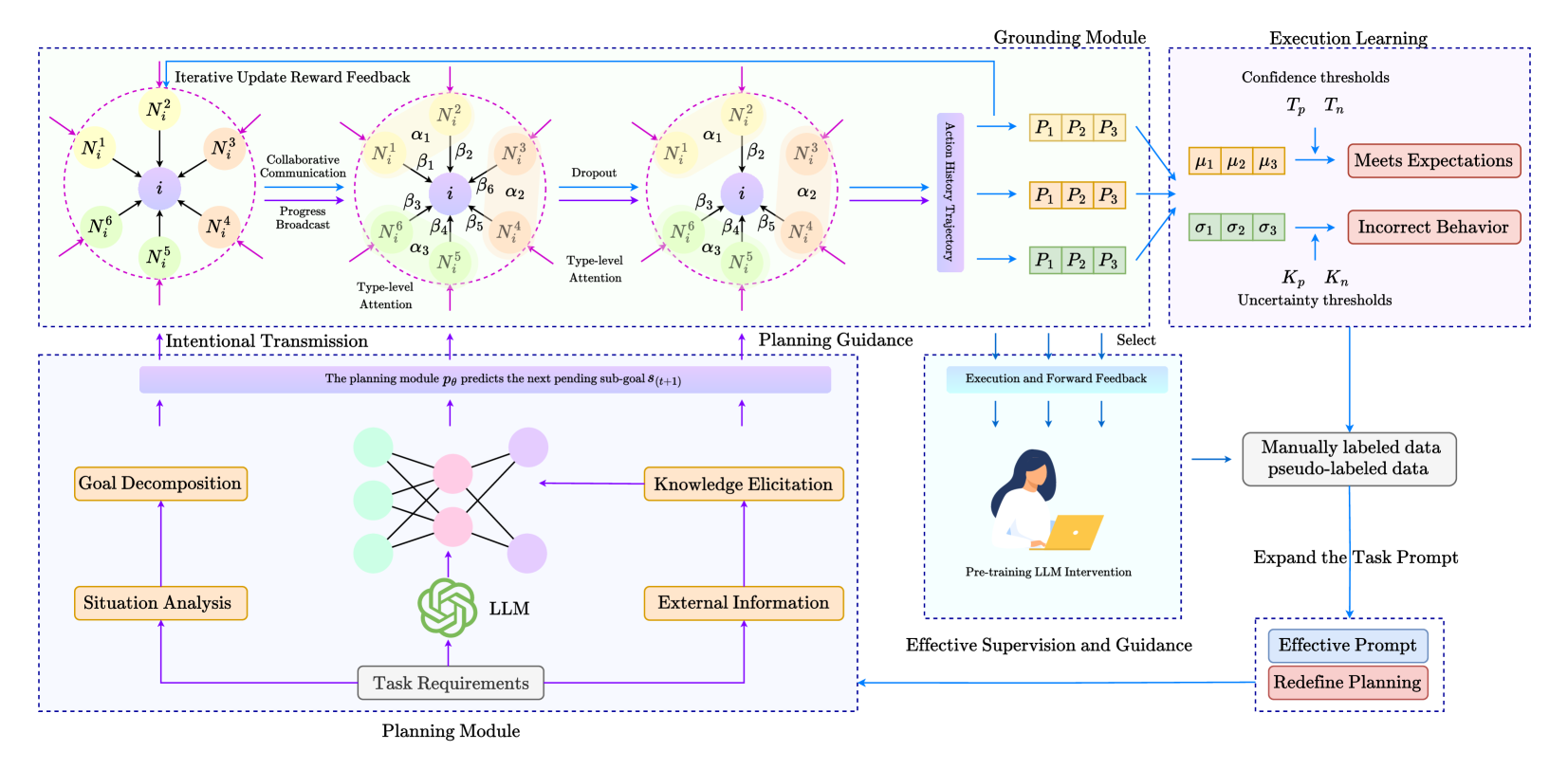
## Diagram: Multi-Stage AI System Architecture with Human-in-the-Loop Supervision
### Overview
The diagram illustrates a complex AI system architecture divided into four interconnected modules: Planning Module, Grounding Module, Execution Learning, and Effective Supervision and Guidance. The system emphasizes iterative feedback loops, human oversight, and adaptive learning through confidence/uncertainty thresholds.
### Components/Axes
1. **Planning Module** (Bottom Left)
- **Goal Decomposition**: Breaks down high-level goals into sub-goals
- **Situation Analysis**: Evaluates current state/context
- **Task Requirements**: Defines operational constraints
- **LLM (Large Language Model)**: Core processing unit
- **Knowledge Elicitation**: Extracts domain-specific knowledge
- **External Information**: Integrates real-world data
- **Intentional Transmission**: Predicts next sub-goal (s(t+1))
2. **Grounding Module** (Top Left)
- **Iterative Update Reward Feedback**: Adjusts performance metrics
- **Collaborative Communication**: Enables agent coordination
- **Progress Broadcast**: Shares status updates
- **Type-level Attention**: Focuses on critical elements
- **Dropout**: Introduces stochasticity for robustness
- **Action History Trajectory**: Tracks past decisions
3. **Execution Learning** (Top Right)
- **Confidence Thresholds (T_p, T_n)**: Determines action validity
- **Uncertainty Thresholds (K_p, K_n)**: Manages risk assessment
- **Meets Expectations**: Successful outcomes
- **Incorrect Behavior**: Failure cases
4. **Effective Supervision and Guidance** (Bottom Right)
- **Pre-training LLM Intervention**: Human-guided model training
- **Manually labeled data**: Ground truth dataset
- **Pseudo-labeled data**: Automated annotations
- **Expand the Task Prompt**: Enhances task understanding
- **Effective Prompt**: Optimized input formulation
- **Redefine Planning**: Iterative strategy adjustment
### Detailed Analysis
- **Flow Direction**:
- Planning → Grounding → Execution → Supervision
- Feedback loops connect Execution Learning back to Planning Module
- Human intervention occurs at multiple stages (pre-training, supervision)
- **Color Coding**:
- Blue: Intentional Transmission/Planning Guidance
- Purple: Collaborative Communication/Action History
- Green: Type-level Attention/Effective Supervision
- Orange: Knowledge Elicitation/External Information
- **Key Connections**:
- Planning Module's LLM output feeds into Grounding Module's Type-level Attention
- Execution Learning's confidence thresholds influence Planning Module's sub-goal prediction
- Human supervision directly impacts all modules through data labeling and prompt engineering
### Key Observations
1. **Iterative Nature**: The system emphasizes continuous improvement through feedback loops
2. **Human-AI Collaboration**: Multiple points of human intervention (pre-training, supervision, prompt engineering)
3. **Risk Management**: Explicit confidence/uncertainty thresholds suggest safety-critical applications
4. **Modular Design**: Clear separation of concerns between planning, execution, and supervision
### Interpretation
This architecture represents a sophisticated AI system designed for complex, dynamic environments requiring:
1. **Adaptive Planning**: Continuous sub-goal prediction and adjustment
2. **Robust Execution**: Confidence-based decision making with uncertainty quantification
3. **Human Oversight**: Critical intervention points for training and supervision
4. **Collaborative Intelligence**: Agent coordination through progress broadcasting
The system's strength lies in its ability to balance autonomous operation with human guidance, particularly through the integration of manually labeled data and pseudo-labeling techniques. The confidence/uncertainty thresholds suggest applications where safety and reliability are paramount, such as autonomous systems or medical diagnostics.
The diagram implies a Peircean investigative approach where the AI system continuously tests hypotheses (sub-goals) against reality (execution feedback), refining its understanding through iterative cycles of action and observation.