## Technical Document: Problem-Solving Examples in Physics and Spatial Reasoning
### Overview
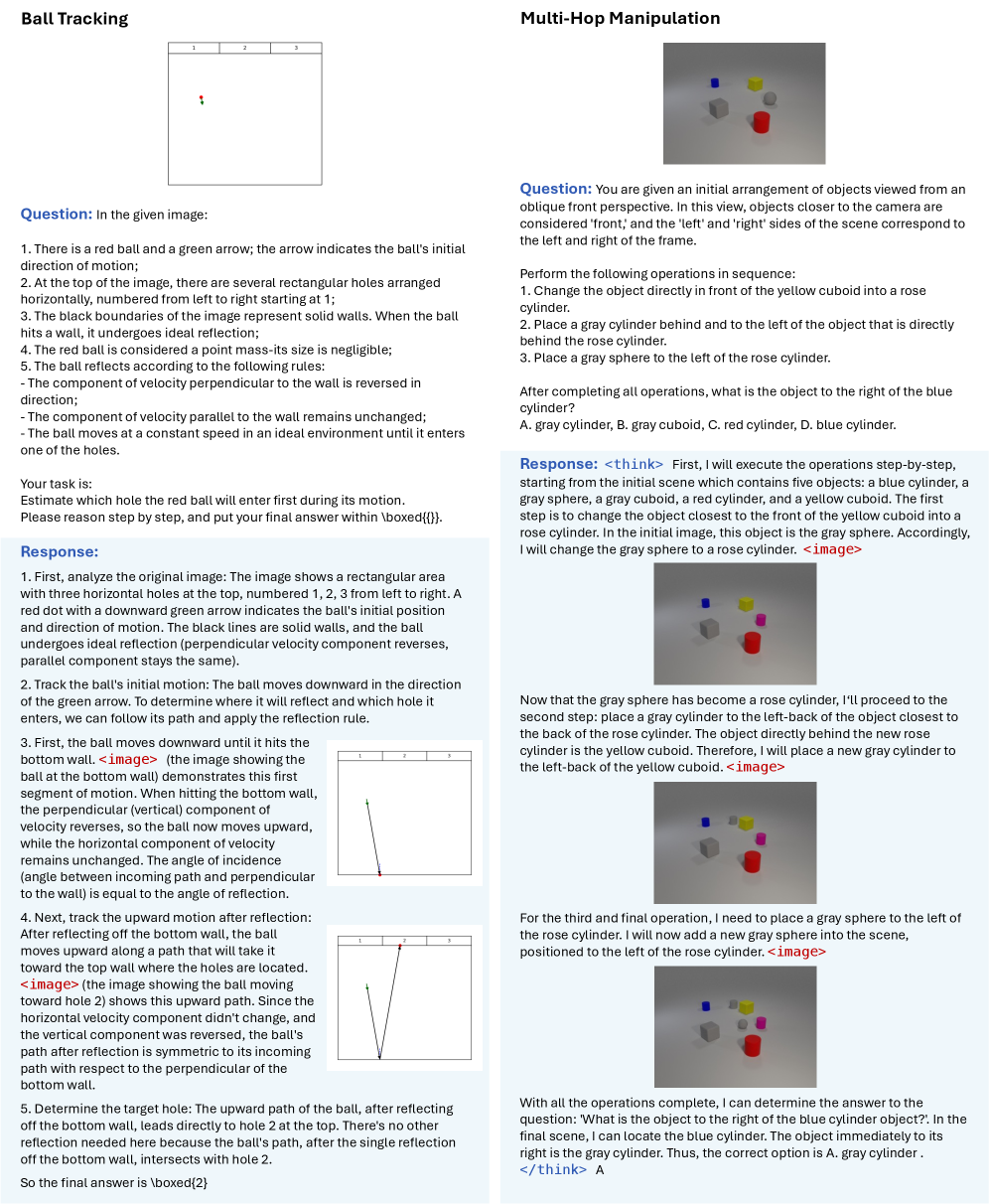
The image is a composite technical document presenting two distinct problem-solving examples. The left section, titled "Ball Tracking," involves a 2D physics problem about a ball reflecting off walls to determine which hole it enters. The right section, titled "Multi-Hop Manipulation," involves a 3D spatial reasoning problem about manipulating objects in a scene. Both sections include a problem statement, a step-by-step response with embedded illustrative images, and a final answer.
### Components/Axes
The document is divided into two primary columns:
**Left Column: Ball Tracking**
* **Title:** "Ball Tracking"
* **Diagram:** A simple 2D schematic showing a rectangular area with three numbered holes (1, 2, 3) at the top. A red dot (ball) with a downward-pointing green arrow (initial velocity) is positioned in the lower-left area. Black lines represent solid walls.
* **Question Text:** A numbered list (1-5) defining the scenario, rules, and the task: "Estimate which hole the red ball will enter first during its motion."
* **Response Text:** A numbered list (1-5) providing a step-by-step solution, referencing embedded images.
* **Embedded Images:** Three smaller versions of the main diagram, illustrating the ball's path at different stages: initial motion, after hitting the bottom wall, and moving toward hole 2.
* **Final Answer:** "So the final answer is \boxed{2}"
**Right Column: Multi-Hop Manipulation**
* **Title:** "Multi-Hop Manipulation"
* **Diagram:** A 3D rendered scene viewed from an oblique front perspective. Initial objects include a blue cylinder, gray sphere, gray cuboid, red cylinder, and yellow cuboid on a gray plane.
* **Question Text:** Describes the initial scene and lists three sequential operations to perform. The final question is: "After completing all operations, what is the object to the right of the blue cylinder?" with multiple-choice options (A. gray cylinder, B. gray cuboid, C. red cylinder, D. blue cylinder).
* **Response Text:** A narrative walkthrough of each operation, referencing embedded images that show the scene after each step.
* **Embedded Images:** Three 3D rendered scenes showing the state after each of the three operations.
* **Final Answer:** "Thus, the correct option is A. gray cylinder."
### Detailed Analysis
**Ball Tracking Problem:**
1. **Initial State:** A red ball is at a starting position with an initial velocity vector pointing straight down (indicated by a green arrow).
2. **Environment:** A rectangular enclosure with solid walls (black lines) and three target holes (1, 2, 3) on the top wall.
3. **Physics Rules:** Ideal reflection. The component of velocity perpendicular to a wall reverses direction upon impact, while the parallel component remains unchanged. The ball moves at constant speed.
4. **Solution Path:**
* The ball moves downward until it hits the bottom wall.
* Upon reflection, its vertical velocity component reverses (now moving upward), while its horizontal component is unchanged.
* The path after reflection is symmetric to the incoming path relative to the point of impact on the bottom wall.
* This symmetric upward path leads directly to hole #2 on the top wall.
5. **Conclusion:** The ball enters hole 2 first.
**Multi-Hop Manipulation Problem:**
1. **Initial Scene (from text description):** Contains five objects: a blue cylinder, a gray sphere, a gray cuboid, a red cylinder, and a yellow cuboid.
2. **Operation 1:** "Change the object directly in front of the yellow cuboid into a rose cylinder."
* **Execution:** The gray sphere is identified as being in front of the yellow cuboid. It is transformed into a rose cylinder.
3. **Operation 2:** "Place a gray cylinder behind and to the left of the object that is directly behind the rose cylinder."
* **Execution:** The object directly behind the new rose cylinder is the yellow cuboid. A new gray cylinder is placed behind and to the left of the yellow cuboid.
4. **Operation 3:** "Place a gray sphere to the left of the rose cylinder."
* **Execution:** A new gray sphere is added to the scene, positioned to the left of the rose cylinder.
5. **Final Query:** Identify the object to the right of the blue cylinder in the final scene.
* **Analysis:** In the final configuration, the blue cylinder is present. The object immediately to its right is the gray cylinder placed in Operation 2.
6. **Conclusion:** The correct answer is A. gray cylinder.
### Key Observations
* **Pedagogical Structure:** Both examples follow a clear "problem → step-by-step reasoning → solution" format, making them effective for teaching problem-solving methodologies.
* **Visual Reasoning:** Each problem heavily relies on interpreting and manipulating visual information—2D trajectories in one, 3D object relationships in the other.
* **Implicit Information:** The "Multi-Hop" problem requires inferring spatial prepositions ("in front of," "behind and to the left") from a single 2D image of a 3D scene, which is a non-trivial cognitive task.
* **Precision in Language:** The problems use precise, operational language ("ideal reflection," "directly in front of," "behind and to the left") to define unambiguous tasks.
### Interpretation
This document serves as a demonstration of **structured analytical reasoning** applied to two different domains: classical mechanics and 3D spatial manipulation.
* **Underlying Principles:** The "Ball Tracking" problem tests understanding of vector decomposition and the law of reflection. The solution hinges on recognizing the symmetry of the path after a single reflection. The "Multi-Hop Manipulation" problem tests sequential logic and spatial relationship tracking. It requires maintaining an accurate mental model of a changing scene.
* **Relationship Between Elements:** In both cases, the initial conditions and rules are fully defined in the question. The response then acts as a **proof of work**, showing how the final answer is logically derived from those premises without external knowledge. The embedded images are not decorative; they are critical evidence supporting each step of the reasoning.
* **Notable Patterns:** The solutions avoid complex calculations. Instead, they rely on **geometric insight** (symmetry of reflection) and **careful bookkeeping** (tracking object identities and positions through transformations). This highlights that the core challenge is logical structuring, not computational power.
* **Broader Context:** These types of problems are foundational in fields like physics education, robotics (path planning and object manipulation), and artificial intelligence (testing spatial reasoning and multi-step planning capabilities). The document likely originates from a technical paper, textbook, or AI benchmarking suite designed to evaluate or teach systematic problem-solving skills.