## Ball Tracking and Multi-Hop Manipulation
### Overview
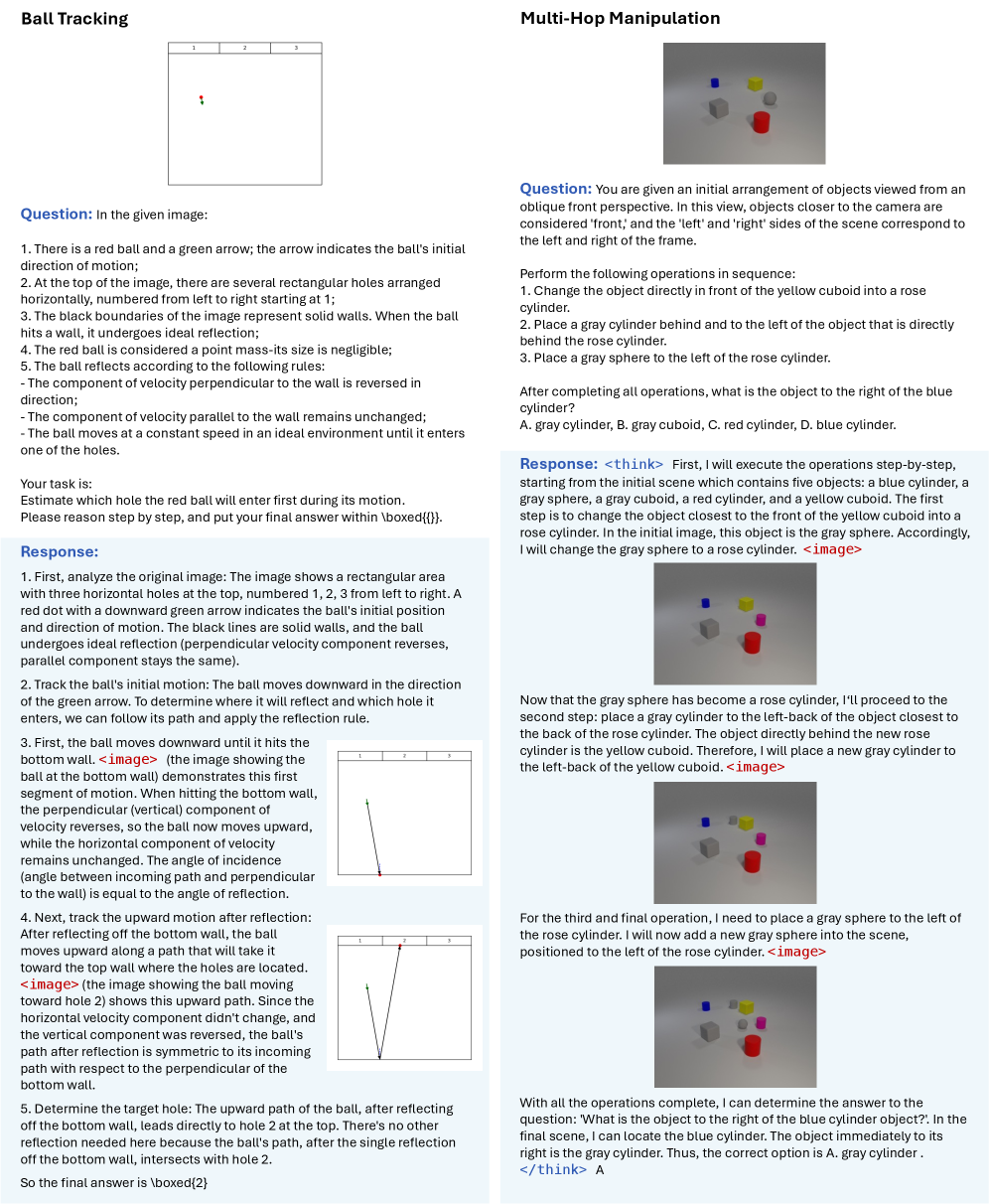
The image presents two distinct problem-solving scenarios: "Ball Tracking" and "Multi-Hop Manipulation." The "Ball Tracking" section involves predicting the trajectory of a ball reflecting off walls to enter a numbered hole. The "Multi-Hop Manipulation" section describes a sequence of object manipulations in a 3D scene and asks for the final configuration.
### Components/Axes
**Ball Tracking:**
* **Question:** Poses the problem of predicting which numbered hole the ball will enter.
* **Given Information:**
* A red ball and a green arrow indicating the ball's initial direction.
* Three rectangular holes numbered 1, 2, and 3 from left to right.
* Black boundaries representing solid walls with ideal reflection.
* The ball is considered a point mass.
* Reflection rules: perpendicular velocity component reverses, parallel component remains unchanged, constant speed.
* **Response:** Provides a step-by-step analysis of the ball's trajectory, including:
* Initial analysis of the image.
* Tracking the ball's initial motion.
* Description of the ball's movement after hitting the bottom wall.
* Tracking the upward motion after reflection.
* Determining the target hole.
* **Diagrams:** Two diagrams showing the ball's trajectory:
* First diagram: Ball moving downward and hitting the bottom wall.
* Second diagram: Ball moving upward towards hole 2 after reflection.
**Multi-Hop Manipulation:**
* **Question:** Describes an initial arrangement of objects in a 3D scene and asks for the object to the right of the blue cylinder after a series of manipulations.
* **Given Information:**
* Objects are viewed from an oblique front perspective.
* Objects closer to the camera are considered 'front'.
* 'Left' and 'right' sides correspond to the frame's left and right.
* **Operations:**
1. Change the object directly in front of the yellow cuboid into a rose cylinder.
2. Place a gray cylinder behind and to the left of the object directly behind the rose cylinder.
3. Place a gray sphere to the left of the rose cylinder.
* **Response:** Provides a step-by-step execution of the operations, including:
* Initial scene description with five objects: blue cylinder, gray sphere, gray cuboid, red cylinder, and yellow cuboid.
* Changing the gray sphere to a rose cylinder.
* Placing a gray cylinder to the left-back of the yellow cuboid.
* Adding a gray sphere to the left of the rose cylinder.
* **Diagrams:** Four diagrams showing the scene after each manipulation step.
### Detailed Analysis or ### Content Details
**Ball Tracking:**
* The initial position of the red ball is in the top-left quadrant of the rectangular area.
* The green arrow indicates a downward and slightly rightward direction.
* The ball's trajectory involves a single reflection off the bottom wall.
* The final answer, \boxed{2}, indicates that the ball will enter hole number 2.
**Multi-Hop Manipulation:**
* The initial scene contains five objects with distinct colors and shapes.
* The first operation transforms the gray sphere into a rose cylinder.
* The second operation places a gray cylinder behind and to the left of the yellow cuboid.
* The third operation adds a gray sphere to the left of the rose cylinder.
* The final answer, A, indicates that the object to the right of the blue cylinder is a gray cylinder.
### Key Observations
**Ball Tracking:**
* The problem relies on understanding basic physics principles of reflection.
* The diagrams visually represent the ball's trajectory.
* The step-by-step reasoning leads to the correct answer.
**Multi-Hop Manipulation:**
* The problem requires spatial reasoning and following instructions carefully.
* The diagrams illustrate the changes in the scene after each operation.
* The step-by-step execution ensures the correct final configuration.
### Interpretation
**Ball Tracking:**
The "Ball Tracking" problem demonstrates the application of physics principles to predict the motion of an object. It highlights the importance of understanding reflection rules and visualizing trajectories. The problem is designed to test logical reasoning and problem-solving skills.
**Multi-Hop Manipulation:**
The "Multi-Hop Manipulation" problem assesses spatial reasoning and the ability to follow a sequence of instructions. It emphasizes the importance of visualizing 3D scenes and understanding relative positions of objects. The problem is designed to test cognitive skills related to spatial awareness and sequential processing.