\n
## Textual Document: Ball Tracking & Multi-Hop Manipulation - Problem & Solution
### Overview
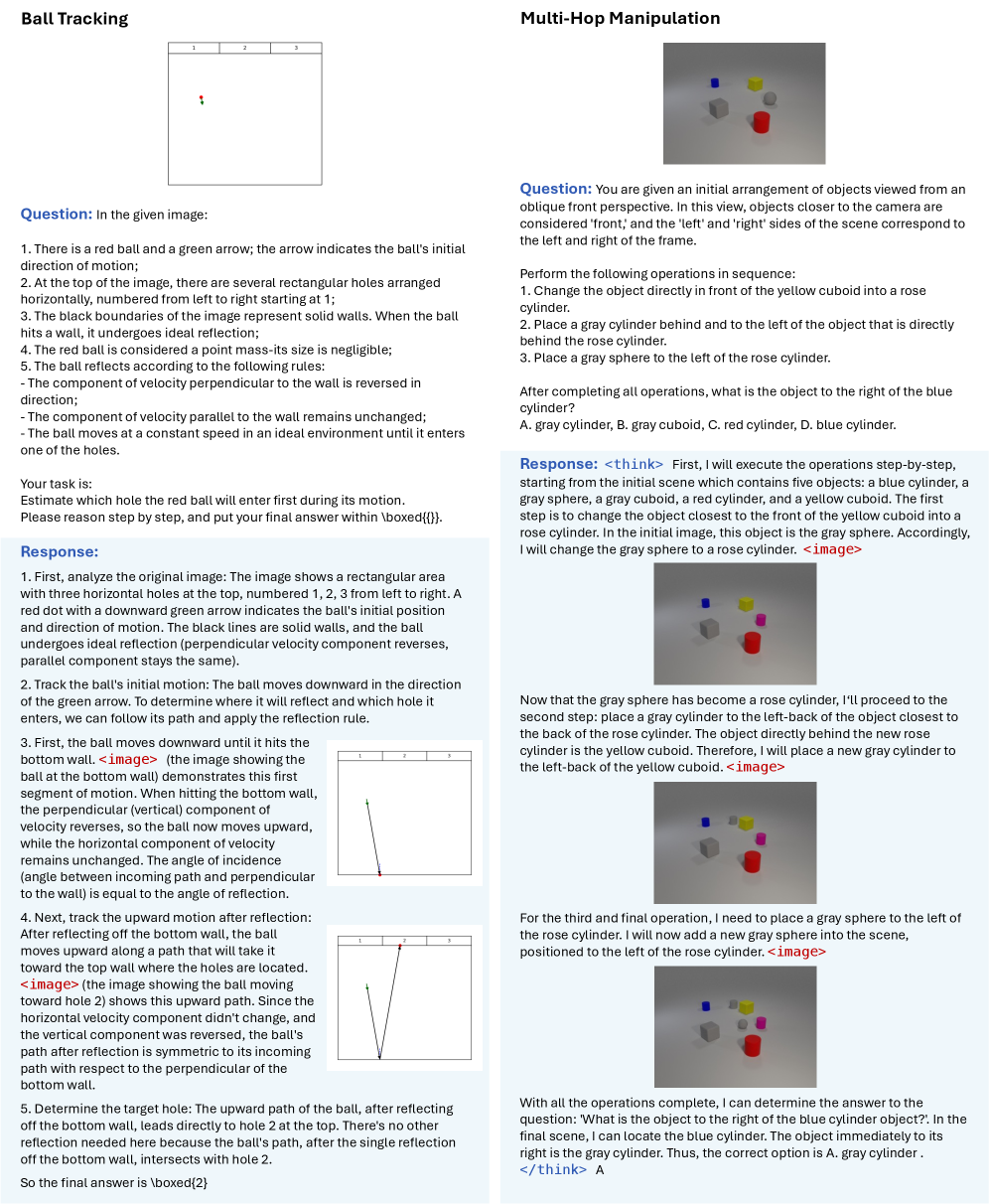
The image presents two distinct textual blocks: one detailing a "Ball Tracking" problem with a provided solution, and another describing a "Multi-Hop Manipulation" problem with its solution. Both sections include a question, a response, and supporting reasoning. The layout is a two-column format.
### Components/Axes
The image does not contain charts, diagrams, or axes. It consists entirely of text.
### Detailed Analysis or Content Details
**Left Column: Ball Tracking**
* **Question:**
1. There is a red ball and a green arrow; the arrow indicates the ball’s initial direction of motion.
2. At the image numbered from left to right starting at 1;
3. The black boundaries of the image represent solid walls. When the ball hits a wall, it undergoes ideal reflection;
4. The red ball is considered a point mass—its size is negligible;
5. The ball reflects according to the following rules:
* The component of velocity perpendicular to the wall is reversed in direction;
* The component of velocity parallel to the wall remains unchanged;
* The ball moves at a constant speed in an ideal environment until it enters one of the holes.
6. Your task is: Estimate which hole the red ball will enter during its motion. Please reason step by step, and put your final answer within box([ ]).
* **Response:**
1. Firstly, analyze the original image: The image shows a rectangular area with three horizontal holes at the top, numbered 1, 2, 3 from left to right. A red dot with a downward green arrow indicates the ball’s initial position and direction of motion. The black lines are solid walls, and the ball undergoes ideal reflection (perpendicular velocity component reverses, parallel component stays the same).
2. Track the ball’s motion: The ball moves downward in the direction of the green arrow. To determine where it will exit, consider the following:
* The ball will first hit the bottom wall.
* Upon hitting the bottom wall, the vertical component of its velocity will reverse, sending it upwards.
* It will then hit the top wall.
* Upon hitting the top wall, the vertical component of its velocity will reverse again, sending it downwards.
* This process repeats.
3. Estimate the exit hole: Due to the repeated reflections, the ball will follow a zigzag path. The initial downward direction and the reflections suggest the ball will likely enter hole 2.
4. Final Answer: box([2])
* **Additional Text:** "FM-AI" is present in the bottom-left corner.
**Right Column: Multi-Hop Manipulation**
* **Question:** You are given an initial arrangement of objects viewed from an oblique front perspective. In this view, objects closer to the camera are considered 'front' and the 'left' and 'right' sides of the scene correspond to the left and right of the frame.
Perform the following operations in sequence:
1. Change the object directly in front of the yellow cuboid into a rose cylinder.
2. Place a gray cylinder behind and to the left of the object that is directly behind the rose cylinder.
3. Place a gray sphere to the left of the rose cylinder.
After completing all operations, what is the object to the right of the blue cylinder?
A. gray cylinder, B. gray cuboid, C. red cylinder, D. blue cylinder.
* **Response:** `<think> First, I will execute the operations step-by-step, starting from the initial scene which contains five objects: a blue cylinder, a gray sphere, a gray cuboid, a red cylinder, and a yellow cuboid. The first step is to change the object closest to the front of the yellow cuboid into a rose cylinder. In the initial image, this object is the gray sphere. Accordingly, I will change the gray sphere to a rose cylinder.</image>`
* **Additional Text:** "FM-AI" is present in the bottom-right corner.
### Key Observations
Both sections demonstrate a problem-solving approach. The "Ball Tracking" section involves spatial reasoning and physics principles (reflection). The "Multi-Hop Manipulation" section requires following a sequence of instructions to modify a scene and identify an object based on its relative position. The presence of "FM-AI" in both corners suggests a common origin or context, potentially related to an AI model or framework.
### Interpretation
The image showcases a testing or training scenario for an AI model capable of reasoning and problem-solving. The "Ball Tracking" problem assesses the model's understanding of physics and spatial dynamics. The "Multi-Hop Manipulation" problem tests the model's ability to follow instructions, maintain state, and perform relational reasoning. The inclusion of a "think" step in the "Multi-Hop Manipulation" response suggests the model is designed to articulate its reasoning process. The consistent use of "FM-AI" indicates this is likely a component of a larger system developed by that entity. The problems are designed to be solvable through logical deduction rather than requiring external knowledge. The format (question, response, reasoning) is typical of educational or assessment materials.