## Photographs: Ice Skating Imagery with Captions
### Overview
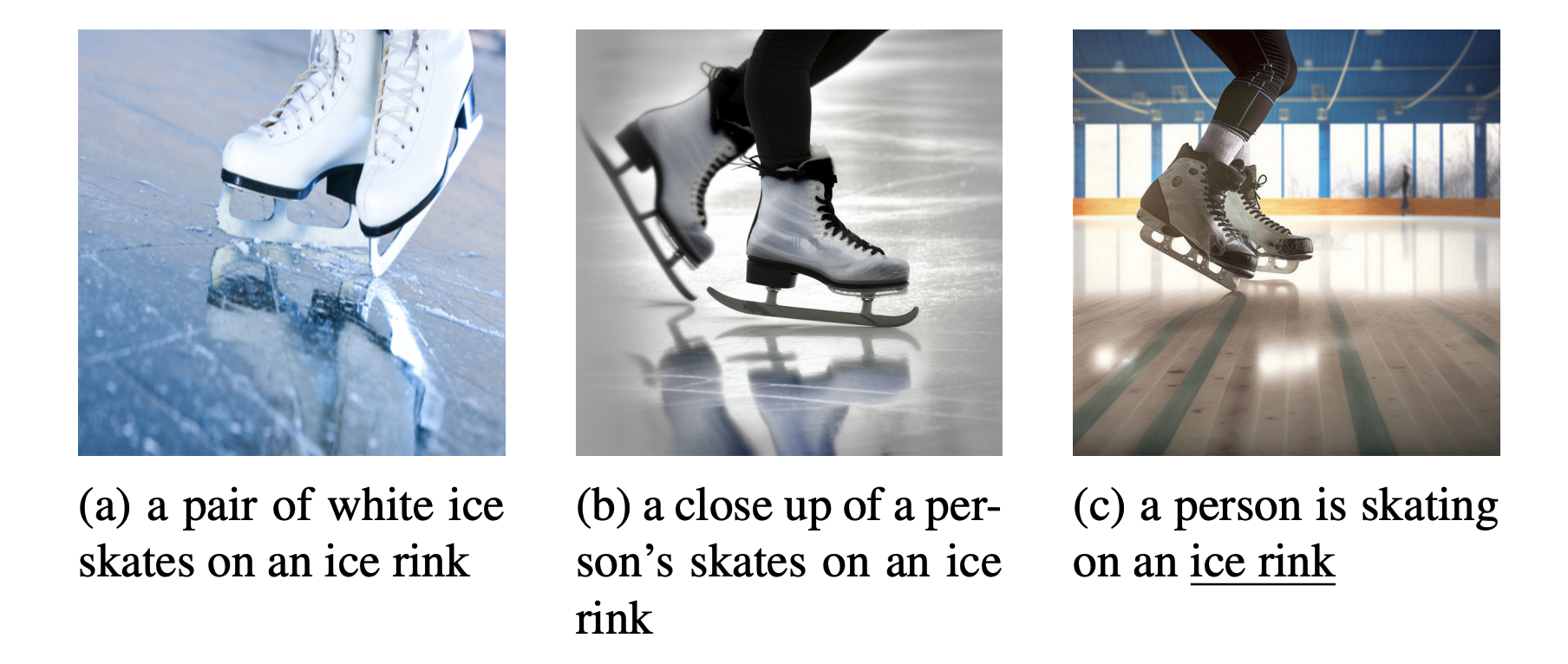
The image is a composite of three separate photographs arranged horizontally in a row. Each photograph depicts a scene related to ice skating and is accompanied by a descriptive caption below it. The overall presentation resembles a figure from a technical or educational document, illustrating different perspectives or stages of ice skating.
### Components/Axes
The image consists of three distinct panels, labeled (a), (b), and (c). Each panel contains a photograph and a corresponding text caption directly beneath it. The captions are in English and use a serif font. The background of the entire composite is white.
**Panel (a):**
* **Image:** A close-up, slightly high-angle shot of a pair of white figure skates resting on an ice surface. The skates are laced with white laces and have blue accents near the heel and blade holder. The ice is reflective, showing a clear mirror image of the skates, and has visible scratches and texture.
* **Caption Text:** `(a) a pair of white ice skates on an ice rink`
**Panel (b):**
* **Image:** A close-up, low-angle action shot focusing on a person's feet and skates. The skates are white with black laces and a distinct heel. The person is wearing black leggings or pants. One skate is lifted slightly off the ice, suggesting motion. The ice surface is smooth and reflective.
* **Caption Text:** `(b) a close up of a person’s skates on an ice rink`
**Panel (c):**
* **Image:** A medium shot of a person actively skating on an indoor ice rink. The skater's lower body and skates are visible. The skates are white with black accents and laces. The person is wearing dark leggings. The background shows the boards of the rink, large windows, and overhead lighting, confirming an indoor setting. The ice has painted lines (green and blue).
* **Caption Text:** `(c) a person is skating on an <u>ice rink</u>` (Note: The words "ice rink" are underlined in the original caption).
### Detailed Analysis
* **Panel (a) Analysis:** This is a static, product-focused image. The primary subjects are the two white ice skates, positioned side-by-side. The composition emphasizes the equipment itself. The reflective ice surface adds depth and context.
* **Panel (b) Analysis:** This image shifts focus to the skates in use, worn by a person. The close crop and low angle create a dynamic feel, emphasizing the connection between the skater and the ice. The black laces and leggings create a strong visual contrast against the white skates and ice.
* **Panel (c) Analysis:** This is the widest shot, placing the activity in its full environment. It shows the skater in motion within the context of a public or sports rink. The underlined phrase "ice rink" in the caption draws specific attention to the location. The painted lines on the ice suggest it may be a multi-use facility.
### Key Observations
1. **Progression of Context:** The three images show a logical progression: from the equipment alone (a), to the equipment being worn (b), to the equipment being used in its intended environment (c).
2. **Visual Consistency:** All three photographs feature white ice skates as the central subject, creating a cohesive theme.
3. **Textual Emphasis:** The underlining of "ice rink" in caption (c) is a deliberate textual emphasis not present in the other captions.
4. **Setting Variation:** Panel (a) and (b) have ambiguous ice surfaces (could be outdoor or indoor), while panel (c) explicitly shows an indoor rink environment.
### Interpretation
This composite image serves as a visual glossary or instructional aid. It deconstructs the concept of "ice skating" into its constituent visual elements: the tool (the skate), the user (the skater's foot), and the activity in context (skating on a rink). The captions provide precise, literal descriptions for each view, which is typical for technical documentation, machine learning training data, or educational materials.
The underlining in caption (c) may indicate that "ice rink" is a key term being defined or highlighted, possibly for language learning or as a specific label in a dataset. The sequence suggests a pedagogical approach, building understanding from a simple object to a complex action. The lack of numerical data or charts means the "information" here is purely descriptive and categorical, aimed at establishing clear visual-textual associations.