\n
## Sudoku Puzzle: Partially Filled Grid
### Overview
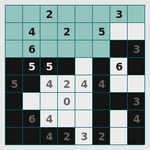
The image presents a partially filled Sudoku puzzle grid. The grid is a 9x9 arrangement of cells, with some cells pre-filled with numbers from 0 to 6. The goal of a Sudoku puzzle is to fill the remaining cells with numbers from 1 to 9, ensuring that each number appears only once in each row, column, and 3x3 subgrid.
### Components/Axes
The image consists of a 9x9 grid. The grid is divided into nine 3x3 subgrids. The cells contain numerical values ranging from 0 to 6. There are no explicit axes or legends.
### Detailed Analysis or Content Details
The following numbers are pre-filled in the grid, listed by row and column (row numbering starts from 1 at the top, column numbering starts from 1 at the left):
* Row 1, Column 2: 2
* Row 1, Column 6: 3
* Row 2, Column 1: 4
* Row 2, Column 3: 2
* Row 2, Column 5: 5
* Row 3, Column 1: 6
* Row 3, Column 5: 3
* Row 4, Column 1: 5
* Row 4, Column 2: 5
* Row 5, Column 2: 4
* Row 5, Column 3: 2
* Row 5, Column 4: 4
* Row 5, Column 5: 4
* Row 6, Column 3: 0
* Row 6, Column 7: 3
* Row 7, Column 1: 6
* Row 7, Column 2: 4
* Row 8, Column 2: 4
* Row 8, Column 3: 2
* Row 8, Column 4: 3
* Row 8, Column 6: 2
* Row 9, Column 4: 4
### Key Observations
The puzzle is in an intermediate state, with a significant number of cells still empty. The presence of '0' in one of the cells is unusual for a standard Sudoku puzzle, which typically uses numbers 1-9. This might indicate a variation of the puzzle or a placeholder value.
### Interpretation
The image represents a logic-based puzzle. The pre-filled numbers provide constraints for solving the puzzle. The '0' value is an anomaly that needs to be considered when attempting to solve the puzzle. The puzzle requires deductive reasoning to determine the correct placement of the remaining numbers, adhering to the Sudoku rules. The puzzle's difficulty depends on the initial configuration of numbers and the complexity of the logical deductions required to solve it.