\n
## Diagram: Causal Directed Acyclic Graph (DAG)
### Overview
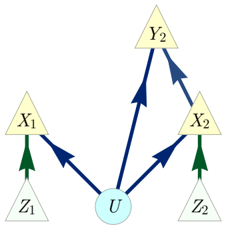
The image displays a directed acyclic graph (DAG), a type of diagram used in statistics, causal inference, and machine learning to represent hypothesized causal relationships between variables. The diagram consists of six nodes connected by directed arrows (edges), indicating the direction of influence or causation.
### Components/Axes
**Nodes (Variables):**
* **Shapes & Colors:**
* Five nodes are represented as **light yellow triangles** with dark outlines. These are labeled: **X₁**, **X₂**, **Y₂**, **Z₁**, **Z₂**.
* One node is represented as a **light blue circle**. It is labeled: **U**.
* **Spatial Placement:**
* **U** is positioned at the bottom center of the diagram.
* **Z₁** is at the bottom-left corner.
* **Z₂** is at the bottom-right corner.
* **X₁** is positioned above and slightly to the right of Z₁.
* **X₂** is positioned above and slightly to the left of Z₂.
* **Y₂** is positioned at the top center, above all other nodes.
**Edges (Relationships):**
* **Color & Direction:**
* **Dark Blue Arrows:** Indicate the primary causal pathways.
* From **U** to **X₁** (upward and left).
* From **U** to **X₂** (upward and right).
* From **U** to **Y₂** (directly upward).
* From **X₁** to **Y₂** (upward and right).
* From **X₂** to **Y₂** (upward and left).
* **Green Arrows:** Indicate a distinct type of relationship, possibly instrumental or exogenous.
* From **Z₁** to **X₁** (directly upward).
* From **Z₂** to **X₂** (directly upward).
### Detailed Analysis
The diagram explicitly maps the following causal structure:
1. **U** is a common cause (confounder) for three variables: **X₁**, **X₂**, and **Y₂**.
2. **Z₁** is a cause of **X₁** only.
3. **Z₂** is a cause of **X₂** only.
4. **Y₂** is a final outcome variable, directly caused by three factors: **X₁**, **X₂**, and **U**.
5. There is no direct arrow from **Z₁** or **Z₂** to **Y₂**, nor between **Z₁** and **Z₂**.
### Key Observations
* **Multiple Paths to Outcome:** The outcome **Y₂** is influenced by three direct causes and has multiple indirect paths (e.g., U → X₁ → Y₂).
* **Color-Coded Edges:** The use of green for arrows from Z₁ and Z₂ visually distinguishes these relationships from the others (blue). This often signifies that Z₁ and Z₂ are **instrumental variables** in an econometric or causal inference context.
* **Common Cause Structure:** The node **U** has arrows pointing to three different nodes, establishing it as a potential source of confounding bias between X₁ and Y₂, and between X₂ and Y₂.
* **Symmetry:** The left (Z₁, X₁) and right (Z₂, X₂) sides of the diagram are structurally symmetrical, both feeding into the central outcome Y₂.
### Interpretation
This diagram is a formal representation of a **causal model**, likely used to illustrate a problem in causal inference, such as estimating the effect of X₁ or X₂ on Y₂ in the presence of an unobserved confounder **U**.
* **What it demonstrates:** The model shows that simply observing a correlation between X₁ and Y₂ would be misleading because both are influenced by the common cause U. The green arrows from Z₁ and Z₂ suggest a potential solution: using these as **instrumental variables**. A valid instrument (like Z₁) affects the outcome (Y₂) only through its effect on the treatment (X₁) and is not correlated with the unobserved confounder (U). This allows researchers to isolate the causal effect of X₁ on Y₂.
* **Relationships:** The core relationship under study is likely the causal effect of **X₁** (and/or **X₂**) on **Y₂**. The diagram explicitly models the complexity introduced by the confounder **U** and proposes a method (via instruments Z₁ and Z₂) to address it.
* **Notable Anomaly/Feature:** The direct arrow from **U** to **Y₂** is critical. It means the confounder affects the outcome through a path that does not go through X₁ or X₂. This is a more challenging scenario for instrumental variable analysis than if U only affected Y₂ through X₁ and X₂. The diagram is therefore likely illustrating a specific, non-trivial causal identification problem.