## Diagram: Interaction Model Between Components K<sub>a</sub> and K<sub>b</sub>
### Overview
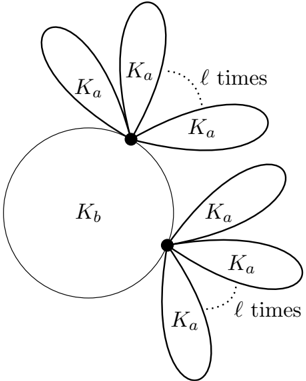
The diagram illustrates a system with two primary components, **K<sub>b</sub>** and **K<sub>a</sub>**, connected through a network of relationships. **K<sub>b</sub>** is a central circular node, while **K<sub>a</sub>** is depicted as a cluster of petal-like structures radiating from a central node. The petals of **K<sub>a</sub>** are labeled identically, and a dotted line connects them, annotated with "ℓ times."
### Components/Axes
- **Central Nodes**:
- **K<sub>b</sub>**: A single large circle on the left side of the diagram.
- **K<sub>a</sub>**: A cluster of petal-like structures on the right side, connected to a central node.
- **Relationships**:
- **K<sub>a</sub> to K<sub>b</sub>**: A single direct connection (solid line) from one petal of **K<sub>a</sub>** to **K<sub>b</sub>**.
- **K<sub>a</sub> to itself**: Three petals labeled **K<sub>a</sub>** are connected via a dotted line annotated with "ℓ times," suggesting repeated interactions or iterations.
- **Annotations**:
- "ℓ times": Indicates a parameter or variable (ℓ) governing the frequency of interactions between the petals of **K<sub>a</sub>**.
### Detailed Analysis
- **K<sub>b</sub>**: Positioned as a standalone node, it appears to act as a hub or recipient of interactions from **K<sub>a</sub>**.
- **K<sub>a</sub>**: The petal-like structures suggest modular or distributed components. The repetition of the label **K<sub>a</sub>** on all petals implies homogeneity within the cluster.
- **ℓ times**: The dotted line connecting the petals of **K<sub>a</sub>** introduces a variable (ℓ) that quantifies the number of interactions or cycles within the **K<sub>a</sub>** cluster. The exact value of ℓ is unspecified but critical to understanding the system's dynamics.
### Key Observations
1. **Asymmetry in Connections**: **K<sub>a</sub>** has three self-interactions (ℓ times) but only one connection to **K<sub>b</sub>**, suggesting a focus on internal processes within **K<sub>a</sub>**.
2. **Label Consistency**: All petals of **K<sub>a</sub>** share the same label, emphasizing uniformity in their roles or functions.
3. **Ambiguity in ℓ**: The parameter ℓ is not numerically defined, leaving its interpretation open (e.g., iterations, frequency, or multiplicity).
### Interpretation
The diagram likely models a system where **K<sub>a</sub>** engages in repeated self-interactions (governed by ℓ) while maintaining a single connection to **K<sub>b</sub>**. This could represent:
- **Modular Systems**: **K<sub>a</sub>** as a distributed module with internal redundancy (ℓ times) and a primary interface with **K<sub>b</sub>**.
- **Network Dynamics**: **K<sub>a</sub>** as a node with self-loops (ℓ times) and a unidirectional link to **K<sub>b</sub>**, possibly in a communication or dependency graph.
- **Process Flow**: **K<sub>a</sub>** processes tasks internally (ℓ times) before forwarding results to **K<sub>b</sub>**.
The absence of a legend or numerical scale for ℓ limits quantitative analysis, but the structure emphasizes the importance of **K<sub>a</sub>**'s internal interactions relative to its external connection to **K<sub>b</sub>**. The use of petal-like shapes for **K<sub>a</sub>** may symbolize modularity or scalability.