## Computer Vision Model Attention Map Visualization
### Overview
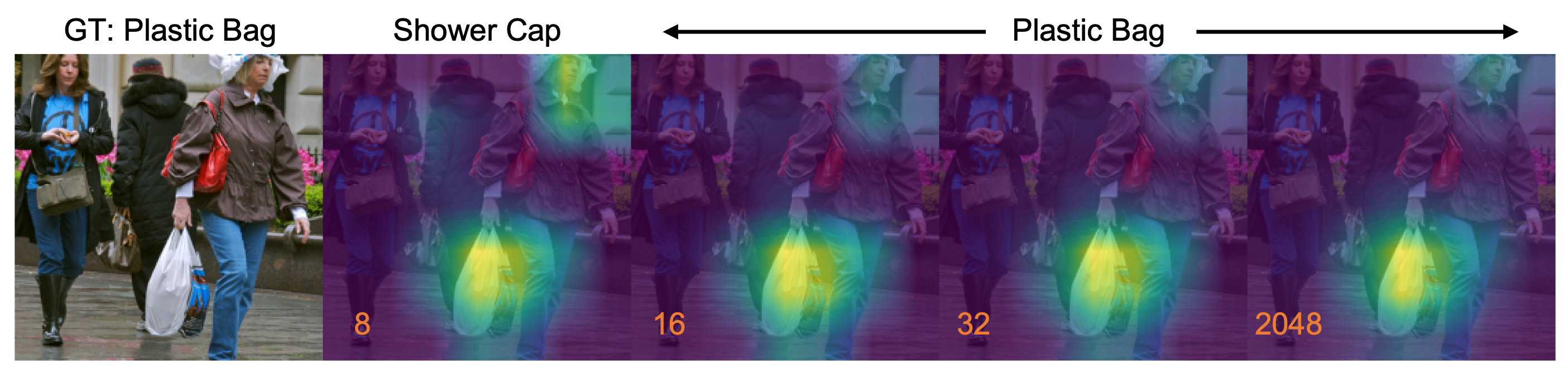
This image is a technical visualization comparing a machine learning model's predictions and attention maps against a ground truth label across different parameter settings. It consists of five horizontally arranged panels showing the same base photograph with varying overlays. The visualization demonstrates how model attention and classification output change with a specific parameter (likely resolution, iterations, or a hyperparameter) denoted by the numbers 8, 16, 32, and 2048.
### Components/Axes
**Header Labels (Top of Image):**
- **Position:** Above each corresponding panel.
- **Text Content:**
- Above Panel 1 (leftmost): `GT: Plastic Bag`
- Above Panel 2: `Shower Cap`
- Above Panels 3, 4, and 5: `Plastic Bag` with a double-headed arrow (`←———→`) spanning these three panels, indicating they share this label.
**Panel Content:**
- **Panel 1 (Leftmost):** Original, unaltered photograph. No numerical label.
- **Panels 2-5:** The same base photograph with a heatmap overlay and a numerical label in the bottom-left corner.
- **Numerical Labels (Bottom-Left of each heatmap panel):** `8`, `16`, `32`, `2048` (in orange text).
- **Heatmap Color Scale:** A gradient from purple (low intensity/attention) through green to bright yellow (high intensity/attention).
**Base Image Content:**
The photograph depicts three individuals walking on a wet, paved surface, likely a city street.
- **Left Person:** Wearing a blue t-shirt with a white peace symbol, blue jeans, and carrying a beige shoulder bag.
- **Middle Person:** Wearing a dark coat and carrying a white plastic shopping bag in their right hand.
- **Right Person:** Wearing a brown jacket, blue jeans, and carrying a red shoulder bag.
### Detailed Analysis
**Panel-by-Panel Breakdown:**
1. **Panel 1 (GT: Plastic Bag):**
- **Content:** The clean, original photograph.
- **Purpose:** Serves as the reference or "Ground Truth" (GT). The label indicates the correct object of interest is the "Plastic Bag" carried by the middle person.
2. **Panel 2 (Shower Cap, Parameter: 8):**
- **Prediction Label:** `Shower Cap` (located above the panel).
- **Heatmap Focus:** The brightest yellow region is concentrated on the white plastic bag. Secondary, lower-intensity (green) attention is visible on the head/hat area of the person on the right.
- **Observation:** There is a discrepancy between the model's textual prediction ("Shower Cap") and its visual attention, which is primarily on the correct object (the plastic bag).
3. **Panel 3 (Plastic Bag, Parameter: 16):**
- **Prediction Label:** `Plastic Bag` (part of the spanned label above panels 3-5).
- **Heatmap Focus:** The brightest yellow region remains strongly focused on the white plastic bag. The attention appears slightly more concentrated than in Panel 2.
4. **Panel 4 (Plastic Bag, Parameter: 32):**
- **Prediction Label:** `Plastic Bag`.
- **Heatmap Focus:** Very similar to Panel 3. The high-intensity (yellow) area is precisely on the plastic bag.
5. **Panel 5 (Plastic Bag, Parameter: 2048):**
- **Prediction Label:** `Plastic Bag`.
- **Heatmap Focus:** The heatmap pattern is consistent with Panels 3 and 4, showing strong, focused attention on the plastic bag.
**Trend Verification:**
- **Visual Trend of Attention:** Across all heatmap panels (2-5), the primary area of high attention (yellow) consistently and correctly localizes the white plastic bag. The focus becomes slightly more refined and concentrated as the parameter increases from 8 to 2048.
- **Textual Prediction Trend:** The model's output label changes from an incorrect `Shower Cap` at parameter `8` to the correct `Plastic Bag` at parameters `16`, `32`, and `2048`.
### Key Observations
1. **Attention vs. Prediction Misalignment:** At the lowest parameter value (`8`), the model's visual attention mechanism correctly identifies the plastic bag, but its final classification output is wrong ("Shower Cap").
2. **Consistent Visual Grounding:** Once the parameter reaches `16`, both the visual attention and the textual prediction align with the ground truth ("Plastic Bag") and remain stable for higher values (`32`, `2048`).
3. **Heatmap Consistency:** The spatial location of the highest attention does not shift dramatically between panels; it consistently highlights the same object. The primary change is in the model's ability to correctly interpret that visual signal into a label.
4. **Parameter Significance:** The numbers `8, 16, 32, 2048` likely represent a key hyperparameter (e.g., feature map resolution, number of iterations, or a scaling factor). The visualization suggests a threshold exists between `8` and `16` where the model's classification accuracy improves significantly.
### Interpretation
This visualization is likely from an analysis of a computer vision model's interpretability, specifically examining its **attention mechanisms** or **saliency maps**. It demonstrates a critical insight: a model can be "looking at" the right thing (as shown by the heatmap) while still producing an incorrect classification. This highlights the difference between **visual grounding** (localizing the relevant feature) and **semantic understanding** (correctly naming it).
The progression suggests that the parameter in question controls some aspect of the model's capacity or precision. At a low setting (`8`), the model's visual features are sufficient to locate the object but insufficient for accurate categorization, possibly due to noise or lack of discriminative detail. At higher settings (`16` and above), the model gains the necessary discriminative power to correctly label the object it has already localized.
The double-headed arrow spanning the last three panels emphasizes that once the correct classification is achieved, it is robust across a wide range of higher parameter values. This type of analysis is crucial for debugging models, understanding failure modes, and ensuring that a model's decisions are based on relevant features rather than spurious correlations.