\n
## Image Analysis: Visual Attention Heatmaps
### Overview
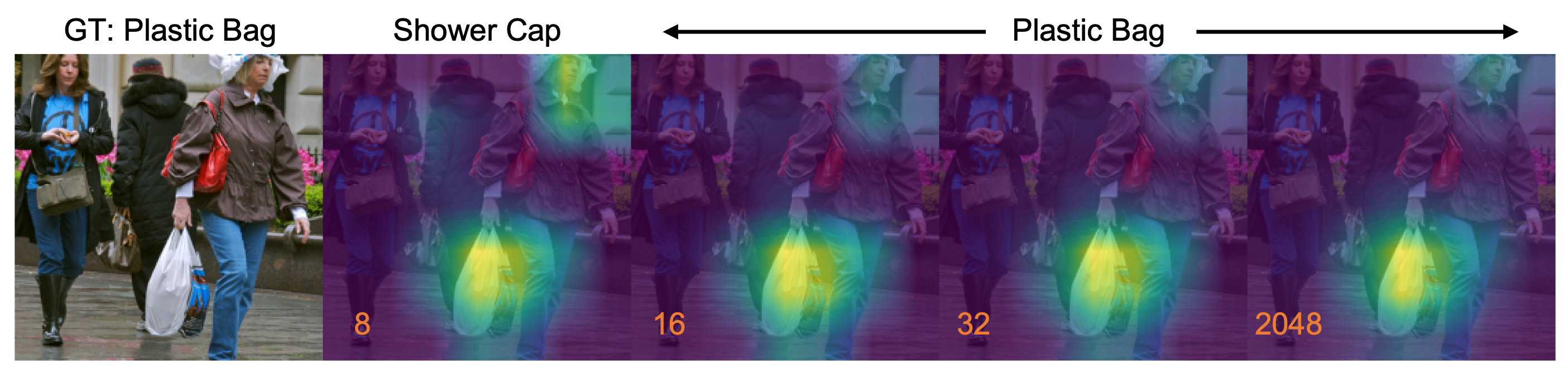
The image presents a series of heatmaps overlaid on a photograph of two people walking. The heatmaps visualize attention, likely from an AI model, as the complexity of the object being identified increases. The ground truth (GT) object is identified as a "Plastic Bag", and the heatmaps show the model's attention shifting from a "Shower Cap" to a "Plastic Bag" as the complexity increases. The complexity is indicated by numbers below each heatmap (8, 16, 32, 2048).
### Components/Axes
* **Image:** A photograph of two people walking on a street. The person on the left is wearing a dark coat and carrying a white plastic bag. The person on the right is wearing a blue jacket and carrying a red bag.
* **Heatmaps:** Five heatmaps are overlaid on the image, each representing a different level of complexity. The heatmaps use a color gradient, with purple indicating low attention and yellow indicating high attention.
* **Labels:**
* "GT: Plastic Bag" - Located at the top-left corner, indicating the ground truth object.
* "Shower Cap" - Label above the first heatmap.
* "Plastic Bag" - Label above the last heatmap.
* Arrow - A double-headed arrow pointing from "Shower Cap" to "Plastic Bag", indicating the shift in attention.
* Numerical values: 8, 16, 32, 2048 - Located below each heatmap, representing the complexity level.
### Detailed Analysis
The heatmaps show a clear shift in attention.
* **8 (First Heatmap):** The heatmap focuses primarily on the head of the person on the left, highlighting what the model initially identifies as a "Shower Cap". The attention is concentrated on the head region.
* **16 (Second Heatmap):** The attention begins to shift downwards, with some focus still on the head, but increasing attention on the white bag.
* **32 (Third Heatmap):** The attention continues to shift downwards, with the majority of the attention now focused on the white bag.
* **2048 (Fourth Heatmap):** The attention is almost entirely focused on the white bag, correctly identifying it as a "Plastic Bag". The heatmap shows a strong concentration of attention on the bag's shape and form.
The intensity of the yellow color (indicating high attention) increases as the complexity number increases, suggesting a more confident identification of the "Plastic Bag".
### Key Observations
* The model initially misidentifies the plastic bag as a shower cap at low complexity (8).
* As complexity increases, the model's attention shifts from the head to the bag.
* At high complexity (2048), the model accurately identifies the bag with strong confidence.
* The heatmaps demonstrate how increasing complexity can help an AI model refine its object recognition.
### Interpretation
This image demonstrates the process of object recognition refinement in an AI model. The initial misidentification of the plastic bag as a shower cap highlights the challenges of visual perception, especially with ambiguous shapes. The increasing complexity levels likely represent more processing power or more sophisticated algorithms being applied to the image. As the model processes more information (higher complexity), it is able to overcome the initial ambiguity and correctly identify the object. The shift in attention, visualized by the heatmaps, shows how the model learns to focus on the relevant features of the object. This is a common technique used in computer vision to understand how AI models "see" and interpret images. The arrow indicates a progression of understanding, from an initial incorrect assumption to a final correct identification. The data suggests that the model relies on contextual information and increasing processing power to resolve ambiguity and achieve accurate object recognition.