## Circular Diagram: Trustworthy Artificial Intelligence
### Overview
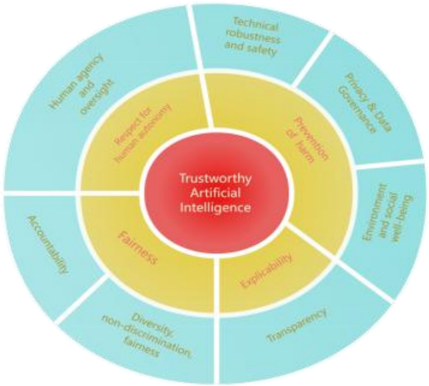
The image is a circular diagram illustrating the components of "Trustworthy Artificial Intelligence." It consists of concentric rings and radial divisions, with key concepts arranged around a central core. The diagram uses color-coding to distinguish between different layers or categories of principles.
### Components/Axes
* **Central Core (Red):** "Trustworthy Artificial Intelligence"
* **Inner Ring (Yellow):** Contains three principles: "Respect for human autonomy", "Fairness", "Prevention of harm", "Explicability".
* **Outer Ring (Light Blue):** Contains six principles: "Human agency and oversight", "Accountability", "Diversity, non-discrimination, fairness", "Transparency", "Environment and social well-being", "Privacy & Data Governance", "Technical robustness and safety".
### Detailed Analysis
The diagram is structured as follows:
1. **Central Core:** The innermost circle, colored red, contains the text "Trustworthy Artificial Intelligence." This represents the core concept of the diagram.
2. **Inner Ring:** Surrounding the central core is a yellow ring divided into four segments. Each segment contains a principle:
* Top: "Respect for human autonomy"
* Left: "Fairness"
* Right: "Explicability"
* Bottom: "Prevention of harm"
3. **Outer Ring:** The outermost ring is light blue and divided into six segments, each containing a principle:
* Top-Left: "Human agency and oversight"
* Bottom-Left: "Accountability"
* Bottom: "Diversity, non-discrimination, fairness"
* Bottom-Right: "Transparency"
* Top-Right: "Privacy & Data Governance"
* Right: "Environment and social well-being"
* Top: "Technical robustness and safety"
### Key Observations
* The diagram emphasizes a multi-faceted approach to trustworthy AI, encompassing ethical, social, and technical considerations.
* The arrangement suggests a hierarchy or relationship between the principles, with the inner ring representing core ethical considerations and the outer ring representing broader implementation and governance aspects.
* The use of color-coding helps to visually distinguish between different categories of principles.
### Interpretation
The diagram illustrates the key principles and considerations necessary for developing and deploying trustworthy artificial intelligence. The central concept of "Trustworthy Artificial Intelligence" is supported by core ethical principles (inner ring) and broader implementation and governance aspects (outer ring). The diagram suggests that trustworthy AI requires a holistic approach that considers human autonomy, fairness, prevention of harm, explicability, human oversight, accountability, diversity, transparency, environmental impact, data privacy, and technical robustness. The diagram serves as a visual framework for understanding the complex requirements of trustworthy AI and can be used to guide the development and deployment of AI systems in a responsible and ethical manner.