## Circular Diagram: Trustworthy Artificial Intelligence Framework
### Overview
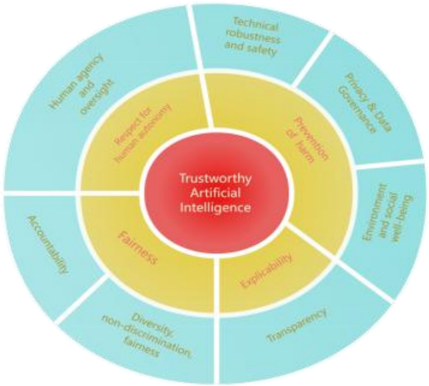
The image depicts a circular conceptual framework for "Trustworthy Artificial Intelligence" (TAI), structured as a multi-layered diagram with color-coded sections. The central red circle anchors the core concept, surrounded by concentric layers of principles and implementation requirements. The design emphasizes interconnectedness, with white lines separating distinct components.
### Components/Axes
1. **Central Core (Red Circle)**
- Label: "Trustworthy Artificial Intelligence"
- Position: Center of the diagram
2. **First Layer (Yellow Sections)**
- Three principles:
- "Respect for human autonomy" (top-left)
- "Fairness" (bottom-left)
- "Explicability" (bottom-right)
- Color: Yellow (likely representing ethical principles)
3. **Second Layer (Blue Sections)**
- Seven implementation requirements:
- "Human agency and oversight" (top-left)
- "Technical robustness and safety" (top-center)
- "Privacy & Data Governance" (top-right)
- "Environment and social well-being" (bottom-right)
- "Accountability" (bottom-center)
- "Transparency" (bottom-left)
- Color: Blue (likely representing technical/operational requirements)
4. **Structural Elements**
- White lines separate all sections
- No explicit legend, but color coding implies categorization
### Detailed Analysis
- **Color Coding**:
- Yellow sections (principles) are positioned closer to the core, suggesting foundational ethical values.
- Blue sections (requirements) encircle the yellow layer, indicating operational dependencies for achieving TAI.
- **Textual Content**:
- All labels are in English, with no non-English text present.
- No numerical data, scales, or quantitative values are included.
### Key Observations
1. **Hierarchical Structure**:
- The core concept ("Trustworthy AI") is central, with principles and requirements radiating outward.
- No single component dominates visually; all are equally sized.
2. **Interconnectedness**:
- White lines imply bidirectional relationships between components (e.g., fairness influences technical robustness).
3. **Absence of Data**:
- The diagram is purely conceptual, lacking empirical data or metrics.
### Interpretation
This framework outlines a holistic approach to TAI, emphasizing that ethical principles (yellow) and technical requirements (blue) are mutually reinforcing. The circular design suggests a cyclical process where principles guide implementation, and implementation outcomes feed back into refining principles. For example:
- "Fairness" (yellow) may require "Technical robustness" (blue) to avoid biased algorithms.
- "Explicability" (yellow) depends on "Transparency" (blue) for meaningful explanations.
The absence of numerical data indicates this is a normative model, likely intended for policy or design guidelines rather than empirical analysis. The equal sizing of components implies no single factor is prioritized over others, aligning with frameworks like the EU’s Ethics Guidelines for Trustworthy AI.