## Bar Chart: Relative Improvement (RI) by Answer Type
### Overview
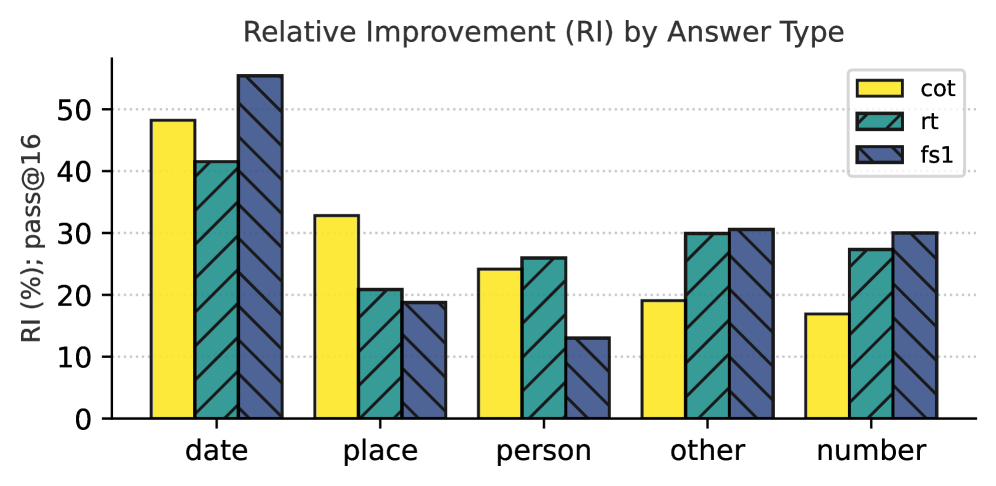
The image is a bar chart comparing the relative improvement (RI) of three different methods (cot, rt, fs1) across five answer types: date, place, person, other, and number. The y-axis represents the relative improvement in percentage (%).
### Components/Axes
* **Title:** Relative Improvement (RI) by Answer Type
* **Y-axis:** RI (%), with tick marks at 0, 10, 20, 30, 40, and 50.
* **X-axis:** Answer Type, with categories: date, place, person, other, number.
* **Legend:** Located in the top-right corner.
* cot (yellow)
* rt (teal with diagonal lines)
* fs1 (dark blue with diagonal lines)
### Detailed Analysis
Here's a breakdown of the relative improvement for each answer type and method:
* **Date:**
* cot: Approximately 48%
* rt: Approximately 42%
* fs1: Approximately 55%
* **Place:**
* cot: Approximately 33%
* rt: Approximately 21%
* fs1: Approximately 19%
* **Person:**
* cot: Approximately 24%
* rt: Approximately 26%
* fs1: Approximately 13%
* **Other:**
* cot: Approximately 19%
* rt: Approximately 30%
* fs1: Approximately 31%
* **Number:**
* cot: Approximately 17%
* rt: Approximately 28%
* fs1: Approximately 30%
### Key Observations
* fs1 shows the highest relative improvement for the "date" answer type.
* cot generally has a higher relative improvement for "place" and "person" answer types compared to "other" and "number".
* For "other" and "number" answer types, rt and fs1 show similar relative improvements.
* The relative improvement varies significantly depending on the answer type and method used.
### Interpretation
The bar chart illustrates the performance of different methods (cot, rt, fs1) in improving the accuracy of answers for various question types. The data suggests that the effectiveness of each method is highly dependent on the type of answer being sought. For example, fs1 appears to be particularly effective for "date" questions, while cot shows better performance for "place" and "person" questions. The chart highlights the importance of selecting the appropriate method based on the specific type of question being addressed. The "other" and "number" categories show a more consistent performance between rt and fs1, suggesting these methods might be more generally applicable or that these question types are less sensitive to the specific method used.