## Line Chart: MUSHRA Score vs. Bitrate Comparison
### Overview
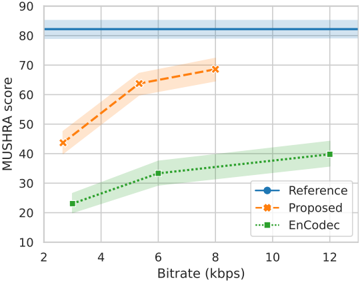
The chart compares the performance of three audio/video encoding methods (Reference, Proposed, EnCodec) across varying bitrates (2–12 kbps) using the MUSHRA score metric. The Reference method maintains a constant score, while the Proposed and EnCodec methods show increasing performance with higher bitrates.
### Components/Axes
- **X-axis**: Bitrate (kbps), ranging from 2 to 12 in increments of 2.
- **Y-axis**: MUSHRA score, ranging from 10 to 90 in increments of 10.
- **Legend**: Located in the bottom-right corner, with three entries:
- **Reference**: Solid blue line (flat line at ~80).
- **Proposed**: Dashed orange line (increasing trend).
- **EnCodec**: Dotted green line (increasing trend).
- **Data Points**: Marked with symbols (X for Proposed, square for EnCodec, circle for Reference).
### Detailed Analysis
1. **Reference (Blue Line)**:
- Flat line at ~80 MUSHRA score across all bitrates.
- No variation observed; likely a baseline or idealized performance.
2. **Proposed (Orange Dashed Line)**:
- Starts at ~45 MUSHRA score at 2 kbps.
- Increases sharply to ~70 at 8 kbps, then plateaus.
- Confidence interval (shaded orange) widens slightly at higher bitrates.
3. **EnCodec (Green Dotted Line)**:
- Starts at ~25 MUSHRA score at 2 kbps.
- Gradually increases to ~40 at 12 kbps.
- Confidence interval (shaded green) remains narrow throughout.
### Key Observations
- **Performance Trends**:
- Proposed outperforms EnCodec at bitrates ≥6 kbps.
- EnCodec shows minimal improvement beyond 8 kbps.
- Reference remains the highest-performing method across all bitrates.
- **Confidence Intervals**:
- Proposed’s uncertainty increases at higher bitrates, suggesting variability in results.
- EnCodec’s narrow confidence interval indicates consistent performance.
### Interpretation
The chart demonstrates that the **Proposed method** achieves superior performance compared to EnCodec at moderate-to-high bitrates, though it starts with lower scores at 2 kbps. The **Reference method** serves as a benchmark, maintaining a constant high score regardless of bitrate. The widening confidence intervals for Proposed at higher bitrates may indicate sensitivity to encoding conditions or data variability. EnCodec’s gradual improvement suggests diminishing returns at higher bitrates. This analysis highlights the trade-offs between bitrate efficiency and quality for different encoding strategies.