## 3D Vector Field Diagram: Central Region Analysis
### Overview
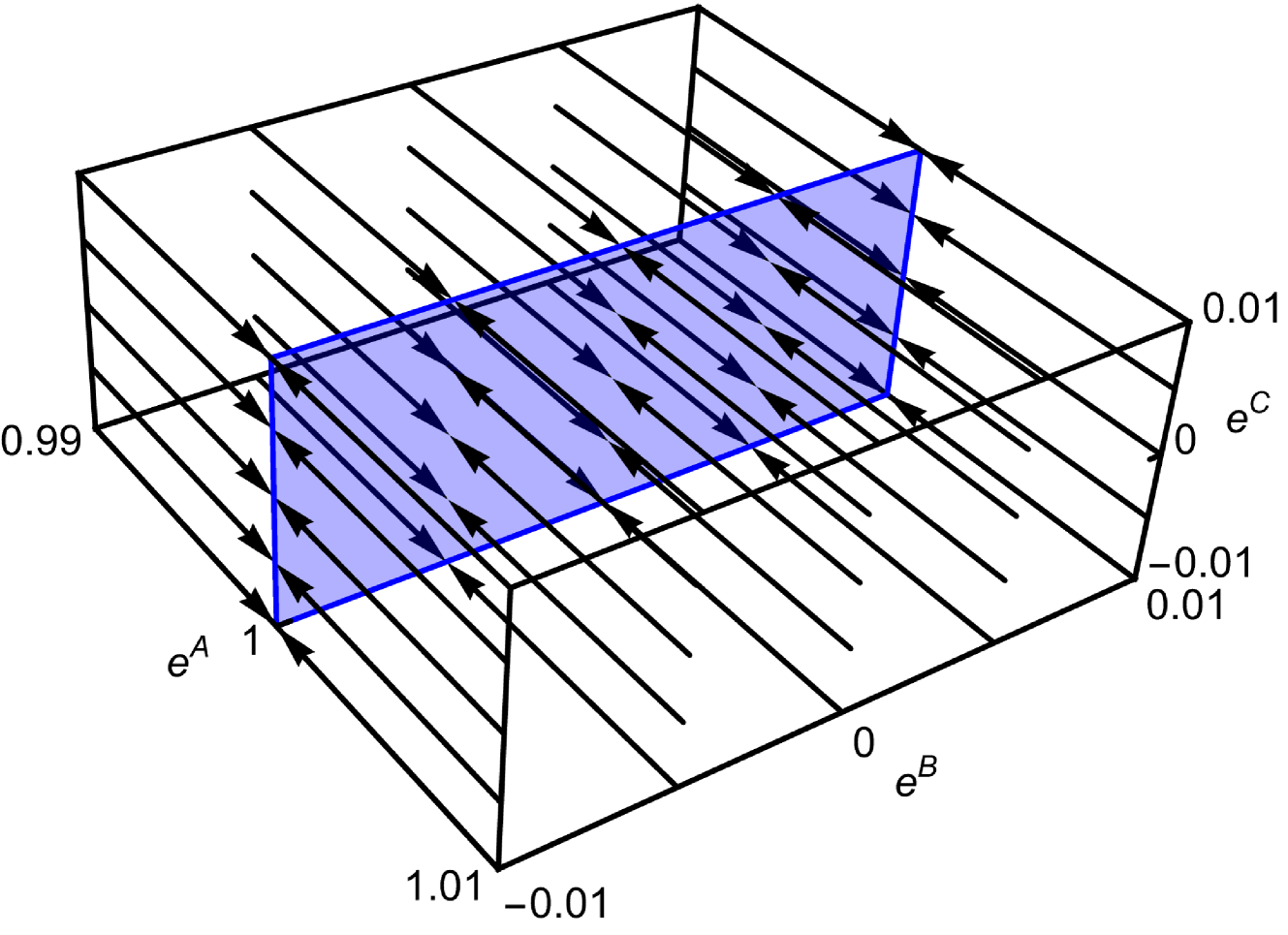
The image depicts a 3D coordinate system with axes labeled **e<sup>A</sup>**, **e<sup>B</sup>**, and **e<sup>C</sup>**. A semi-transparent blue shaded region occupies the central space, surrounded by black arrows with blue tips pointing in various directions. The axes are scaled with approximate numerical values, and the diagram emphasizes directional relationships within the shaded region.
---
### Components/Axes
1. **Axes Labels and Scales**:
- **e<sup>A</sup> Axis**:
- Range: **0.99 to 1.01** (centered at 1.00).
- Position: Leftmost axis, oriented diagonally in the 3D space.
- **e<sup>B</sup> Axis**:
- Range: **-0.01 to 0.01** (centered at 0).
- Position: Bottom axis, horizontal in the 3D space.
- **e<sup>C</sup> Axis**:
- Range: **-0.01 to 0.01** (centered at 0).
- Position: Rightmost axis, vertical in the 3D space.
2. **Blue Shaded Region**:
- A rectangular prism centered at **(e<sup>A</sup>=1.00, e<sup>B</sup>=0, e<sup>C</sup>=0)**.
- Dimensions: Spans the full range of **e<sup>A</sup>** (0.99–1.01) and partial ranges of **e<sup>B</sup>** and **e<sup>C</sup>** (-0.01–0.01).
- Transparency: Semi-transparent, suggesting a gradient or intensity variation.
3. **Arrows**:
- Black vectors with blue tips distributed throughout the 3D space.
- Directions: Point toward or away from the blue shaded region, indicating flow, influence, or interaction.
- Density: Higher concentration near the blue region, suggesting localized activity.
---
### Detailed Analysis
- **Axis Values**:
- **e<sup>A</sup>**: Dominates the scale (0.99–1.01), with the blue region anchored at **e<sup>A</sup>=1.00**.
- **e<sup>B</sup> and e<sup>C</sup>**: Narrower ranges (-0.01–0.01), indicating secondary variables with minimal variation.
- **Blue Region**:
- Positioned at the intersection of **e<sup>A</sup>=1.00**, **e<sup>B</sup>=0**, and **e<sup>C</sup>=0**.
- Likely represents a critical threshold or equilibrium point in the system.
- **Arrows**:
- Orientations vary: Some point radially outward from the blue region, others inward or tangential.
- Suggests dynamic interactions (e.g., forces, gradients) centered on the shaded area.
---
### Key Observations
1. **Central Focus**: The blue region is spatially and numerically centered at **(1.00, 0, 0)**, emphasizing its significance.
2. **Axis Dominance**: **e<sup>A</sup>** has the largest scale, while **e<sup>B</sup>** and **e<sup>C</sup>** are tightly constrained, implying their roles as secondary parameters.
3. **Arrow Dynamics**: Arrows near the blue region point in divergent directions, hinting at competing or interacting forces.
4. **Transparency Gradient**: The blue region’s semi-transparency may indicate a decay or diffusion effect from the center.
---
### Interpretation
- **System Behavior**: The diagram likely models a physical or mathematical system where **e<sup>A</sup>=1.00** is a critical state (e.g., phase transition, resonance). The blue region represents this state, with arrows visualizing perturbations or influences around it.
- **Directional Relationships**: Arrows pointing toward the blue region could signify attraction or convergence, while outward-pointing arrows might represent divergence or instability.
- **Scale Implications**: The narrow ranges of **e<sup>B</sup>** and **e<sup>C</sup>** suggest these variables are tightly controlled or have minimal impact compared to **e<sup>A</sup>**.
- **Anomalies**: No outliers are visible, but the uniform arrow distribution implies a homogeneous field outside the blue region.
---
### Conclusion
This diagram illustrates a 3D vector field centered on a critical threshold (**e<sup>A</sup>=1.00**), with directional interactions concentrated in the blue-shaded region. The axes and arrows collectively highlight the dominance of **e<sup>A</sup>** and the dynamic interplay of forces within the system. The absence of a legend leaves the exact nature of the vectors open to interpretation, but their spatial distribution strongly suggests a focus on the central equilibrium point.