\n
## Bar Chart: Trendyol-LLM - Proportion of Speaker Selections
### Overview
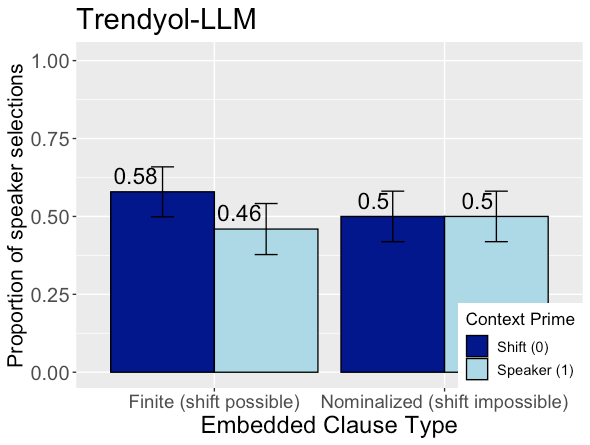
This bar chart displays the proportion of speaker selections based on two factors: Embedded Clause Type (Finite vs. Nominalized) and Context Prime (Shift vs. Speaker). Error bars are included for each bar, indicating the variability in the data.
### Components/Axes
* **Title:** Trendyol-LLM
* **X-axis:** Embedded Clause Type. Categories are:
* Finite (shift possible)
* Nominalized (shift impossible)
* **Y-axis:** Proportion of speaker selections. Scale ranges from 0.00 to 1.00, with increments of 0.25.
* **Legend:** Located in the top-right corner.
* Shift (0) - Represented by dark blue color.
* Speaker (1) - Represented by light blue color.
### Detailed Analysis
The chart consists of four bars, representing the combinations of Embedded Clause Type and Context Prime. Each bar has an associated error bar indicating the standard error or confidence interval.
* **Finite (shift possible) - Shift (0):** The dark blue bar has a height of approximately 0.58, with an error bar extending roughly from 0.53 to 0.63.
* **Finite (shift possible) - Speaker (1):** The light blue bar has a height of approximately 0.46, with an error bar extending roughly from 0.41 to 0.51.
* **Nominalized (shift impossible) - Shift (0):** The dark blue bar has a height of approximately 0.50, with an error bar extending roughly from 0.45 to 0.55.
* **Nominalized (shift impossible) - Speaker (1):** The light blue bar has a height of approximately 0.50, with an error bar extending roughly from 0.45 to 0.55.
### Key Observations
* For the "Finite" clause type, the "Shift" context prime has a higher proportion of speaker selections (approximately 0.58) compared to the "Speaker" context prime (approximately 0.46).
* For the "Nominalized" clause type, the proportions for "Shift" and "Speaker" context primes are approximately equal (around 0.50).
* The error bars suggest that the difference between "Shift" and "Speaker" for the "Finite" clause type is statistically significant, while the difference for the "Nominalized" clause type is less clear.
### Interpretation
The data suggests that the context prime influences speaker selections differently depending on the type of embedded clause. When the embedded clause allows for a shift in perspective ("Finite"), the "Shift" context prime leads to a higher proportion of speaker selections. However, when a shift is impossible ("Nominalized"), the context prime appears to have little effect on speaker selections. This could indicate that the ability to shift perspective is a key factor in determining how context primes influence language processing and speaker attribution. The fact that the "Nominalized" clause type shows similar proportions for both context primes suggests that the context prime's effect is contingent on the clause's inherent properties. The error bars provide a measure of uncertainty, and further statistical analysis would be needed to confirm the significance of these observations.