## Bar Chart: Trendyol-LLM Speaker Selection Proportions
### Overview
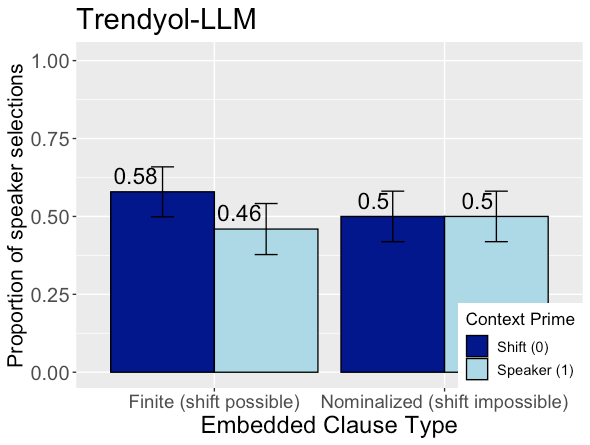
The image is a grouped bar chart titled "Trendyol-LLM." It displays the proportion of "speaker selections" made by a language model (Trendyol-LLM) across two different types of embedded clauses, further broken down by a "Context Prime" condition. The chart includes error bars for each data point.
### Components/Axes
* **Chart Title:** "Trendyol-LLM" (top-left, above the plot area).
* **Y-Axis:**
* **Label:** "Proportion of speaker selections" (rotated vertically on the left).
* **Scale:** Linear scale from 0.00 to 1.00, with major tick marks at 0.00, 0.25, 0.50, 0.75, and 1.00.
* **X-Axis:**
* **Label:** "Embedded Clause Type" (centered at the bottom).
* **Categories:** Two primary categories are displayed:
1. "Finite (shift possible)"
2. "Nominalized (shift impossible)"
* **Legend:**
* **Title:** "Context Prime"
* **Location:** Bottom-right corner of the plot area.
* **Categories:**
* **Dark Blue Bar:** "Shift (0)"
* **Light Blue Bar:** "Speaker (1)"
### Detailed Analysis
The chart presents data for two "Embedded Clause Type" categories, each containing two bars representing the "Context Prime" conditions.
**1. Category: Finite (shift possible)**
* **Shift (0) [Dark Blue Bar]:**
* **Value:** 0.58 (annotated above the bar).
* **Error Bar:** Extends approximately from 0.50 to 0.66.
* **Trend:** This is the highest bar in the chart.
* **Speaker (1) [Light Blue Bar]:**
* **Value:** 0.46 (annotated above the bar).
* **Error Bar:** Extends approximately from 0.38 to 0.54.
* **Trend:** This bar is lower than its paired "Shift (0)" bar.
**2. Category: Nominalized (shift impossible)**
* **Shift (0) [Dark Blue Bar]:**
* **Value:** 0.5 (annotated above the bar).
* **Error Bar:** Extends approximately from 0.42 to 0.58.
* **Trend:** This bar is lower than the "Shift (0)" bar in the "Finite" category.
* **Speaker (1) [Light Blue Bar]:**
* **Value:** 0.5 (annotated above the bar).
* **Error Bar:** Extends approximately from 0.42 to 0.58.
* **Trend:** This bar is equal in height to its paired "Shift (0)" bar and higher than the "Speaker (1)" bar in the "Finite" category.
### Key Observations
1. **Interaction Effect:** The relationship between "Context Prime" and the proportion of speaker selections depends on the "Embedded Clause Type." For "Finite" clauses, the "Shift (0)" prime leads to a higher proportion (0.58) than the "Speaker (1)" prime (0.46). For "Nominalized" clauses, both primes result in an equal proportion (0.5).
2. **Reversal of Trend:** The direction of the difference between the two context primes reverses between clause types. The dark blue bar is higher in the first group, while the bars are equal in the second group.
3. **Central Tendency:** All data points cluster around the 0.5 (50%) mark, suggesting the model's selections are near chance level across these conditions, with modest deviations.
4. **Variability:** The error bars (likely representing standard error or confidence intervals) are substantial and overlap between conditions within each clause type, indicating the observed differences may not be statistically significant.
### Interpretation
This chart appears to visualize the results of a psycholinguistic or NLP experiment testing how a language model (Trendyol-LLM) interprets perspective or "speaker selection" in sentences containing embedded clauses. The "Context Prime" ("Shift" vs. "Speaker") likely refers to a preceding linguistic cue designed to bias interpretation.
The key finding is that the model's sensitivity to this contextual prime is modulated by the grammatical structure of the embedded clause. When a "shift" in perspective is syntactically possible ("Finite" clause), the prime has a measurable effect, with the "Shift" prime increasing the proportion of shift-related selections. However, when a perspective shift is syntactically impossible ("Nominalized" clause), the prime has no effect, and the model's selections default to a neutral 50/50 proportion.
This suggests the model has learned, to some degree, the syntactic constraints on perspective shift in the language it was trained on. Its behavior is not random but is guided by the interaction of contextual cues and grammatical structure. The proximity to 0.5 across the board, however, indicates the task is challenging for the model or that the primes are not strongly deterministic. The overlapping error bars caution against over-interpreting the magnitude of the observed differences without further statistical analysis.