## Bar Chart: Trendyol-LLM
### Overview
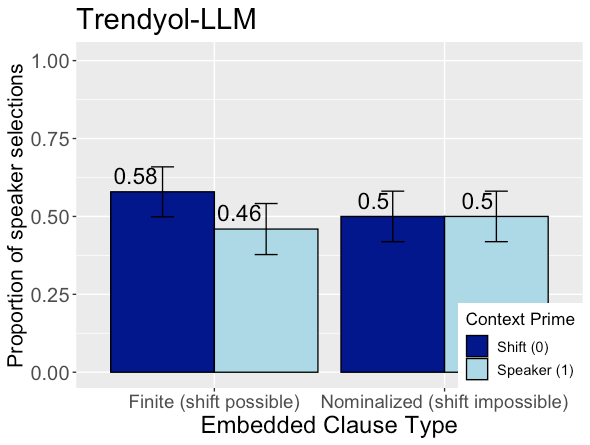
The chart compares the proportion of speaker selections across two embedded clause types ("Finite" and "Nominalized") under two context primes ("Shift" and "Speaker"). Error bars indicate variability in measurements.
### Components/Axes
- **X-axis**: Embedded Clause Type
- Categories: "Finite (shift possible)", "Nominalized (shift impossible)"
- **Y-axis**: Proportion of speaker selections (0.00–1.00)
- **Legend**:
- **Dark blue**: Shift (0)
- **Light blue**: Speaker (1)
- **Title**: "Trendyol-LLM" (top of chart)
### Detailed Analysis
1. **Finite (shift possible)**:
- **Shift (0)**: 0.58 (± error bar)
- **Speaker (1)**: 0.46 (± error bar)
2. **Nominalized (shift impossible)**:
- **Shift (0)**: 0.5 (± error bar)
- **Speaker (1)**: 0.5 (± error bar)
### Key Observations
- In "Finite" clauses, the "Shift" prime results in a higher proportion of speaker selections (0.58) compared to the "Speaker" prime (0.46).
- In "Nominalized" clauses, both primes yield identical proportions (0.5), suggesting no difference in speaker selection when shifting is impossible.
- Error bars are present but not quantified numerically.
### Interpretation
The data suggests that the **possibility of shifting** (Finite clauses) influences speaker selection behavior, with the "Shift" prime driving higher proportions. When shifting is impossible (Nominalized clauses), both primes produce equivalent results, indicating that the linguistic structure (finite vs. nominalized) mediates the effect of the context prime. The error bars imply measurement variability, but their magnitude is unspecified. This aligns with theories where syntactic flexibility (e.g., finite clauses enabling subject-verb shifts) amplifies context-driven biases.