## Line Chart: response_length/mean
### Overview
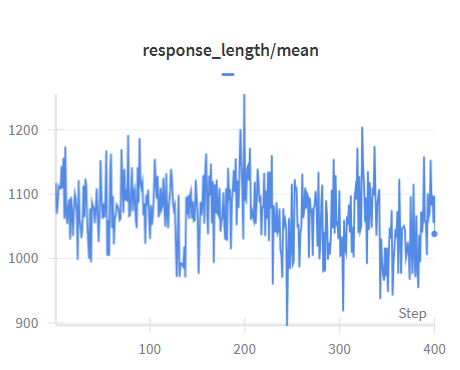
The image depicts a line chart titled "response_length/mean" with a blue line representing data fluctuations over a series of steps. The y-axis measures the ratio of response length to mean values, while the x-axis represents sequential steps. The chart shows significant variability, with a prominent peak near step 150.
### Components/Axes
- **Title**: "response_length/mean" (centered at the top).
- **X-axis (Horizontal)**: Labeled "Step," with values ranging from 0 to 400 in increments of 100.
- **Y-axis (Vertical)**: Labeled "response_length/mean," with values ranging from 900 to 1200 in increments of 100.
- **Legend**: A single entry labeled "response_length/mean" in blue, matching the line color.
- **Line**: A single blue line with sharp fluctuations, peaking at approximately step 150.
### Detailed Analysis
- **Y-axis Range**: The response_length/mean values oscillate between ~900 and ~1200.
- **X-axis Progression**: Steps progress linearly from 0 to 400.
- **Notable Peak**: At step 150, the line reaches its maximum value of ~1200, followed by a sharp decline.
- **General Trend**: The line exhibits irregular oscillations, with no clear upward or downward trend. Variability increases near step 150, then stabilizes slightly toward step 400.
### Key Observations
1. **Peak at Step 150**: The most significant outlier occurs at step 150, where the response_length/mean ratio spikes to ~1200, far exceeding the baseline range.
2. **Baseline Fluctuations**: Between steps 0–100 and 200–400, the line remains within a narrow band (~1000–1100), with minor deviations.
3. **Post-Peak Decline**: After step 150, the line drops sharply to ~900 by step 200, then recovers to ~1000 by step 300.
### Interpretation
The chart suggests that the response_length/mean ratio is highly variable, with a critical anomaly at step 150. This peak could indicate an outlier event, such as an unusually long response or a systemic error in data collection. The subsequent decline and stabilization imply a return to baseline behavior, though the cause of the spike remains unexplained. The lack of a consistent trend highlights potential instability in the measured variable, warranting further investigation into the factors influencing response lengths.