## Visual Pattern Sequence: Geometric Shape Progression
### Overview
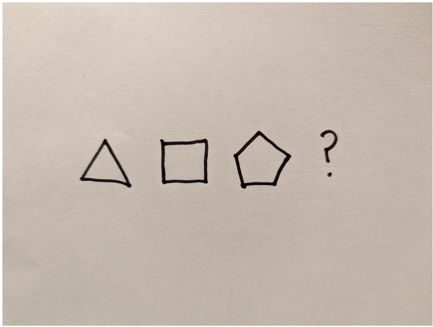
The image displays a hand-drawn sequence of four geometric shapes arranged horizontally on a plain, light-colored surface (likely paper). The sequence presents a logical progression based on the number of sides, culminating in a question mark, indicating a missing or next element in the series.
### Components/Axes
* **Elements:** Four distinct, hand-drawn symbols are present, aligned in a single row from left to right.
* **Labels/Text:** The only textual element is a question mark (`?`) positioned as the fourth and final element in the sequence.
* **Spatial Arrangement:** The elements are spaced relatively evenly across the horizontal plane. The sequence begins on the left and ends on the right.
### Detailed Analysis
The sequence consists of the following shapes, analyzed from left to right:
1. **First Element (Far Left):** A hand-drawn **triangle**. It is an irregular, three-sided polygon with a roughly horizontal base.
2. **Second Element (Center-Left):** A hand-drawn **square**. It is a four-sided polygon with sides of approximately equal length, though the angles are not perfectly 90 degrees due to the hand-drawn nature.
3. **Third Element (Center-Right):** A hand-drawn **pentagon**. It is a five-sided polygon. The shape is recognizable but irregular, with a pointed top and a wider base.
4. **Fourth Element (Far Right):** A hand-drawn **question mark (`?`)**. This symbol is composed of a curved line above a dot.
### Key Observations
* **Progression Pattern:** The core pattern is an arithmetic progression in the number of sides: 3 (triangle) → 4 (square) → 5 (pentagon).
* **Visual Style:** All shapes are drawn with a consistent, single-weight black line. The style is informal and sketch-like, not geometrically precise.
* **Implied Continuation:** The question mark explicitly frames the sequence as a puzzle or question, prompting the viewer to deduce the next logical element.
* **Absence of Data:** The image contains no numerical data, axes, legends, or quantitative information. It is purely a conceptual or logical diagram.
### Interpretation
This image is a classic visual logic puzzle. The data it presents is the **rule of progression itself**: each subsequent shape increases its side count by one.
* **What it demonstrates:** The sequence establishes a clear, simple rule (n, n+1, n+2...). The question mark challenges the viewer to apply this rule to predict the next term.
* **Relationship between elements:** The elements are linked solely by their position in the ordered sequence and their shared property of being polygons. The relationship is sequential and mathematical, not causal or functional.
* **Notable Anomaly/Outlier:** There is no outlier within the given three-shape sequence. The "anomaly" is the intentional absence of the fourth shape, replaced by the question mark, which is the central point of the image.
* **Conclusion:** Based on the established pattern (3, 4, 5 sides), the logical answer to the puzzle implied by the question mark is a **hexagon** (a six-sided polygon). The image's purpose is to present this inductive reasoning challenge.