## Line Chart: Llama-3.1-8B Proportion of Flips Over Iterations
### Overview
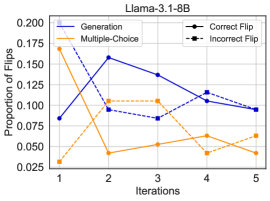
This image displays a 2D line chart titled "Llama-3.1-8B", illustrating the "Proportion of Flips" on the y-axis against "Iterations" on the x-axis. Four distinct data series are plotted, representing different conditions: "Generation", "Multiple-Choice", "Correct Flip", and "Incorrect Flip". The chart tracks how the proportion of flips changes across 5 iterations for each condition.
### Components/Axes
The chart is structured with a main plotting area, an x-axis at the bottom, a y-axis on the left, and a legend positioned in the top-center to top-right area.
* **Chart Title**: "Llama-3.1-8B" (positioned at the top-center).
* **X-axis**:
* **Title**: "Iterations" (positioned below the x-axis).
* **Markers**: 1, 2, 3, 4, 5. The axis ranges from approximately 0.5 to 5.5.
* **Y-axis**:
* **Title**: "Proportion of Flips" (positioned vertically along the left side).
* **Markers**: 0.025, 0.050, 0.075, 0.100, 0.125, 0.150, 0.175, 0.200. The axis ranges from approximately 0.01 to 0.21.
* **Legend**: Located in the top-center to top-right of the plot area.
* **Generation**: Represented by a solid dark blue line with circular markers.
* **Multiple-Choice**: Represented by a solid orange line with square markers.
* **Correct Flip**: Represented by a dashed black line with circular markers.
* **Incorrect Flip**: Represented by a dashed black line with square markers.
* *Note*: There is a visual discrepancy. The legend indicates "Incorrect Flip" should be a dashed *black* line with square markers. However, the line plotted on the chart that is dashed with square markers is distinctly *orange*. For the detailed analysis, the data points for the *dashed orange line with square markers* will be extracted, noting this inconsistency with the legend's color description.
### Detailed Analysis
The chart displays four data series, each with a distinct trend over 5 iterations.
1. **Generation (Solid Dark Blue Line, Circular Markers)**:
* **Trend**: Starts relatively low, peaks at iteration 2, then generally declines with a slight increase at iteration 4 before a final drop.
* **Data Points**:
* Iteration 1: ~0.085
* Iteration 2: ~0.158
* Iteration 3: ~0.138
* Iteration 4: ~0.105
* Iteration 5: ~0.095
2. **Multiple-Choice (Solid Orange Line, Square Markers)**:
* **Trend**: Starts high, drops significantly at iteration 2, then shows a gradual increase, followed by a slight dip and a final increase.
* **Data Points**:
* Iteration 1: ~0.168
* Iteration 2: ~0.040
* Iteration 3: ~0.053
* Iteration 4: ~0.063
* Iteration 5: ~0.063
3. **Correct Flip (Dashed Black Line, Circular Markers)**:
* **Trend**: Starts low, increases sharply to iteration 1, then decreases, followed by a sharp increase at iteration 4, and a final slight decrease.
* **Data Points**:
* Iteration 1: ~0.030
* Iteration 2: ~0.098
* Iteration 3: ~0.083
* Iteration 4: ~0.118
* Iteration 5: ~0.098
4. **Incorrect Flip (Dashed Orange Line, Square Markers - *Legend states Dashed Black Line*)**:
* **Trend**: Starts high, decreases to iteration 2, remains relatively stable until iteration 3, then decreases sharply before a final increase.
* **Data Points**:
* Iteration 1: ~0.175
* Iteration 2: ~0.108
* Iteration 3: ~0.108
* Iteration 4: ~0.040
* Iteration 5: ~0.065
### Key Observations
* **Initial State (Iteration 1)**: "Multiple-Choice" and the visually "Incorrect Flip" (dashed orange) lines start with the highest proportion of flips, both around 0.17. "Generation" starts at a moderate level (~0.085), while "Correct Flip" starts the lowest (~0.030).
* **Peak Proportions**: "Generation" peaks at iteration 2 (~0.158). "Multiple-Choice" starts at its highest point and then drops. "Correct Flip" has a local peak at iteration 2 (~0.098) and a higher peak at iteration 4 (~0.118). The visually "Incorrect Flip" (dashed orange) starts at its highest point.
* **Significant Drops**: "Multiple-Choice" experiences a sharp drop from iteration 1 to 2 (from ~0.168 to ~0.040). The visually "Incorrect Flip" (dashed orange) also drops significantly from iteration 1 to 2 (from ~0.175 to ~0.108) and again from iteration 3 to 4 (from ~0.108 to ~0.040).
* **Crossovers**:
* Between Iteration 1 and 2, "Generation" crosses above "Multiple-Choice" and "Correct Flip" crosses above "Generation".
* Around Iteration 2, "Generation" crosses above "Correct Flip" and "Incorrect Flip" (dashed orange).
* Around Iteration 4, "Correct Flip" crosses above "Generation" and "Incorrect Flip" (dashed orange).
* **End State (Iteration 5)**: All lines converge to a "Proportion of Flips" between approximately 0.06 and 0.10, with "Generation" and "Correct Flip" being slightly higher than "Multiple-Choice" and "Incorrect Flip" (dashed orange).
* **Legend Discrepancy**: The most notable observation is the visual color of the "Incorrect Flip" line (dashed orange) not matching its legend entry (dashed black).
### Interpretation
This chart likely illustrates the performance or behavior of the "Llama-3.1-8B" model across different task types ("Generation", "Multiple-Choice") and specific error categories ("Correct Flip", "Incorrect Flip") over a series of training or evaluation "Iterations". The "Proportion of Flips" could refer to a specific type of error, a change in prediction, or a measure of model instability/correction.
* **Initial Model Behavior**: At iteration 1, the model seems to exhibit a higher "Proportion of Flips" for "Multiple-Choice" tasks and the "Incorrect Flip" category, suggesting initial instability or a tendency to change answers in these contexts. "Generation" and "Correct Flip" start with lower flip rates.
* **Learning/Stabilization Trends**:
* The "Generation" task shows an initial increase in flips, peaking at iteration 2, before gradually stabilizing at a lower rate. This could indicate an initial phase of exploration or adjustment, followed by refinement.
* "Multiple-Choice" tasks show a rapid decrease in flips after iteration 1, suggesting the model quickly stabilizes or learns to avoid flips in this context. However, it then shows a slight increase again.
* "Correct Flip" (dashed black) shows an increasing trend in flips, particularly between iterations 3 and 4, which might imply that the model is learning to *correctly* flip its predictions, potentially indicating an improvement in self-correction or reasoning.
* The visually "Incorrect Flip" (dashed orange) line shows a general decreasing trend, especially a sharp drop between iterations 3 and 4, which is a positive sign if "flips" are errors. This suggests the model is reducing instances of *incorrect* changes in its predictions.
* **Relationship between Flip Types**: The "Correct Flip" and "Incorrect Flip" lines provide insight into the quality of the model's changes. Ideally, "Correct Flip" should increase (model learns to correct itself), and "Incorrect Flip" should decrease (model avoids making wrong changes). The chart shows "Correct Flip" increasing significantly at iteration 4 while "Incorrect Flip" drops sharply at the same point, which is a very positive sign for model improvement.
* **Convergence**: By iteration 5, all categories show a relatively low proportion of flips, suggesting that the model has largely stabilized or converged in its behavior across these different conditions. The "Proportion of Flips" for "Correct Flip" and "Generation" are slightly higher, which might be acceptable if "Correct Flip" indicates beneficial changes.
The discrepancy in the legend for "Incorrect Flip" (stated as black, but plotted as orange) is a critical point. Assuming the *visual* orange dashed line with squares represents "Incorrect Flip", the data suggests a positive trend where incorrect changes decrease significantly over iterations, especially after iteration 3. This indicates that the Llama-3.1-8B model, over iterations, becomes more stable and makes fewer incorrect changes, while potentially increasing its ability to make correct changes.